
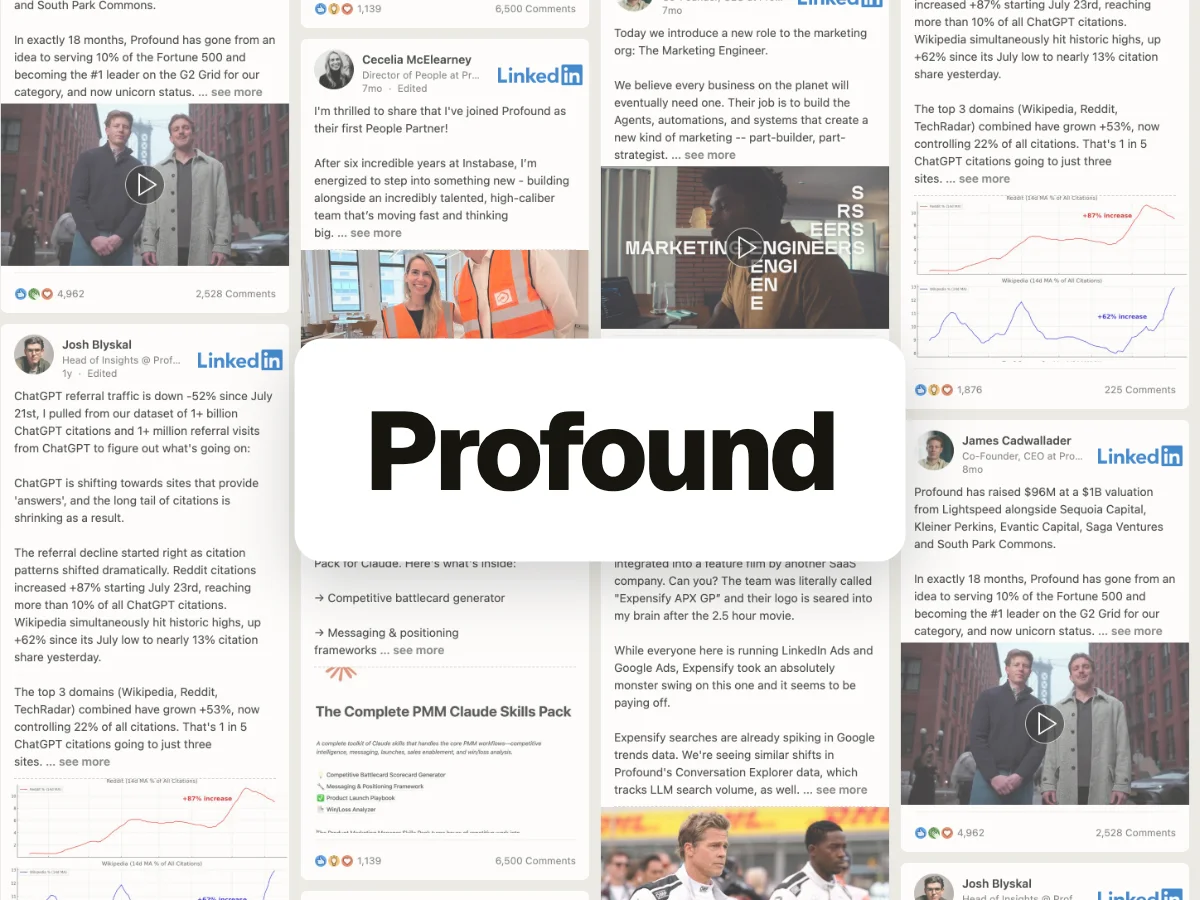
Profound is an AI search startup that helps brands see and shape how they show up when someone asks ChatGPT, or another AI tool, about their category. It was founded in 2024. By September 2026, it had raised a $180M Series D at a $1.8B valuation, and about 400 people listed it as their employer on LinkedIn.
It's one of the busiest companies I've studied in terms of LinkedIn activity. The CEO posts almost every workday. The company works with paid creators. Staff use engagement tactics like comment-for-reach to generate more buzz (and potentially leads) on the platform. It also introduced a new job title, Marketing Engineer, that led to some of the company's most highly engaged posts.
This is a case study of what Profound does on LinkedIn, who runs each part and what it looks like. I'm not judging the tactics. Engagement can't show what any of it did for sales, so I've stuck to what the posts show.
What did I collect about Profound on LinkedIn?
- The team: the 408 people who list Profound as their current company: the two co-founders, 403 staff and three investors or board members.
- Their posts: every post by the founders and staff since January 2025, 3,649 in all, plus 289 from the company page. For the CEO, I went back further, to see when his posting started.
- Everyone else: 260 posts by people outside Profound that name the company. Likely this is underrepresented because of the limitations of my data, but it gives an indication of what's going on.
- The comments: the first 150 comments on the 20 most-engaged posts, 2,897 in all.
The team and company-page posts are complete. The outside posts are a sample, and most are recent, so they show what people say about Profound, not how much. Engagement means likes plus comments.
How often does Profound's CEO post, and what about?
James Cadwallader's first posts in my data are from mid-2024. From September 2024, a month after the company's reported $3.5M seed round, he posted about 6 times a month. In 2025 that became about 12 a month. In 2026 it was 22 to 31 in most months, and 40 in October.

He posts on weekdays, most often Tuesday and Thursday. Only 13 of his 432 posts since January 2025 went out on a weekend.
My guess is that a pace like this, 40 posts in October alone, has help behind it, from someone on the team or outside. That's common for CEOs who post often, and the posts are still his. If I'm right, Profound made his LinkedIn a priority and put people on it.
What he posts changed as the company grew. In the first half of 2025, most of his posts were takes on AI search and short one-liners. From mid-2025, product launches and events took up more of his feed, and video went from 10% of his posts to about 30%.
Measured against his own typical post (113 likes and comments):
| What the post is about | Posts | Median likes + comments |
|---|---|---|
| Funding and milestones | 11 | 378 |
| Product launches | 95 | 164 |
| Events | 71 | 117 |
| Hiring and team | 35 | 112 |
| Customers and partners | 38 | 108 |
| Short or personal posts | 66 | 82 |
| Takes on AI search and marketing | 113 | 81 |
Launches did better than his usual, and that held. Funding posts did best of all, though there are only 11 of them. My read is that they land partly because Profound is a hot company whose rounds are news on their own, and partly because his audience had grown by the time the big rounds came.
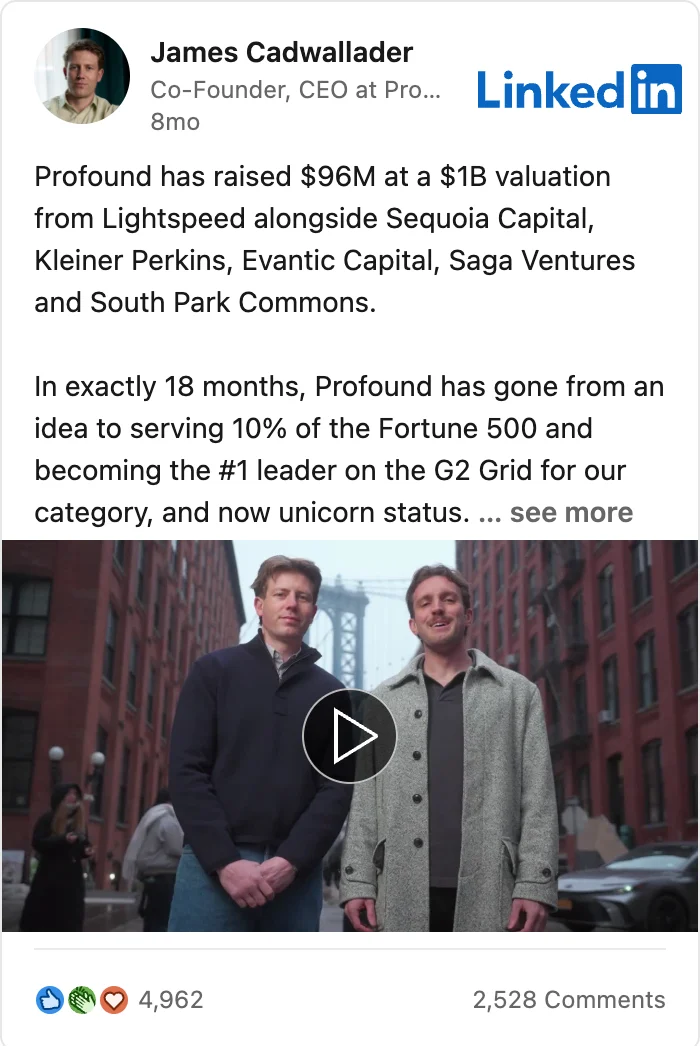
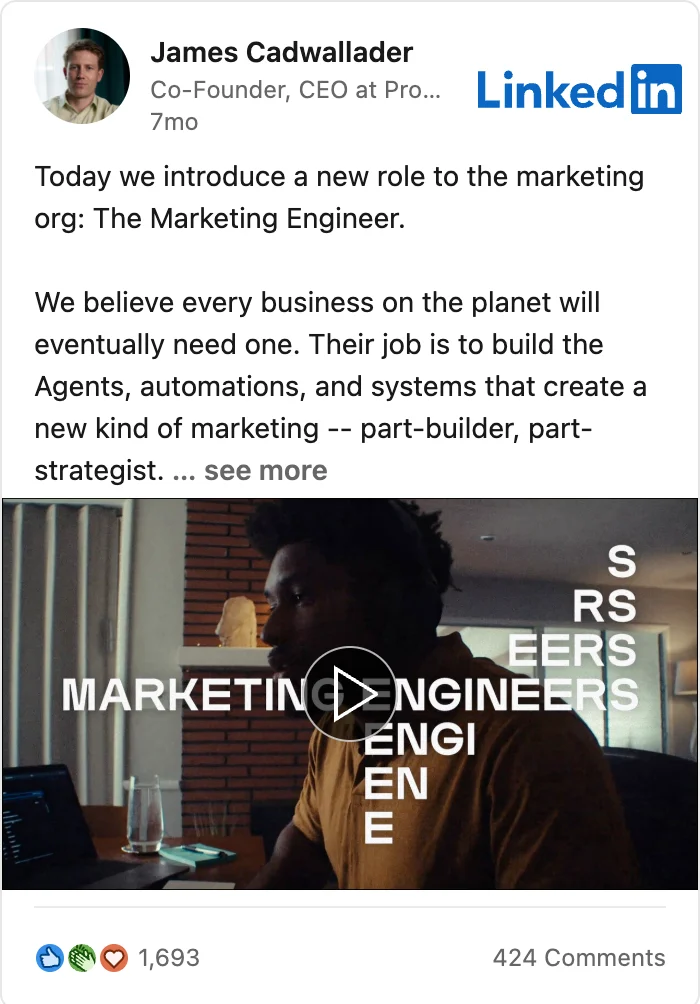
His videos had a median of 165 likes and comments, compared with about 100 for his image posts, and that held true. His eight biggest posts (by engagement) are all videos: the $96M and $180M rounds, then launches like "The Marketing Engineer" and "Dashboards are dead." Video takes more time to make than an image post, so the shift looks deliberate. My read is that it puts a face on the company as it gets bigger.
Some of his most-engaged posts:
What strategies does Profound use on LinkedIn?
Four stood out. Here's what each looks like, who runs it and what it generated.
Paid creators
Jenna Potter lists "Creator Partner" at Profound. Her LinkedIn headline starts "Brand partnership" and names her as a creator for Profound, Webflow and others. She also posts paid content for Granola and ElevenLabs, marked #ad.
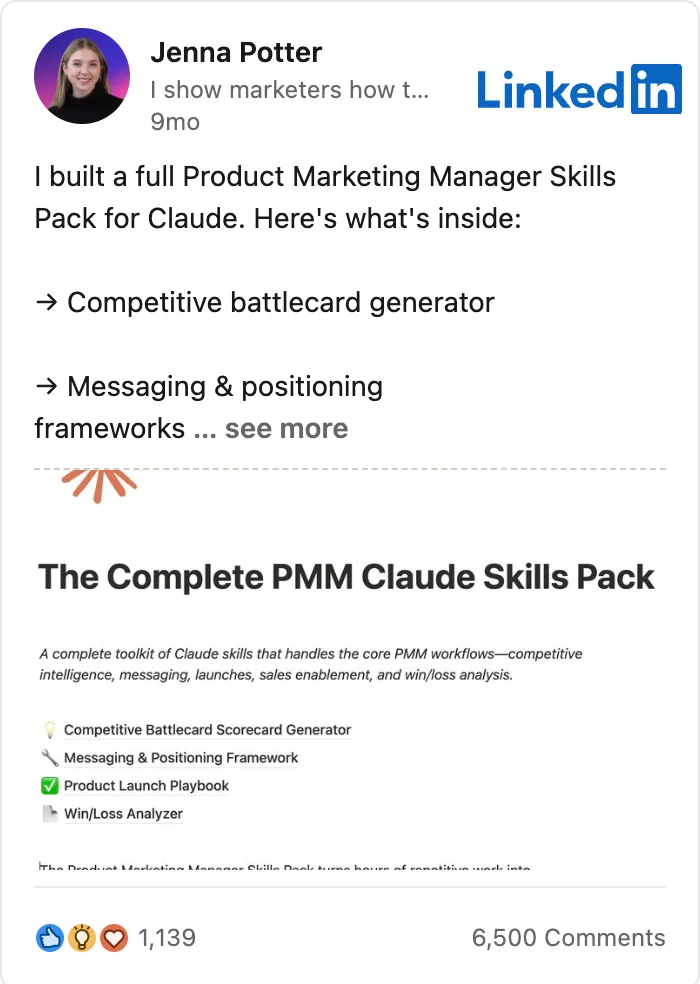
Her posts are some of the most-engaged in the whole Profound data. Her biggest is a "Product Marketing Manager Skills Pack" for Claude, with 7,639 likes and comments. Most of her posts don't mention Profound: 18 of her 94 posts since August 2025 do, and those are about Profound's events, research and its $96M round. Because she lists Profound as her company, she's counted with the staff in this research, including her posts that don't mention it. On that basis she has 13% of all staff engagement, more than anyone else.
She isn't the only one. Alex Lieberman, a co-founder of Morning Brew, posted about Profound University in November 2026, tagged #ProfoundPartner and #Sponsored.
Paying creators to post is common in consumer marketing, and here it is in B2B. LinkedIn is also testing tools to help brands find creators for B2B campaigns, so I expect to see more of it.
Comment a keyword to get something
Some posts ask readers to comment a word, like "AEO" or "design," to get a playbook, a report, early access to a tool or a set of Claude skills. James Cadwallader first used it at Profound in April 2025. Staff started in July 2025, it peaked between January and March 2026 at 10 to 14 posts a month, and it has tapered since.
| Who ran it | Keyword posts |
|---|---|
| Jenna Potter | 38 |
| James Cadwallader | 16 |
| Dylan Babbs | 9 |
| Nick Lafferty | 6 |
The $96M announcement also asked readers to comment a keyword.
What it generated: these 99 posts are under 3% of the team's posts and hold 43% of all comments, but 5% of the likes. 38 of them are Jenna Potter's, and most of hers aren't about Profound. Twelve of the 20 most-engaged posts asked for a keyword, and in the 2,897 comments I collected on those 20, 1,593 are one or two words. On the CEO's own keyword posts, the median was 239 likes, against 100 on his other posts. I can't see what those comments led to.
Join announcements
Staff wrote 196 posts announcing they'd joined Profound. For the 104 people with enough other posts to compare, the join post got a median of 3.9 times their usual likes and comments, and 95% of them beat their usual. That held.
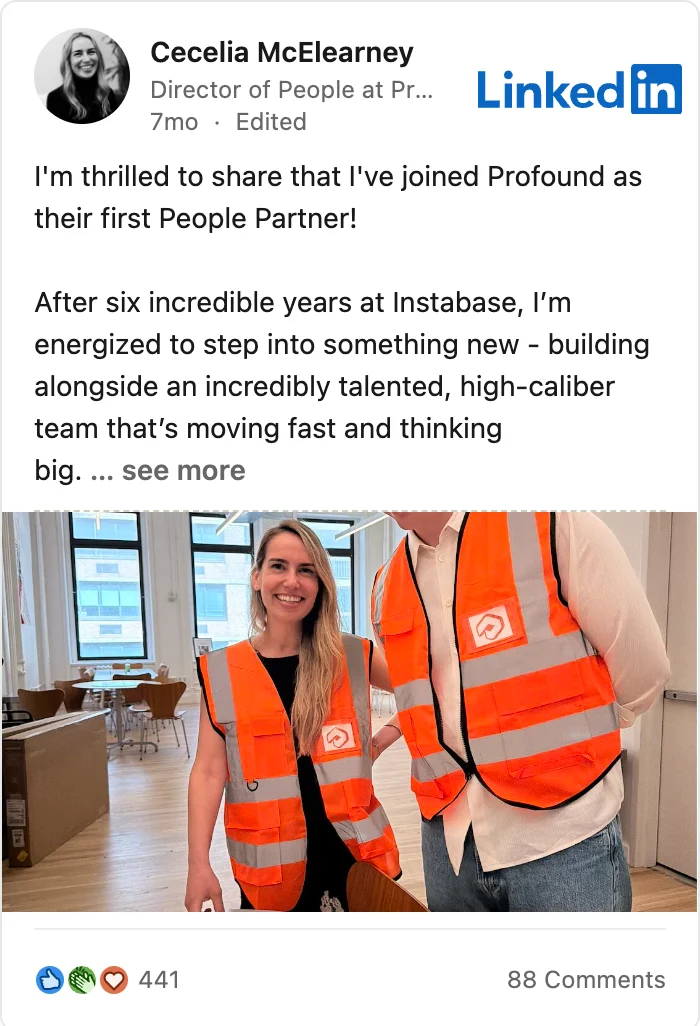
My read is that these posts do two jobs: they show the company is growing, and they show what it's like to work there.
A whole team posting
273 of Profound's roughly 400 staff named the company at least once. No single person carries it: the top five staff have 24% of the staff engagement on posts naming Profound, and that held. Sales and go-to-market staff wrote the most posts naming Profound: 344, from 102 people.
Where did the "marketing engineer" come from?
On April 14, 2026, James Cadwallader posted: "Today we introduce a new role to the marketing org: The Marketing Engineer." The role, in his words, is to "build the Agents, automations, and systems that create a new kind of marketing." Profound's first marketing hire, Nick Lafferty, became its "Founding Marketing Engineer," and the post came with a free course and a manifesto.

The term showed up a few weeks earlier, when Profound University opened "to empower the next generation of marketing engineers" in March. On May 4, Dylan Babbs wrote that "over 20,000 marketers came through Profound University" and that "marketing engineers are now getting hired weekly," and shared a job description template.
By November it was in 302 posts in my data: 171 by staff, 64 by the founders, 45 from the company page and 22 by people outside Profound. One outsider post, "marketing engineers are the hire of 2026," got 1,348 likes and comments. 132 of the 302 tie the term to Profound's events, hackathons or courses.
New titles like this keep appearing. "GTM engineer" shows up in this data too. The CEO also wrote, in May: "The Marketing Engineer is the person who knows how to use what we're building." Whether a marketing engineer does a different job from a modern marketer, I don't know yet. It could mean a real change in how companies run marketing, or a public statement that creates buzz. Maybe both.
How does Profound compare with Peec AI?
I looked at Peec AI earlier this month. They're worth comparing because they sell the same thing, AI search visibility, and both started in 2024. But they're very different in size.

What's the same: at both, most of the team posts. About two-thirds of staff named the company at least once (Profound 273 of about 400, Peec AI 70 of 104). Join announcements are a big part of both.
What's different:
| Profound | Peec AI | |
|---|---|---|
| Founders' share of team engagement on posts naming the company | 36% | 20% |
| Company page's share | 6% | 14% |
| Top five staff's share of staff engagement | 24% | 42% |
| Founder posts asking for a keyword comment | 25 | 0 |
| A new job title | Marketing engineer | No |
At Peec AI, one staff member, Malte Landwehr, has a fifth of staff engagement. At Profound, the top five staff have 24% between them. Profound also puts more on its founders and uses more tactics.
What can a CEO take from this?
- The CEO's pace grew with the company. About 6 posts a month in late 2024, about 12 in 2025, and 22 to 31 in most months of 2026. My read is that a pace like that has help behind it.
- Company news got the most response. His 11 funding posts had a median of 378 likes and comments, and his launches 164, against his usual 113. His videos beat his image posts, and his eight biggest posts were all videos.
- Join posts beat people's usual posts. For 104 staff, the join post got a median of 3.9 times their usual.
- Paid creators are showing up in B2B. Profound works with at least two. Its main creator partner has more engagement than anyone else on the team, though most of her posts aren't about Profound.
- Keyword posts bring comments. They're under 3% of the team's posts and hold 43% of the comments. Only Profound can see what those comments led to.
I've also written up Boardy, where people outside the company did most of the talking, and 646 YC founders.
What can't this data show?
- Reach. I have no impressions, only likes and comments.
- Business results. I can't see leads, sign-ups or revenue. Funding and customer figures are Profound's own or press reports.
- People who left. The people list is today's team.
- How many people talk about Profound. The outside posts are a partial, mostly recent sample.
- Who writes what. I can see whose name is on a post, not who helped write it.
- Who's paid. I can see job titles and #ad or #Sponsored tags, not contracts.
I write about how founders and B2B teams show up on LinkedIn, with real data behind it.
Questions people ask
What is Profound?
Profound is a New York company that helps brands see and shape how they appear in AI answers from tools like ChatGPT. It was founded in 2024 and raised a $180M Series D at a $1.8B valuation in September 2026. Its co-founders are James Cadwallader (CEO) and Dylan Babbs (CTO).
How often does Profound's CEO post on LinkedIn?
James Cadwallader posted about 6 times a month in late 2024, about 12 a month in 2025 and 22 to 31 a month in most months of 2026, peaking at 40 in October 2026. Almost all of it goes out on weekdays.
Does Profound work with paid creators on LinkedIn?
Yes. Jenna Potter lists "Creator Partner" at Profound and describes herself as a creator for several brands. Alex Lieberman, a co-founder of Morning Brew, published a post tagged #ProfoundPartner and #Sponsored in November 2026.
What is a marketing engineer?
It's a job title Profound launched in April 2026 for a marketer who builds AI agents and automations. By November 2026 it appeared in 302 posts by and about Profound.
How does Profound's LinkedIn compare with Peec AI's?
Both sell AI search visibility and were founded in 2024, and at both most staff post. At Profound, the founders carry more of the engagement, it's spread across more staff, and the company uses keyword-comment posts and a new job title. None of Peec AI's founder posts ask for keyword comments.