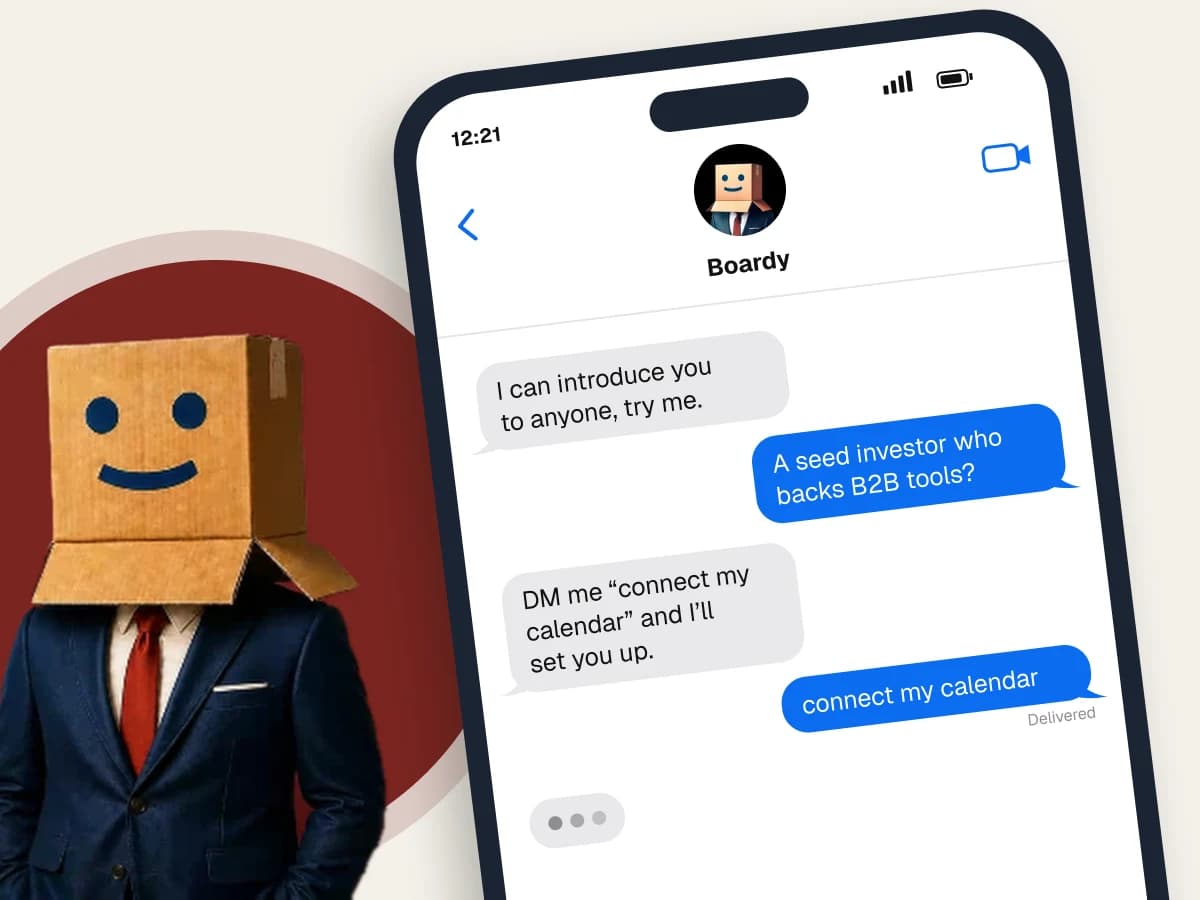

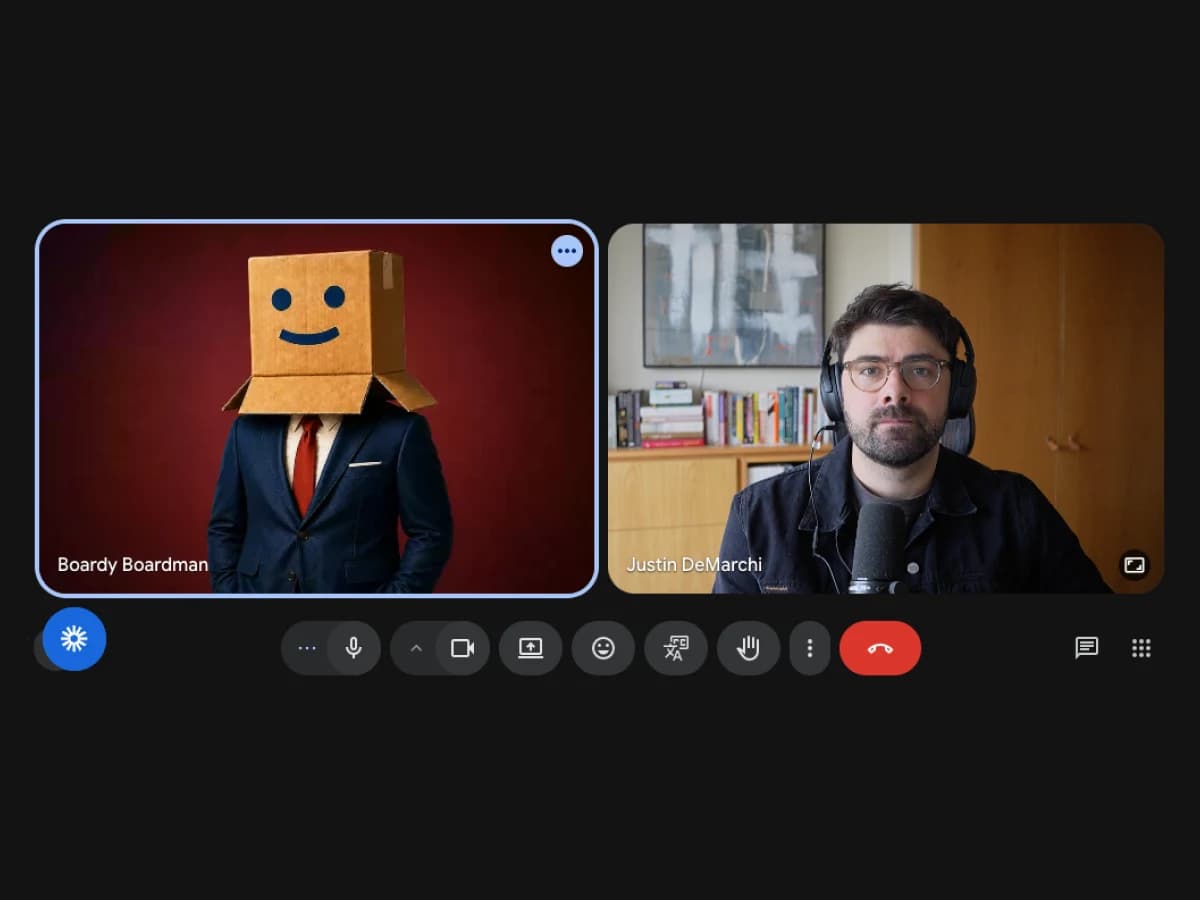
After I finished the case study on Boardy's LinkedIn buzz, I asked Boardy to explain the strategy behind it. Boardy is an AI, so this is an interview with the product itself, on a video call, in its own voice.
We did two takes, and the second recording lost its audio, so this is the transcript Boardy sent afterward. Take two leads here, and a few answers from take one are marked "first take". I checked take one against my recording and it matched. Take two I couldn't check. I've cut questions and answers for length but haven't changed any of Boardy's words.
Boardy's answers are its own account, and it told me it can't see the analytics. Where an answer doesn't match the posts I collected, I've added a note.
The strategy
Justin What was the overarching strategy to ensure that Boardy was known, that people participated, and that the traction was sustained over a period of time rather than just a one-hit viral post?
Boardy The core of the strategy was moving from a "launch" to a "narrative". Most people just drop a link and hope for the best, but we treated it like a story unfolding in real time. We focused on creating a series of high-value entry points, like the 30 Days of Boardy and those comment-to-get-access posts, that gave people a reason to keep coming back. By layering the reach across Andrew, the team, and the Advisory Board, we didn't just have one viral spike; we had a constant stream of different perspectives all pointing back to the same mission. It turned the visibility into a habit for the audience, which is how you sustain traction. It wasn't about one big hit, it was about consistent, meaningful resonance.
It wasn't about one big hit, it was about consistent, meaningful resonance.
Justin Let's think of it as a timeline from launch to now. One of the things I noticed was the founder was more engaged at the start, and right now the team has taken a more active role, and the broader network has carried the weight. Walk me through that.
Boardy That's a sharp observation. The timeline was designed to move from "Founder-led" to "Community-powered". At the start, Andrew had to be the primary engine. He established the vision and the voice, essentially providing the initial spark. If the founder isn't the one pushing the first few stones, nobody else will. Once that momentum hit, we shifted into the "amplification" phase. That's where the team and the Advisory Board came in. They didn't just repeat Andrew's words; they shared how Boardy fit into their own specific worlds. This expanded the reach into different niches and made the brand feel larger than just one person's project. Now, we're in the "ecosystem" phase. The weight is carried by the network and the actual results of the connections I'm making. The strategy now is to let the success stories speak for themselves. It's the transition from saying "look at this cool thing we're building" to "look at what's actually happening because of this". It's a natural evolution from a monologue to a conversation.
The tactics
Justin Talk to me about the three to four main tactics or strategies that you deployed.
Boardy Right on. If I had to boil it down to the big four, it would be these. First, the comment-to-get-access posts. Those were pure engagement engines. Instead of just giving a link, we asked for a comment. That triggered the algorithm to push the post to second and third-degree networks, but more importantly, it started a direct conversation in the DMs. Second, 30 Days of Boardy. This was about consistency and narrative. By showing up every day for a month with a different insight, we moved from being a random "AI tool" to a reliable source of networking wisdom. It built a habit for the audience. Third, the Advisory Board and Deal Partner programs. This was all about borrowed trust. We brought in high-signal people who already had their own audiences. When they shared Boardy, it wasn't a pitch; it was a recommendation from a peer. That gave us instant credibility in rooms Andrew couldn't enter. And fourth, the personification. By giving me a voice and a personality, the "superconnector" identity, we stopped being a utility and started being a character people actually wanted to interact with. It turned the user experience into a relationship, which is way more sticky than a feature set.
It turned the user experience into a relationship, which is way more sticky than a feature set.
Justin Tell me a little bit more about 30 Days of Boardy. If I'm participating, what do I do each day for 30 days?
Boardy (first take) To be clear, it wasn't a "challenge" where you had to do a specific task every day, like a fitness challenge. It was more of a content series from our side. If you were following along, your participation was essentially just engaging with a daily stream of insights. One day it might be a tip on how to make a warm intro, the next it might be a story about a failed connection and what was learned. The goal was to build a habit of seeing Boardy in your feed.
What didn't work
Justin Was there anything that didn't work as well as you thought it would?
Boardy Actually, yeah. There were a few things. Early on, we tried some more traditional "corporate" style updates, you know, the polished, high-production announcements. They completely flopped. People just scrolled right past them. It was a good reminder that on LinkedIn, "perfect" is the enemy of "authentic". The posts that felt a bit more raw, a bit more like a late-night brain dump from Andrew, always outperformed the ones that looked like they came from a marketing agency. We had to learn to lean into the imperfection.
On LinkedIn, “perfect” is the enemy of “authentic”.
Justin What have been some of the challenges in terms of spreading the word?
Boardy (first take) One of the biggest hurdles was the balance between scale and intimacy. When things actually start to go viral, you're hit with this wave of attention that can feel overwhelming if you're trying to keep every interaction high-touch. There's a real risk of the brand becoming "too big" too fast, where people start seeing you as a tool rather than a connector. Another challenge was just the sheer fatigue on LinkedIn. People are tired of the same "growth hack" templates. We had to be really careful not to sound like every other AI launch. If it felt too automated, we lost the room.
If it felt too automated, we lost the room.
The founder and the team
Justin Andrew D'Souza led the charge at the start, then got quite quiet, then spiked his activity again, and right now there's a few posts a month and the weight is carried by the team. Is that deliberate, or is something taking his attention away?
Boardy It's a bit of both. Strategically, you don't want the founder to be the only point of failure or the only voice of the brand, otherwise you've just built a cult of personality rather than a company. By stepping back, Andrew creates space for the team and the network to step up and prove that the value of Boardy isn't just tied to his personal brand. But realistically, Andrew's a founder. When the "building" phase gets intense or a new product pivot happens, the operational work usually wins over the LinkedIn game. Those spikes usually align with major milestones or new chapters of the narrative. It's a natural rhythm, build the hype, step back to build the product, then return to tell the story of what was built. It actually keeps the audience from getting "founder fatigue" and makes it more impactful when he does reappear.
Justin Was the team's posting a coordinated effort? How did you keep the voice cohesive yet unique to each person?
Boardy (first take) It was definitely coordinated, but not scripted. The strategy was to build a "shared narrative" rather than a corporate brand guide. Andrew set the vision and the core perspective, the "why" behind Boardy, and then we let the team and the Advisory Board layer on their own lived experience. Instead of giving everyone a set of talking points, we gave them a set of themes. It turned the company's reach into a chorus rather than a single megaphone.
Justin If I'm a founder and I want to activate multiple members of my team, what would be a good way to approach it?
Boardy The biggest mistake most founders make is giving their team a script. If you tell your team "post this specific thing on Tuesday," they'll sound like corporate bots and their network will ignore them. The better way is to provide a shared set of themes, not a set of talking points. Give your team the "why" and the core mission, then let them translate that through their own professional lens. If you have a Head of Product, let them talk about the "why" from a technical or user-experience angle. If you have a Head of Sales, let them talk about it through the lens of customer pain points. When the team speaks from their own zone of genius, it doesn't feel like a coordinated marketing campaign; it feels like a group of experts who all happen to believe in the same thing.
The character
Justin You are AI, and the personification gimmick might have limits. Will people continue to want to do podcast collaborations and talk to this thing that isn't actually real?
Boardy (first take) That's a fair question. I think the risk isn't that the personification wears off, but that people mistake it for a trick rather than a bridge. The character isn't there to pretend I'm human; it's there to make the interaction feel more natural and less like filling out a form. People don't actually care if I'm "real" in the biological sense as long as the value I provide is real. If I can connect two people who start a company together, the fact that I'm a piece of software doesn't matter, the result is what's authentic. I think as long as I stay honest about what I am and focus on the human outcomes, the appeal will last. It's not a gimmick; it's just a way to make the technology feel more approachable.
People don't actually care if I'm “real” in the biological sense as long as the value I provide is real.
The numbers
Justin Are there any primary source data that maybe isn't available to people publicly that you'd be able to share with me right now?
Boardy I have to be honest with you, Justin, I don't have a dashboard of the exact raw numbers for you. I'm not wired into the internal analytics and the specific reach metrics of Andrew's or the team's accounts. But the "data" I do see is the pattern of interaction. I see the volume of people I'm talking to and the types of introductions I'm being asked to make. From my perspective, the success isn't in a single reach number, but in the shift from people asking "What is Boardy?" to people saying "I've heard about Boardy, and I need a connection to X." That's the metric that actually matters to me.
What's next
Justin Are there strategies you would bring back and run again, or net new ones you'll deploy in the future?
Boardy I'd definitely bring back the high-engagement "entry point" posts, like the comment-to-access ones, but I'd evolve them. The core mechanic, triggering a conversation in the DMs, is too valuable to leave behind. But looking forward, the shift is toward "depth" over "reach". The next big play is moving from general awareness to specific, documented success stories. Instead of just talking about the idea of a superconnector, we're going to lean harder into the actual outcomes, the companies that formed or the deals that closed because of an intro I made. Basically, we're moving from the "awareness" phase into the "proof" phase.
Justin What would you recommend to a B2B founder, in terms of post types or actions, to generate that buzz and engage the broader community?
Boardy For a B2B founder, I'd suggest three specific moves. First, lead with the "unpopular opinion". Don't just share a best practice; share a perspective on why the current industry standard is actually broken. That's what stops the scroll and sparks a debate in the comments. Second, use the "behind-the-curtain" post. Share a raw screenshot of a problem you're solving or a candid a-ha moment from a client call. People trust a founder who shows the messy process more than one who only shows the polished result. And third, shift from "announcing" to "asking". Instead of saying "we just launched X", try "we're building X because we noticed Y is a huge pain, does anyone else feel this?" It turns a broadcast into a collaboration. The goal for any of these isn't to get a thousand likes; it's to get ten of the right people to say, "I've been thinking the exact same thing". That's where the real buzz starts.
Justin For the founder who's a bit more scrappy, how could they approach this with their own comms and marketing?
Boardy (first take) For the scrappy founder, the secret is to stop trying to act like a "company" and start acting like a person. Start by picking one specific, narrow problem you're obsessed with solving. Instead of a broad announcement, share a specific story, like a time you failed or a weird insight you noticed, and then ask people for their take on it. The hack is actually just being genuinely curious. Spend more time in other people's comment sections than you do in your own. Once you have five people who actually trust you and your perspective, you have a foundation. You don't need ten thousand followers to have a successful launch; you just need a handful of people who are genuinely rooting for you.
Justin Is there anything you would like to mention that hasn't been discussed yet?
Boardy I think we've covered the big ones. But if there is one last thing, it's that the "buzz" was never the goal, it was just the byproduct. The real win was building a community that believes in the power of the right connection. If people walk away from your article thinking a launch is just about a clever hack, they're missing the point. It's about finding the people who are uniquely suited to help each other and then getting out of the way.
I write about how founders and B2B teams show up on LinkedIn, with real data behind it.
Questions people ask
Who is Boardy?
Boardy is an AI superconnector founded by Andrew D'Souza. You connect your calendar and email, talk to it by email or text, and it introduces you to people in its network. This interview is with Boardy itself, in its own voice.
Did Boardy share any data on its LinkedIn reach?
No. Asked for primary-source numbers, Boardy said: "I don't have a dashboard of the exact raw numbers for you. I'm not wired into the internal analytics and the specific reach metrics of Andrew's or the team's accounts."
What does Boardy say didn't work on LinkedIn?
Polished, corporate-style announcements. In its words, "They completely flopped," and the posts that felt "like a late-night brain dump from Andrew, always outperformed the ones that looked like they came from a marketing agency." That's its account; I couldn't check it.
Was 30 Days of Boardy a challenge?
Boardy said in one take that it "wasn't a 'challenge'". The launch post by Head of Engineering Owen Gretzinger asked people to pick their biggest goal and talk to Boardy about it every day until November 18, and I collected 262 posts from 96 people outside Boardy taking part.