The interview
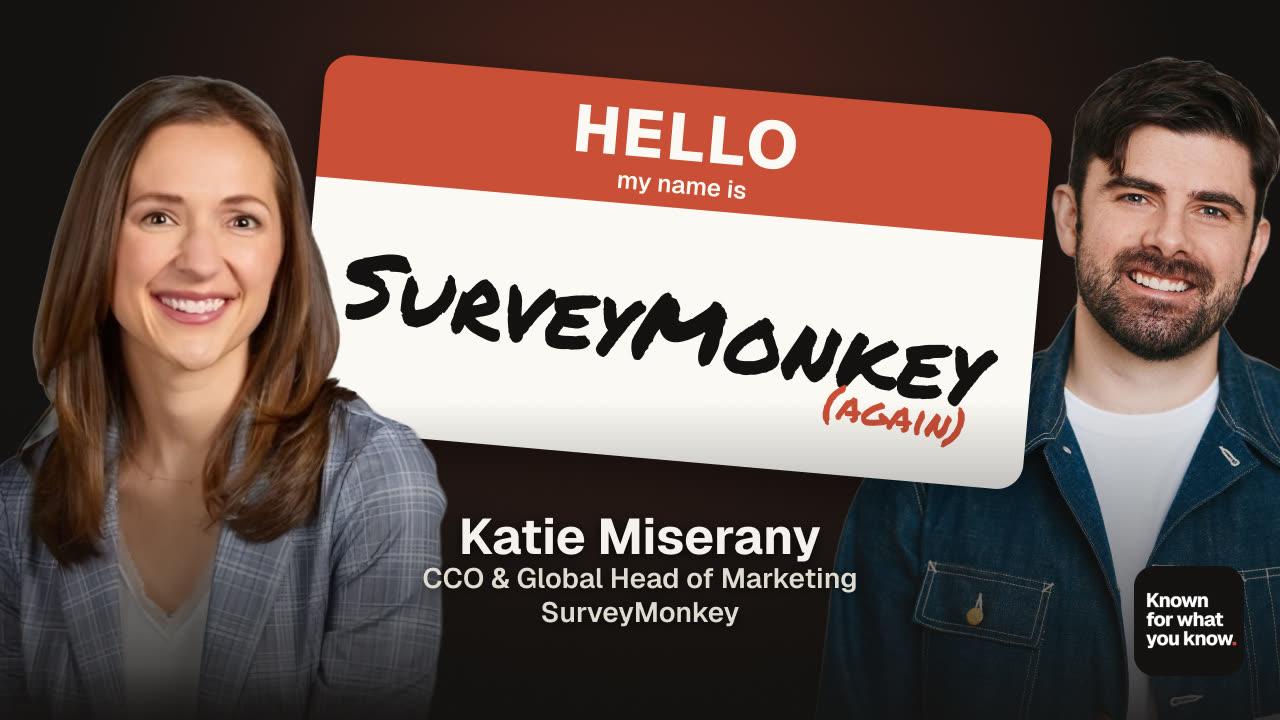
We talk about why the quirky name became an advantage with a new generation of B2B buyers, why her own copy was too perfect, finding a brand's personality, what to do when everyone knows your brand but doesn't consider it, why she stopped looking at what other companies are doing, telling a new CEO what they need to hear, and how she uses AI for chores, not craft.
Edited for length and clarity. Times play the video from that point.
Copy that's too perfect
Justin What's kind of exciting you these days?
Katie I have been here for seven years going on eight years, and what a different time we're in than seven or eight years ago when I first joined the organization. Because marketers are one of our biggest buyers, I was kind of like the ICP and needed to be out there using my voice on LinkedIn, creating my own content.
One of the things I told her back when we first started working together was like, the copy you're writing for me is too perfect. I need it to have messy hair like I do. I needed it to have more personality and more authenticity. And I'm really excited to see how many people and brands are latching onto that now, where it seems like with AI that sheen of perfection is just way too easy to manufacture now.
The copy you're writing for me is too perfect. I need it to have messy hair like I do.
People aren't fixing punctuation mistakes in their LinkedIn posts, or they're using run on sentences and comma splices and driving my English teacher mother crazy. But it shows that you wrote it, that that person did that, that was not ChatGPT. And I think there's a lot more value in that than there used to be.
SurveyMonkey to Momentive, and back
Justin I have to touch on this because it's such an interesting scenario of a pivot and coming back. SurveyMonkey rebranded itself to Momentive. I think from what I understand, a large part was to make it feel more serious, to appeal to a different demographic. And then I think it was two to three years after that, came back to SurveyMonkey, brought the monkey back, if you will. Can you tell me just broadly about that scenario?
Katie You have to think back to 2021, and we've just gotten through the pandemic. Our sales team was signing bigger and bigger deals. And we had all these ambitions and aspirations to be more of this enterprise company. And people kept saying internally, nobody wants to spend six figures with a company called SurveyMonkey. It just sounds too silly. And our upmarket competitors just had this sheen on them.
So the decision was made to rebrand to Momentive. And when we went private through a private equity acquisition, it was the very first thing that the incoming CEO did, was return to that SurveyMonkey name, and that was in 2023. What had changed in that time was you start to see the emergence of AI, you start to see this great flattening of affect across the market. You also start to see that these bigger, more heavyweight enterprise brands are struggling.
And I think it created this real opportunity for us to embrace who we've always been and to get some differentiation out of that. SurveyMonkey came about in 1999 when people were naming companies all kinds of silly things. But I think that longevity, the beloved nature of the brand, and the fact that there's Monkey in the name and that's quirky and strange for a whole new generation of B2B buyers was a value add. We're different than these other competitors that you could potentially choose. And I think it really creates a lot of heart and soul to the brand that you don't get with something shiny and new.
Knowing who your brand is
Justin How do you walk that line where you keep the standard, you still appeal to the companies that have the security reviews and the big requirements, but also want to feel connected to who they're working with?
Katie I think you really have to understand what it means to be you really well. I think one of the ways that we lost our way with Momentive is we were looking around at the companies around us and saying we want to be more like them. And when you do that, you're basically throwing away what makes you you and is distinct about you.
It's true with personal style, too. I might wish I was 5'11 and blonde, but I have to embrace that I'm 5'4 and brunette and curvy. You cannot try to be someone else and get that polish or really well done vibe that you're going for if you don't understand who you are at its core.
You cannot try to be someone else.
He and I would just go back and forth over specific words, like, is the brand spicy? No, that's not quite right. We landed on cheeky, which I think has a lot of monkey. It's playful, and it is the thing that our name enables us to be that our competitors cannot be.
Then we balanced that with, we needed to be research-backed and to have this real nerdy bent, because we enable people to do really high quality research. Those two ingredients, other companies might have one of them, we're the only ones who can claim both.
Where the ideas come from
Justin When you're in it, where do you get your ideas from? Are you just following the data or looking internally, or are there resources?
Katie We do market research as one of the pillars of our brand. We have a brand health tracker that's in the field every six months, and so many ideas just come from getting your brand mirrored back to you. A great example was when through the research we discovered there was such little awareness of a specific product offering. That became this huge opportunity. Everybody knows SurveyMonkey, but they don't consider us in that set. So then we're thinking about, okay, well, what kind of storytelling should we be doing around this? We think we're well known, but in this one vector, when you look at the data, that's not the case. So how do we take the strength of the brand and our vast awareness and get some more product awareness for this specific offering?
Because we have kind of a pro-sumer buyer, we can get inspiration from all over the place. We had this crazy idea over the course of the summer where we wanted to have the world's most uncurious meeting, because curiosity is core to our brand. We hired this troupe of improv actors and they were amazing. It was hilarious. And we live streamed it on LinkedIn. Our competitors could never, it would be so off-brand for them, but for us, it was this really fun thing.
Justin I got stuck when you said curiosity is core. I love the monkey now more than ever.
Katie We're not saddled with it. You have to make it special. Instead of that feeling like, we got to get rid of this name because it's holding us back, we just really had to embrace it and say, what about this enables us to be special and different?
Starting somewhere new
Justin Let's say you went into a new environment tomorrow and you had the similar title. If I'm gonna carry over what I've learned, these are the aspects that should be the guiding force in this new environment.
Katie What's funny about this is it's like old-time advice. You have to talk to customers and understand the role that this company plays in their life, how they feel about it, how they would characterize it to you. I think that is the most important part for starting to understand the personality that already exists.
I would just look for differentiation wherever it comes from. You could use a Google Form for a lot of things you could use SurveyMonkey for. So in our case, it has to be something else. The differentiation comes from the brand and what it means to people, as well as the higher end with the security and all the things that we do that a Google Form couldn't. Just understanding who you are and then what's different about you, and then pedal to the metal on that stuff, that is what you have to do. Stop looking at what other companies are doing. Don't compare yourself. Zero in on what makes you you to your customers and the people you're trying to serve.
Comms people are truth tellers
Justin What does it mean to activate the executive team or the leadership team in comms? That could be on LinkedIn, webinars, these episodes, on stage. What role have you played in that at SurveyMonkey?
Katie Most comms people are truth tellers, and that is our superpower. When I get a new CEO, we've had three CEOs in my time here, I always try in beginning stages to tell them something that they need to hear that they don't want to hear. Because they need to start to see you as someone who, when you say they did a good job on stage, they really did a good job on stage.
Once executives, the good ones at least, see you in that capacity of being someone who is going to tell them the truth, they start to lean on you more and more for strategic decision support. I was on the receiving end of this. All of a sudden, I was being asked to do a lot more on social media, way out of my comfort zone.
The higher up you get, all these CEOs, it's a lonely job, because people stop telling you the truth. Embrace the feedback that you get, whether it's in the comments or it's from other people inside your organization. Love your comms people, because they're going to help you deliver the message that you're trying to get out there.
Seven years of accelerated learning
Justin So seven years you've been there. Was there moments of accelerated learning on your part?
Katie Think about the last seven years. I started in 2019. COVID, crazy. Then we ride that wave of digital transformation, and then we get an activist on the board. And we announced an acquisition by Zendesk that Zendesk shareholders did not approve. We go private with private equity, we rebrand the company, I get expanded responsibilities. It feels like over the course of seven years, I've gotten a masterclass in every type of corporate communications crisis.
I feel so lucky to have done it at SurveyMonkey, which is this iconic brand with this incredible base of customers. The strength of SurveyMonkey meant that we could ride the waves. It became this incredible laboratory for learning while things have been so chaotic in the last seven years.
Justin As a comms person, you're absorbing this, but also needing to figure out how to communicate that.
Katie I have a favorite saying, and it's smooth seas never made a skilled sailor. We do not want blue skies and smooth seas every day. That does not build your skills.
Claude for chores, not craft
Justin What comes to mind in terms of excitement for you moving forward?
Katie I've committed to using Claude for chores, not craft. And that means that I'm getting more time back to do the things I really love, like writing and message development. I draw things by hand. I use my own handwriting as a font sometimes. And I'm loving the creative energy that's coming from creating those things using my brain and my hands, while Claude pulls my daughter's school menu and emails it to me every day.
Wrapping up
Justin So thank you so much, Katie, for joining. It's so great to have you. Really appreciate your insights and your time.
Katie Thank you for having me. It's been fun.
Katie Miserany is Chief Communications Officer and Global Head of Marketing at SurveyMonkey.
Full transcript
Katie People kept saying internally, nobody wants to spend six figures with a company called SurveyMonkey. It just sounds too silly. So the decision was made to rebrand to Momentive. When we went private through a private equity acquisition, it was the very first thing that the incoming CEO did was return to that SurveyMonkey name.
Justin If you've been around business for the last 27 years, you've likely heard of SurveyMonkey. It's often the first company that comes to mind when you think of digital surveys and forms. And as a brand, they're also one of the most interesting case studies out there, including the rebrand to Momentive and back to SurveyMonkey. So I'm really excited to have Katie Miserany on today's episode. Katie is the chief communications officer and global head of marketing at SurveyMonkey. She's been there since 2019 through three CEOs and helped navigate the rebrand. She's seen it all at SurveyMonkey and in the industry.
So let's get into it. So great to have you on this episode. And I guess I'll open it up with kind of a general look, a high level just to get things going, but what's kind of exciting you these days?
Katie Yeah, great question. I mean, thank you for having me. I'm excited to chat. I have been here for seven years going on eight years, and what a different time we're in than seven or eight years ago when I first joined the organization. I think one of the things I'm thinking about a lot, I've had some great comms people come through our doors and somebody I've worked with for many, many years who is running exec comms for me. And because marketers are one of our biggest buyers, I was kind of like the ICP and needed to be out there using my voice on LinkedIn, creating my own content and everything.
And one of the things I told her back when we first started working together was like, the copy you're writing for me is too perfect. I need it to have messy hair like I do. I'm not like that perfectly coiffed, you know, out there like shiny example of an executive. I needed it to have more personality and more authenticity and like messy hair, for lack of a better metaphor. And I'm really excited to see how many people and brands are latching onto that now, where it seems like with AI that sheen of perfection is just way too easy to manufacture now.
And you're seeing people go back to, or maybe for the first time ever really embrace what's messy or different about them. Like people aren't fixing like, you know, punctuation mistakes in their LinkedIn posts or they're using run on sentences and comma splices and driving my English teacher mother crazy. But it shows that you wrote it, that that person did that, that was not ChatGPT. And I think there's a lot more value in that than there used to be, which is something that gets me excited.
Justin I completely agree. People are even, I feel like adding in roughness to their material, if that makes sense. go back and they'll see the mistake in their social post and say, I'm going to leave that just to prove. It's interesting how it's changed behavior, but I have to touch on this because it's such an interesting scenario of a pivot and coming back. SurveyMonkey pivoted or transitioned, rebranded itself to Momentive. I think from what I understand, a large part was to make it feel more serious, to appeal to a different demographic and sort of say we need to shift moving into the future.
And then I think it was two to three years after that, came back to SurveyMonkey, brought the monkey back, if you will. Can you tell me just broadly about that scenario? The journey. Yeah, there's a lot that, but I just kind of what comes to mind first when you think about that?
Katie Yeah. I mean, you have to think back to like 2021. and we've just gotten through the pandemic. And we were really leaning heavily on the sales side of our business. So most people know us as like that PLG model where like you see a survey, now when you need to send a survey, you're gonna think of SurveyMonkey. But our sales team was signing bigger and bigger deals. And we had all these ambitions and aspirations to be more of this enterprise company. And people kept saying internally, nobody wants to spend six figures with a company called SurveyMonkey. It just sounds too silly. and our upmarket competitors just had this sheen on them and it was just a completely different competitive set that we were going against.
So the decision was made to rebrand to Momentive and when we went private, so we were publicly traded at the time, when we went private through a private equity acquisition, it was the very first thing that the incoming CEO did was return to that SurveyMonkey name and that was in 2023. So I think what had changed in that time was you start to see the emergence of AI, you start to see this great flattening of affect across the market. You also start to see that these bigger, more heavyweight enterprise brands are struggling.
There's a shift in just where the market was going. And I think it created this real opportunity for us to embrace who we've always been and to get some differentiation out of that. So SurveyMonkey came about in 1999 when people were naming companies all kinds of silly things. You wouldn't do that necessarily today, but I think that longevity, the kind of like beloved nature of the brand, and the fact that there's Monkey in the name and that's quirky and strange for a whole new generation of B2B buyers was a value add where I like, we're different than these other competitors that you could potentially choose.
And I think it really creates a lot of heart and soul to the brand that you don't get with something shiny and new.
Justin Yeah, I completely can see that. The quirkiness creates personality. Yes. There's something there. And I mean, if you think about words, the word Google is kind of a strange word too. Apple. Yeah, it makes you think of kind of the point you were saying before, this idea of perfection. And sometimes I think, I mean, this comes over me too. I feel like marketers, this is just a reality of our life where we want things to be polished, not necessarily, but we want things to be done well. And often well, how that's defined can be tricky because it could be rough, but maybe that's the best thing to connect with your audience.
So it's really difficult to know how much to roughen things up or how much authenticity to put while keeping a high brand standard, how do you walk that line where you keep the standard, you keep that narrative going, you still appeal to the companies that have the security reviews and the big requirements, but also want to feel connected to who they're working with. How do you navigate that?
Katie I think you really have to understand what it means to be you really well. So instead of just this polish or a really well-done standard that could apply to anybody. I think one of the ways that we lost our way with Momentive is we were looking around at the people around us, the companies around us, and saying we want to be more like them. And when you do that, you're basically throwing away what makes you you and is distinct about you and your differentiation and the way that your customers feel about you and how they contextualize your place in their lives.
It's true with personal style, too. I might wish I was 5'11 and blonde and could pull off something that someone who looks like that does, but I have to embrace that I'm 5'4 and brunette and curvy, you cannot. try to be someone else and get that like polish or really well done vibe that you're going for if you don't understand who you are at its core. So that's what I worked a lot with our, we have a senior director of brand creative and he and I would just like go back and forth over specific words like, is the brand spicy?
No, that's not quite right. I remember we had a long conversation about piquant. We were like, is that the word that we're looking for? Is that the right thing we landed on Cheeky which I think has like a lot of monkey yeah yeah that's so true actually yeah but it's playful and it was like it is the thing that our name enables us to be that our competitors cannot be and then we balanced that of course with like you know we needed to be research-backed and to have like this like real nerdy bent because of what we do we enable people to do really high quality research so it's like then you can your whole brand becomes about balancing the cheekiness with that cerebral research intelligence thing, now you're talking about something really interesting because those two ingredients, other companies might have one of them, we're the only ones who can claim both. And then to do that really, really well was the mission from there. But it took so many conversations and really like, why doesn't that sit quite right?
Like we had to nail down the personality before we could get to a place where we were expressing it in a way that we felt like was a full expression of who we are and why we're different.
Justin I can see myself, I was working for a company, and we were doing a similar kind of rebranding. I think for everyone else, it seemed like we were in this glass office room. On the glass walls, we were writing words, we were scratching them out, and they're like, Come on, what is this? You're deciding. But, I mean, so what you're saying, I can really relate to because it's more than just the words, but it's, it's the, it sets the tone for everything that you're doing. It can end ultimately can drive decisions like the renaming or the renaming back based on these sort of feelings that you want to evoke.
Here's a question, cause I don't always speak to someone who has seven years and has worked for a brand that basically is like a household name that we all know. When you're in it, where do you get your ideas from and you're learning from? right? Because there's so much out there. Are you just following the data or looking internally or are there resources? What's the guiding force here with your work?
Katie We're really lucky because we do market research as one of the pillars of our brand. We have a brand health tracker that's in the field every six months and so many ideas just come from getting your brand mirrored back to you. A great example is what I just said. We do market research. We've We've done it for a long time. You could do it yourself, or you could do it through a professional services. But just, there was such little awareness of that product offering, that that became this huge opportunity. Everybody knows SurveyMonkey, but they don't consider us in that set. So then we're like thinking about like, okay, well, what kind of storytelling, what should we be doing around this?
And like so many ideas can come from, oh, like we think we're well known, but in this one vector, when you look at the data, you're like, we are not well known for that thing. So how do we take the strength of the brand and our vast awareness and get some more product awareness for this specific offering. I also, we're in a lucky position where because we have kind of a pro-sumer buyer, so they're like a professional who behaves like a consumer in a lot of ways, we can get inspiration from all over the place. So, you know, you like see an interesting ad on Instagram.
for like, you know, I don't know, a toothbrush or something. You're just like, I like how they did this specific thing. Can we borrow something from that? We had this crazy idea over the course of the summer where we wanted to have the world's most uncurious meeting because curiosity is core to our brand. That's one of our brand words. And we're like, What does it look like when people's curiosity is stifled in a meeting? We hired this troupe of improv actors and they were amazing. It was hilarious. It was 90 minutes because like, that's gross, nobody wants to be in an eight-minute meeting. And we live streamed it on LinkedIn and it was insane.
It was just like crazy, like cheeky, you know, our competitors could never, it would be so off-brand for them, but for us, it was this really fun thing. Like something that is like out of the more like stunty PR, like consumer marketing playbook. But we get to borrow from that and what the B2B SaaS folks are doing just because of like the type of product that we have and really leaning into what makes us different, I think enables us to do that.
Justin I got stuck when you said curiosity is core. I'm like monkey in curiosity, I feel like I want to say, I'm sure that's not a coincidence, but it's like endless, I'm like that's, I love the monkey now more than ever. The more I think about how it relates and the positive qualities, it's great. Yeah.
Katie We're not saddled with it, we're like, you have to make it special. You have to. Instead of that feeling like, we got to get rid of this name because it's holding us back. We just really had to embrace it and say, What about this enables us to be special and different?
Justin I love that. It's meaning that you put into it. It can be anything. The logo and design and website are great, but I feel like it's the meaning that you attach to it that you make someone feel, and there's a lot that you can do to do that. That's not just the name of the company, but it's everything else surrounding it. So I love that as an idea. Thinking beyond SurveyMonkey, but what you've learned.
Let's say you went into a new environment tomorrow and you had the similar title, but it was new and you came in and you were thinking, okay, if I'm gonna carry over what I've learned, these are the aspects that I'm confident that should be the guiding force in this new environment.
Katie Back to what we were saying about embracing the SurveyMonkey name, I think it's the most important thing that any marketer could do. What's funny about this is it's like old-time advice. You have to talk to customers. You have to talk to customers and understand the role that this company plays in their life, how they feel about it, how they would characterize it to you. I think that is the most important part for starting to understand the personality that already exists, you know, and then and then you can work on are there parts of it that we're not fully embracing?
Are there elements to it that we could like amp up for more differentiation? So whether you're listening to your customers like in one on one interviews or you're doing more like brand health tracker type broader market research, I think it's still the number one thing that any marketing leader or communications person could come in and do to really understand that customer point of view. And then I would just look for differentiation wherever it comes from. So a lot of times, it's from the product itself.
You could use a Google Form for a lot of things you could use SurveyMonkey for. So in our case, it has to be something else. It's like the differentiation comes from the brand and what it means to people, as well as the higher end with the security and all the things that we do that a Google Form couldn't. But I think all of that, just understanding who you are and then what's different about you, and then like pedal to the metal on that stuff, that that is what you have to do. Stop looking at what other companies are doing. Don't compare yourself zero in on what makes you you to your customers and the people you're trying to serve.
Justin That's a theme that keeps coming up, this understanding your customers, especially with AI, especially with so much noise, like nothing replaces just going and having these conversations with these people who are there in terms of... personal branding, like you are in this leadership position, you're at the table. What does it mean to kind of activate the executive team or the leadership team in comms? That could be on LinkedIn, that could be doing webinars or doing these episodes, content series on stage. I feel like that is one of the things in the last, I don't know, four or five years has become so important where every company is really trying to activate their team, not just C-suite, but what does that mean for you?
What role have you played in that at SurveyMonkey, being at the table with you as a leader, but other figures as well? Yeah.
Katie Well, I have a point of most comms people are truth tellers, and that is our superpower. When I get a new executive CEO, we've had three CEOs in my time here, I always try in beginning stages to tell them something that they need to hear that they don't want to hear. Because they need to start to see you as someone who when you say they did a good job on stage, they really did a good job on stage. And when you say like, you never should say that again, that they believe you and they trust you and you have to like have that credibility.
And I think once executives, the good ones at least like see you in that capacity of being someone who is going to tell them the truth, who's there to support them and getting the the message out and getting it right, closing that gap between what you say and what people end up hearing, they start to lean on you more and more for like strategic decision support and all of the great parts of being in communications where you can really shape a company's strategy and how it rolls out and how it plays out. And it's, everyone has a platform now. So I was on the receiving end of this, like I said, as an ICP buyer for SurveyMonkey, All of a sudden, I was being asked to do a lot more on social media and way out of my comfort zone was not interested in doing that before.
I'm a behind the scenes person. But you need those people to bounce that stuff off. Even me as a comms person, I would have to ask the exec comms person, I'm thinking about doing this. Is this how you would ... Tell me if this is wrong, and you need somebody that you know is going to tell you when you have stupid ideas. It's so valuable, and the higher up you get, all these CEOs, it's a lonely job. because people stop telling you the truth or giving you this true honest reflection or feedback or advice going into these high-profile moments. So I feel like that's a thing that people need to embrace as they're going out and doing their own content creation or being an influencer for their company, forced or otherwise.
Embrace the feedback that you get, whether it's in the comments or it's from other people inside your organization. love your comms people because they're going to help you and really get you to deliver the message that you're trying to get out there.
Justin Yeah. That's such a good point. I view it as a journey. Maybe this is too airy-fairy language, but it's really that. The only way to understand is by putting yourself out there, the same as the only way to really understand how your business is doing and being received is to ask your customers. You need to engage people. And now with social and different forms, like the way to engage the public digitally is to do that and to hear what they're saying. Pivoting here, so seven years you've been there.
Was there moments of accelerated learning on your part, or did you feel like it was pretty steady? And if so, what were some of those moments? I'm curious.
Katie Yeah. Well, I mean, think about the last seven years. So like, I started in 2019. COVID, crazy. Then we ride that wave of digital transformation, and then we get like an activist on the board. And we announced an acquisition by Zendesk that Zendesk shareholders did not approve. So then we were in this beleaguered state, we go private with private equity, we rebrand the company, I get expanded responsibilities. It feels like over the course of seven years, I've gotten a masterclass in every type of corporate communications crisis you could possibly had I mean there was a time where we were planning for at least three different potential scenarios depending on how like the M&A talks went.
where I was keeping alive three different strategic communications plans because we just didn't. And then I was like, okay, it's lane B where that's the one we're doing. We're going forward with that. So, you know, as the world has changed, the learnings have continued. I feel so lucky to have done it at SurveyMonkey, which is this iconic brand with this incredible base of customers that isn't like, you know, at a startup and I've had my startup years too, you're, you're concerned. You're not going to be a going concern in the future, but like the strength of SurveyMonkey meant that we could ride the waves.
We could pivot as things came about, and it became this incredible like laboratory for learning while things have been so chaotic in the last seven years in the industry, generally.
Justin For sure. I mean, it's like pandemic for instance, happened to all of us, but as a comms person, you're absorbing this, but also needing to figure out how to communicate that and deal with it from a comms marketing angle for the company as well. So it's like we're taking impact, but also needing to like step up at the same point. It is a challenge, but I can imagine if you are into that challenge and embrace it, it can be quite exciting because it feels like you are at a spot of influence.
Katie I have a favorite saying, and it's smooth seas never made a skilled sailor. And so we do not want blue skies and smooth seas every day. That does not build your skills. And what we experienced as a comms industry over the last seven years has definitely made a lot of skilled sailors around the team.
Justin Absolutely. I feel like part of marketing too is to always have some element of experimentation. And that's just to constantly see what else can we do? What else us out there, challenge the norm. It's a healthy part of discomfort that we choose to bring into our jobs because we know we'll be better off for it. What comes to mind in terms of excitement for you moving forward, anything that you're energized by?
Katie Yeah. I mean, I think we all kind of fell in love with the potential of AI when it first came out and I'm still loving some of the automation stuff, but I'm really excited these days because Because I've committed to using Claude for chores, not craft. And that means that I'm getting more time back to do the things I really love, like writing and message development and things like that. Where I'm not outsourcing that to AI as just like as a personal practice, I draw things by hand. I like use my own handwriting as a font sometimes.
And I'm loving the like creative energy that's coming from creating those things using my brain and my hands, while Claude pulls my daughter's school menu and emails it to me every day, so I don't have to do that in my hand. That's been exciting for me.
Justin Amazing. Yeah. I would say the same. There's definitely a line that we need to constantly figure out how to draw with AI, but take this content series I'm doing with you, I've been able to focus on collaborating more because the executional parts, the reminders, even the production elements, I can kind of offload it, which is such a joy that I'd rather be in conversation with you than doing timestamping or whatever behind the scenes. So thank you so much, Katie, for joining. It's so great to have you. Really appreciate your insights and your time.
Katie Yeah. Thank you for having me. It's been fun.
Justin Awesome. Thank you.