The interview
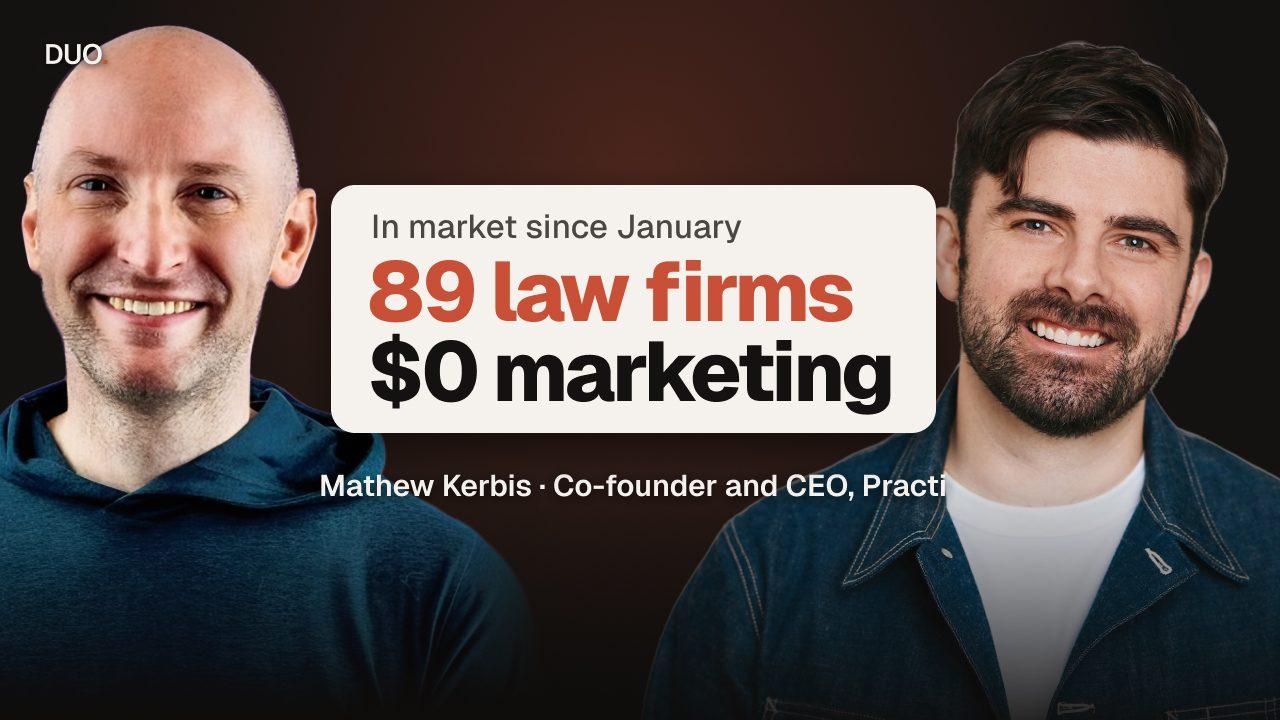
We talk about why lawyers rarely become founders, why your first 50 episodes don't have to be good, the power of a niche, how a podcast led to most of his speaking gigs, why four years of content still didn't make selling Practi fast, what he'd do starting from zero today, and why AI tools now recommend his law firm.
Edited for length and clarity. Times play the video from that point.
From attorney to five-time founder
Justin What made you even think about that journey into founding Practi?
Mathew On the content stuff, it's just when's the best time to plant a tree, right? Years ago, but if not years ago, today. I just got a LinkedIn message yesterday from somebody who is participating in one of my LinkedIn lives, because I pretty much record all my content live on LinkedIn these days. And she was like, what do you suggest I do? I'm a legal tech founder too. And this was my answer to her, it was content. She's like, well, how did you do it? I said, well, I just started four years ago.
I've always had an entrepreneurial spirit. Going back to even when I was a kid, I called it being an inventor. Practi is my fifth company that I've started, first venture-backed tech startup. So I've been down this road before, so it was probably only a matter of time before what I was doing as an attorney and a podcaster evolved into being a co-founder of a company that does the thing that I've been talking about and doing for so long.
Why lawyers rarely become founders
Justin I want to cast maybe some judgment, not to you, but thinking about the stereotypical attorney that's in my mind. This figure that I'm imagining isn't really a founder, five times founder. It's not really a content creator. Is that fair? How did that realization even come to you?
Mathew One of the things I like to say to people who have worked with lawyers a lot: oh, you have the curse of knowledge, right? That's the problem with lawyers. We go through this extra education and training and we get the curse of knowledge. So why are lawyers not entrepreneurial? Because we are a little bit by nature, definitely by training, risk averse, right? 'Cause we know all the things that could happen. The answer to every single legal question: it depends. I like to reframe that as context matters, which is also really important in the age of AI.
So you don't see a lot of entrepreneurship come out of lawyers because of that reason, but a lot of lawyers are consummate problem solvers. That is our job, and that is also entrepreneurship, right? You see problems in the world, go out and make the change happen. And lawyers feel that urge, I think most of us, but then we go, oh, but all this stuff could happen. And so we don't. But if you dig a little bit deeper, just like ogres, lawyers have layers. So they all are entrepreneurial in their own way.
Just like ogres, lawyers have layers.
Don't overthink it
Justin In the age of social media, when you're creating a 45 second video, you need to stay high level enough where it engages someone, and then you give them the opportunity to dive in. How do you keep your messaging accessible and broadly engaging, but still give the context necessary, especially in the world of legal?
Mathew I just don't overthink it. Do it enough that you don't need a script, that you know your material forwards and backwards and left and sideways, and you could remix it at any point in time. And the only way to do that is to start doing it, right? You're going to be bad in the beginning when you start making content, but the good news is nobody knows you because you just started making content, so nobody's going to see the bad stuff.
I keep all my old stuff uploaded, so if you want to go back and watch the first 50 episodes of Law Subscribed, I am not as polished. I'm not as good. I used gimmicks back then to make up for it. I used to ask the question, is a hot dog a sandwich?
The power of a niche
Just don't overthink it, but having a niche helps a lot. Same thing is true of any kind of branding or marketing or selling of any kind. Most of our users are fractional general counsel attorneys, which is a relatively newer way to practice law that lends itself incredibly well to recurring business model structures.
When I've said, hey, we are the subscription software for fractional general counsel attorneys, I get way more interest and clicks than if I just say we help you ditch the billable hour and use subscription billing for any lawyers. The power of a niche is incredibly important, and I just have that niche of the billable hour is gonna die. We as a legal profession, and really any service provider billing by the hour, needs to adapt their business model.
And that's been my brand for so long that now I have a product that just helps you with the mechanics of it and makes it stupid simple to do. So it was an easy transition to start selling the product on top of that.
Justin Having a niche is so important because then there's something that attaches to you and your company that you're known for. It often shows up as a simple line where you're like, that's genius, but getting to that point, I find is quite difficult.
Mathew It took me eight years, Justin, right? It didn't happen overnight. It took eight years of practicing law. I mentor a lot of college kids. I'll go and speak to middle schools and high schools, and they want to know, how do I find my niche? Just follow your interests, dive deep on multiple topics. Don't be a generalist, but have broad general interests and then find something that you're passionate about, and lean into that. And don't be afraid to pivot.
There are growth limitations with niches too. I'm a top 10% global podcaster for Law Subscribed, but my listen score is low because it's still a niche topic, subscription-based legal services. I'm never gonna crack into top 200 lists because of that. But I've got a great core audience that's super engaged. The goal should never be making money as a content creator. Content is a means to an end and a way to spread the message.
How a podcast led to 200 speaking gigs
Justin When you're on this journey of content, you're not trying to make money, but you do want to see some payoff. How did you land on podcast as that platform? And what encouraged you to keep that going?
Mathew I super believe in podcasting as a medium more than I ever did before, because also, what is podcasting now? Yes, you're on all the podcast apps, but you're also on YouTube. You also have newsletters. It's everything. But podcasting at the core of it, because it's human, it's relatable, you could take that content and turn it into all the other things. So as a starting point, I think podcasting is kind of a no brainer.
I really got started with it in 2018. My whole production takes like five minutes now, it's unbelievable. I actually probably have closer to 400 or 500 published episodes across all the content that I make and produce, including speaking engagements. Last year, I did 52 speaking engagements.
And then this year, I'm on track to do 70. Over four years, I've accumulated close to 200 public speaking opportunities. And having a podcast has led to most of those opportunities. You don't just get public speaking gigs because you've done it, or because you ask for it. But having a platform where you could invite people to, or you could point to, like, hey, look at me on this thing. I'm happy to come and talk about this to your community, your group, your event, your podcast.
I'm sure AI pointed you to me, if you used AI to find who should be guests, because I do a lot of this stuff. I'm out there and I have a platform and I'm always publishing.
Justin From my experience with my content journey, helping others, it's really hard to predict what will actually hit. So the best thing is just do it, put a lot out there and see what actually happens. With this series that we're doing now, the shorts that are produced, some of them have 20 views and then some will have a thousand.
Plus. And I couldn't predict what will actually perform. You got to just put stuff out there and then let the audience tell you what they want to learn more about.
Mathew Look, the audience is AI agents sometimes these days, right? And that's okay. They're reading transcripts that are gonna be useful to their humans. I don't care if it's humans or AI that report back to a human. I'm totally agnostic when it comes to that stuff.
Reading with your ears
The question that you asked me, Justin, is why podcasting, right? My first podcast ever listened to, my wife's first cousin recommended Hardcore History.
Now the modern equivalent would be Acquired, which is also a top podcast. One is about history and one is about modern businesses.
I'm probably undiagnosed, a little bit dyslexic. I have a really good memory, but I just don't read as fast as other people read. But I read with my ears, and I listen to more stuff than I ever would have read. In Safari, on iPhone, you could listen to articles with Siri. So as a medium, it was always really appealing to me as a consumer of information. And so I just wanted to figure out how could I produce that stuff, too.
I've dropped a lot of money on my home recording studio. And a lot of that came from what I learned about voice acting, actually. And so now I just adapted and applied that to podcasting, because you could self-publish. You could say whatever you want. You could publish whatever you want.
On camera, I just want to be like a guy on video, but I sound really good. And you can't tell that I've got headphones in and a really high quality microphone. I'm always wearing navy, right? So building a brand around all that stuff too comes back to how important this is. But podcasting is not audio. It is audio and video today.
Podcasting is not audio. It is audio and video today.
Creating a category: Shopify for law firms
Justin I wanna go into Practi as a new category. You've definitely helped define the category, but that's really difficult. You're educating people. You're trying to create interest. You're trying to create trust. What have you learned through this process?
Mathew LegalTech has been around for a super long time, but I'd say we are the first e-commerce platform for law firms. We're like Shopify purpose-built for small, medium-sized law firms. Until the last few years, you didn't go to Shopify.com to buy anything. It was actually just infrastructure for small businesses to sell their stuff online. And so that is all we are today, helping them create an e-commerce storefront and purchase experience with their clients. Right now, if you ever had the displeasure of hiring a lawyer, you might have to send them a check.
AI and the end of the billable hour
There's been e-billing for two decades, but law firms historically don't adopt it, because a lot of their billing is done in arrears. And I've been doing this before AI. But AI is finally, I think, the nail in the coffin for billable hours, because now you could do work better, faster, and cheaper. At such speed that billing by the hour, you have to bill $25,000 an hour to make the same amount of money. And nobody's going to pay that. So that's where subscription comes in. Let's just create an ongoing relationship.
Why four years of content still sold slowly
The biggest lesson is that I had tens of thousands of downloads of the pod over four years. I've got thousands of lawyers subscribing to my newsletters and listening to the podcast. I'm approaching 9,000 followers on LinkedIn, which are mostly lawyers. You'd think, oh, well, you've spent four years doing this, you're the guy, that should convert really well for launching a product. And the answer is no, it's slow. It's still super slow.
Lawyers are also known to be slow purchasers, in an industry based on precedent. And here we're creating this category, e-commerce for law, so there's very little precedent. So it doesn't just automatically convert, but that doesn't mean you stop or you give up. There is interest. We've got 89 law firms on the platform for being in market since January of 2026. Without spending a dime on marketing, being an early stage zero to one startup, we're pretty close to product market fit.
Some lawyers will sign up and they don't even talk to us. They integrated Stripe and they're off to the races in less than 10 minutes. Other lawyers, it's like, okay, let's strategize this. Let's figure out what we should price and package our things at.
There's all these things that you still have to do after getting the interest and having the content to make the product successful. So just because you've been creating content forever is not a guaranteed thing. And that was sort of the hardest lesson.
Just because you've been creating content forever is not a guaranteed thing.
Starting from zero today
Justin You're starting a company, maybe someone doesn't have the audience that you've built. You need to go to market. Content is valuable, but it takes time. If you were talking to yourself, you don't have the following, you're starting Practi today, what would you do in the first 90 days?
Mathew We're launching this podcast network starting next year. It's just a Substack back end right now. I actually publish all my podcasts with Substack, because when you publish it, it goes out to all the podcast apps and as a newsletter at the same time. You click one button. And it's free.
So I would say start a podcast, if not a full-on podcast network. When I would podcast, I would do it under different brands.
Why AI recommends his law firm
I only got that gig because I was podcasting for four years. So I'm out there, and every single time an episode is published from a different domain, it points back to my law firm, right? And so AI is suggesting my firm like crazy. I've gotten Claude and Grok, too, which is pretty incredible. My how did you hear about us question for my firm, one says Grok, one says Claude. I'm like, oh my gosh, I'm doing something right.
Worried about being overproduced? Go live
I really think podcasting as a medium is the most important thing you could do, because also it's human. Making live content is way more believable, relatable, realistic. And frankly, I think people hold themselves to a different standard when they're doing live content. So if you're worried about being overproduced, go live, don't worry about it, and then produce the live stuff for the shorts.
There's no secret sauce
Justin Building the brand is tough. You're super well spoken. You get that visibility, but it didn't just happen. You didn't wake up and you were an excellent public speaker. You put the time in. You went through the period where you're less polished.
There's no secret sauce here. You literally just have to act on it, be out there and get better and improve, and also pivot and follow the signs where one thing's working better than something else.
Theatre, improv and speaking on camera
Mathew You said act on it, but I actually think there's a little bit of a double entendre there, because my father was actually a theater major and he's in sales in the insurance industry. He taught me how to enunciate. He taught me how to pause for effect. So I did learn a lot of public speaking techniques just by virtue of being the son of a theater major. But anybody could take an acting class or an improv class. And improv is probably the most important thing you could learn, especially if you want to create live content.
If you could go take an improv class, even if it's online, study a little bit of acting, not to be an actor, because it helps.
Wrapping up
Justin I did a standup comedy class, not to become a comic, but it's kind of like an improv class, where you actually learn the pauses, the framing, the setup. That's really helpful when you're doing a podcast, doing a content session. You're obviously putting in an immense amount of time and effort. You said 70 plus sessions lined up for next year.
Mathew Oh yeah, just in content I create is around 70 hours a year.
Justin That's wild. That's a tip of the iceberg with how much work you're putting into it. So Mathew, thank you so much for joining me on this session. Looking forward to following you with your content journey, with what you're doing at Practi.
Mathew Thanks for having me. I'm on LinkedIn. Ask AI to tell you about the subscription attorney.
Mathew Kerbis is the co-founder and CEO of Practi.
Full transcript
Mathew And every single time an episode is published from a different domain, it points back to my law firm, right? And so AI is suggesting my firm like crazy.
Justin We had Mathew Kerbis, who is known as the subscription attorney. He practiced law for eight years, hosts a Law Subscribed podcast, and this year co-founded Practi, which helps law firms move off the billable hour. It's a new category in the space that he calls the Shopify for law firms. We talk about the four years of content that he made before even starting Practi. There's really no secret sauce, and it's evident that if you put in time, you get rewarded for it. Let's get into it. So Mathew, so great to have you here, starting off, what made you even think about that journey into founding, being a founder, founding Practi?
Mathew Yeah, I mean, look on the content stuff, it's just when's the best time to plant a tree, cliche, right? It's like, well, you know, years ago, but if not years ago today. So to people watching that are like, shoot, I don't know how to get started, like literally Justin, I just got a LinkedIn message yesterday from somebody who is participating in the channel, I'm one of my LinkedIn lives, because I pretty much record all my content live on LinkedIn these days. And she was like, what do you suggest I do? I'm a legal tech founder too. And this was my answer to her, it was content. She's like, well, how did you do it? I said, well, I just started four years ago. So we can't start four years ago. But for me, I've always had an
entrepreneurial spirit. I think going back to even when I was a kid, I called it being an inventor, because that was the nomenclature available to me at the time, right? This is, like, Practi is my fifth company that I've started, first venture-backed tech startup, but, you know, fifth company. So I've been down this road before, so it was probably only a matter of time before the evolution of what I was doing as an attorney and a podcaster evolved into having a-- being a co-founder of a company that does the thing
that I've been talking about and doing for so long.
Justin I want to cast maybe some judgment, not to you, but thinking about the stereotypical attorney that's in my mind. And the person, this figure that I'm imagining, isn't really a founder, five times founder. It's not really a content creator. Is that fair? How did you, I feel like who you are is quite unique that you're in this industry, yet you are committed to building your personal brand. you know how to do it, you see the value in content, how did that realization even come to you?
Mathew So one of the things I like to say to people who are not lawyers, but they have worked with lawyers a lot and the way they talk and think about things is like a legal mind. I go, oh, you have the curse of knowledge, right? So that's the problem with lawyers is we go through this extra education and training and we get the curse of knowledge. And so why are lawyers not entrepreneurial? Because we are a little bit by nature, Definitely by training, risk averse, right? 'Cause we know all the things that could happen. The answer, the two words that are the answers to, the answer to every single legal question are it depends. I like to reframe that as context matters, which is also really important in the age
of AI, right? But we know that better than anybody. So you don't see a lot of entrepreneurship come out of lawyers because of that reason, but I will actually say that a lot of lawyers are consummate problem solvers. That is our job, and that is also entrepreneurship, right? You see problems in the world. That true entrepreneur can't help themself but to go out and make the change happen. And lawyers feel that urge, I think most of us, but then we go, oh, but all this stuff could happen. And so we don't. But I actually think, yes, your perspective on it is accurate, but I think that if you dig a little bit deeper, just like ogres, lawyers have layers. So they all are entrepreneurial in their own way.
Justin It makes sense. You mentioned something where everything starts with, it depends, right? There's context matters, but in the age of social media, of context, of content, yes, there's space for that kind of value, real, you know, you get into the weeds, but when you're creating a social post, that's 45 second video, you need to sort of stay high level enough where it engages someone and then you give them the opportunity to dive in if they need to. How do you navigate that, so you keep your messaging accessible and more broadly engaging, but you don't sell yourself short or you still give the context necessary, especially in the world of legal or attorneys, right?
Mathew I just don't overthink it. That's when it comes down to it, right? It's like, don't overthink it. Do it enough that you don't need a script, that you know your material forwards and backwards and left and sideways, and you know, you could remix it at any point in time, and the only way to do that is to start doing it, right? Like you're going to be bad in the beginning when you start making content, but the good news is nobody knows you because you just started making content, so nobody's going to see the bad stuff, right? I keep all my old stuff uploaded, so if you want to go back and watch the first, let's be real, 50 episodes of Law Subscribed, I am not as polished. I'm not as good. I used gimmicks back
then to make up for it. I used to ask the question, "Is a hot dog a sandwich?" And I'll still get that sometimes. Some people are like, "Oh, you're an OG, Law Subscribed listener!" Or you went back and listened to the backlog, right? It does help. I have three compilation episodes that total, like... I don't know, almost like two or three hours worth of just answers to that question, right? So it's kind of crazy. But yeah, just don't overthink it, but having a niche, right, helps a lot. Same thing is true of any kind of branding or marketing or selling of any kind. And I struggle with this even in practice where we're just trying to help any law firm, regardless of practice area and size, transition from hourly billing to
subscription and flat fee. Even then like most of our users are fractional general counsel attorneys, which is a relatively newer way to practice law that lends itself incredibly well to recurring business model structures. And when I've said sometimes like, "Hey, we are the subscription software for fractional general counsel attorneys," I get way more interest and clicks than if I just say we help you ditch the billable hour and use subscription billing for any lawyers. Right? It's like the power of a niche is incredibly important, and I just have that niche of the billable hour is gonna die. We as a legal profession and really any service provider billing by the hour needs to adapt their business model.
And that's been my brand for so long that yeah, well now I have a product that just helps you with the mechanics of it and makes it stupid simple to do. So it's just like it was an easy transition to start selling the product on top of that.
Justin Yeah, having a niche is so important because then there's something that attaches to you and your company that you're known for. It often shows up as a simple line where you're like, that's genius, but getting to that point, I find is quite difficult.
Mathew It took me eight years. It took me eight years, Justin, right?
Like it didn't happen overnight. It took eight years of practicing law, not just eight years of like being like post-college, right? So like I talk, I mentor a lot of college kids. I'll go and speak to middle schools and high schools and like they want to know the answer to the question, right? That you're like, well, how do I find my niche? How do I find my special ed? Like just follow your interests, dive deep on multiple topics. like don't, the goal is not be a generalist, but like have broad general interests and then find something that's passionate, that you're passionate about, that you're interested in and like lean into that and don't be afraid to pivot, is almost like just entrepreneur advice
in general, right? Don't be afraid to pivot your niche if it doesn't work out or you're not interested. But like, I mean, nobody listened to the podcast and I still like, and there are growth limitations with niches too sometimes. Like I'm a top 10% global podcaster for Law Subscribed. But my listen score is low because it's like still like a niche topic of Subscription-based legal services, right? So so I'm never gonna crack into like top 200 lists right and podcasting because of that But I've got a great core audience that's super engaged and I could actually get like sponsorships and stuff because of that Even though that's not the goal. The goal should never be Making money as a content creator, right?
Like find a niche to make money doing content No, like content is a means to an end and a way to spread the message is like my take on it.
Justin 100% and even that leads into, when you're on this journey of content, you're creating the podcast, you're doing so, you're not trying to make money, but you do want to see some payoff to this. You want to see interest lead, some type of signal that there's value. How did, I mean, there's so many questions, like how did you land on podcast as that platform? And what encouraged you to keep that going? Was it just personal interest or did you start to get signals early on that this was gonna be an effective channel? Like walk me through kind of these early signs that have led you to have, you know, 200 episodes at this point.
Mathew Oh my gosh, I mean, I have so many podcasts that are not necessarily as well known 'cause like niche podcasting and local podcasting is actually like really powerful. I super believe in podcasting as a medium more than I ever did before because also what is podcasting now? Yes, you're on like all the podcast apps, but you're also on YouTube. You also have newsletters. You also have like, it's everything, but podcasting, I think at the core of it, because it's human, it's relatable. You could take that content and turn it into all the other things, right? And like, so as a starting point, I think podcasting is kind of like a no brainer. Like if you're gonna, like... we're launching a new podcast network as
part of Practi's go-to-market, right? And like I have the experience, like I've got, I don't know, like five, six years of experience podcasting. I really got started with it in 2018. But like the stuff we recorded, I don't think we have, we published maybe like one thing back, that we recorded back then. And then we were using GarageBand, like Descript is incredible, like we're recording in Descript, like it's, like my whole production takes like five minutes now, it's unbelievable. Thank you. It's amazing. Right. But I actually probably have closer to 400 or 500 published episodes across all the content that I make and produce. And yeah, including speaking engagements. Last year, I did 52 speaking engagements.
Maybe 40-something of them were recorded and are published and available somewhere online. And if they're not, I always record myself using my on-the-road podcast recording equipment so that I publish it via my own platforms. And then this year, I'm on track to do 70. So just in two years, right now, next year, I want to do 52 again, or fewer, right? Like, 70 is way too many. But yeah, over like four years, I've accumulated close to 200 public speaking opportunities. And having a podcast has led to most of those opportunities. You don't just get public speaking gigs just because you've done it, or because you ask for it, or whatever. but like having a platform where you could invite people to
or you could point to like, hey, look at me on this thing. I'm happy to come and talk about this to your community, your group, your event, your podcast, whatever, right? Like I'm sure AI pointed you to me, if you used AI to find who should be guests or whatever, because I do a lot of this stuff. I'm like, I'm out there and I have a platform and I'm always publishing. So I know we kind of got away from the answer
to the question, but it's always the way it's going.
Justin No, no, I mean, it's really interesting. And I don't know if this is relatable, But from my experience with my content journey, helping others, it's really hard to predict what will actually hit, what will actually happen. So kind of the best thing is just like, just do it, put a lot out there and see what actually happens. Like I'm doing this now with this channel that we're, you know, the series that we're doing now is the shorts that are produced. Some of them have 20 views and then some will have a thousand.
Mathew Yeah.
Justin Plus. And I couldn't predict what will actually perform, so. Kind of my learning is just you got to just put stuff out there and then let
kind of the audience to tell you what? What they want to learn more about and
Mathew look the audience is AI agents sometimes these days, right? and like and that's okay like they're reading transcripts that are gonna be useful to their
You know, they're humans right like and so like who cares I don't care who the audience is I don't care if it's humans or AI that report back to a human right on something And so, I'm totally agnostic when it comes to that stuff. Oh yeah, the question that you asked me, Justin, which I do have an answer for, so I think you should go back, is like why podcasting, right? How do I get into it and all that? So my first podcast ever listened to, my wife's first cousin recommended Hardcore History.
Justin Oh yeah, great series.
Mathew And like now the modern equivalent would be Acquired, right, which is also like a top podcast. They do like four hour plus episodes. But one is about history and one is about modern businesses, right?
So I maybe even recommend people listen to Acquired over-- especially to the people who are watching this, listen to Acquired over Hardcore History. But then I got into podcasts and got into Hidden Brain and all these NPR podcasts, TED Radio Hour. And I'm still listening to Hidden Brain and TED Radio Hour. Hardcore history isn't really published a lot. I listen to all legal podcasts and tech podcasts, AI podcasts, a couple of gaming podcasts because I can't just all be like, knowledge that I'm gaining. And so I'm probably undiagnosed, a little bit dyslexic. I was never dyslexic to the point where I still got pretty excellent grades, and I have a little bit of a photographic memory, so
I have a really good memory, but I just don't read as fast as other people read, ever. But I read with my ears, and I listen... to more stuff than I ever would have read. And like in Safari, on iPhone, you could do listen to articles with Siri. And so I consume even written material, but via audio, so much. So as a medium, it was always really appealing to me as a consumer of information. And so I just wanted to figure out how could I produce that stuff, too. I dabbled with voice acting a little bit, and so I already had knowledge of microphones and stuff. I've got my Shure MV7 just off camera. It's about a hang loose distance away with a DB amplifier attached to my audio mixer because in order
to have a Shure that far away you need to increase the decibels. I've got all this stuff. I've dropped a lot of money on my setup in my home recording studio. And a lot of that came from what I learned about voice acting, actually. And so now I just adapted and applied that to podcasting because you could self-publish. It's easier. You could say whatever you want. You could publish whatever you want. So like I, and also as a lawyer, and like I teach podcasting for lawyers, I've got behind the ear headphones that are plugged in that are clear, right? Now, if I had hear you would definitely not be able to see them, but now that I've called it out, you could probably see that I've got these headphones in it
that's an extension cable, right? 'Cause on your on camera appearance, especially as an attorney, but I just think generally, like, well, you've got the microphone and a black shirt, like I could barely notice the microphone, Justin. But like, I actually think, like, yes, if you want the like, look at me, I'm a podcast, I'm a content creator, 'cause that's like a common thing. I'm like, no, I just want to be like a guy on video, but I sound really good. And you can't tell that I've got headphones in and a really high quality microphone. Some of this is like the choices that you make with stuff like that, right? I'm always wearing Navy, right? Like I'm always, always, always wearing Navy. So like building a brand around all that
stuff too, I think comes back to like how important this is. But podcasting is not audio. It is audio and video today.
Justin Right, that's what it's evolved into for sure, because there's the clips portion, which is so important, especially how the platforms run, right? Like the shorts, people watch the short and if they're interested, then that takes them to the long form. Yeah. I wanna go like into Practi as a new category. It seems like in the space, right? Billable, our billable attorney is not something that most people think of. I mean, you've definitely helped define the category, but that's really difficult. You're educating people. You're trying to create interest. You're trying to create trust. What have you learned through this process in essentially like a category creation company?
Mathew Yeah, so I mean LegalTech has been around for a super long time, but I'd say we are the first e-commerce platform for law firms, right? We're like Shopify purpose-built for small, medium-sized law firms. And like everybody knows Shopify. And until like the last few years, you didn't go to Shopify.com or use the ShopApp to buy anything. It was actually just infrastructure for small businesses to sell their stuff online. And so that is all we are today, is we are like OG Shopify for law firms, helping them create an e-commerce storefront and purchase like experience with their clients, which right now, if you ever had the displeasure of hiring a lawyer, you might have to send them a check, right?
There is e-billing and there's been e-billing for like two decades, but law firms historically don't adopt it because a lot of also their billing is done in arrears. Maybe you have to pay a retainer that they track time and bill against. And we're just like, there's a new paradigm. AI-- and I've been doing this before AI. And some lawyers I've interviewed on my podcast, I've been doing it for decades before AI, not billing by the hour and billing on subscription. But AI is finally, I think, the nail in the coffin for billable hours, because now you could do work better, faster, and cheaper. Just at speed, at such speed that billing by the hour, you have to bill $25,000 an hour to make the same amount of money.
And nobody's going to pay that, and that's also outrageous. And it's probably legally unethical for lawyers who have to follow legal ethics. So probably an unreasonable fee. So at certain points, it's hard to value-based price everything that you do. Certainly, there's value to certain things. But-- But it's hard, so that's where subscription comes in. Because it's like, let's just create an ongoing relationship. Software industry, software as a service. Software industry was looking at service providers, and they're charging subscriptions and trying to adapt to business models. We should look at the software industry now and say, hey, we should take them back. We should do that. So yeah, I mean, but look, I'd say the
biggest lesson is that taking a look at the fact that I had tens of thousands of downloads of the pod over four years. I'm in year five now, or approaching year five. And thinking that I've got thousands of lawyers subscribing to my newsletters and listening to the podcast, I'm approaching 9,000 followers on LinkedIn, which are mostly lawyers, which is where a lot of lawyers live, although I'm also discovering that Facebook and meta platforms are also on as well. But especially LinkedIn is a good place for lawyers. You'd think, oh, well, you've spent four years doing this, you're the guy, that should convert really well for launching a product. And the answer is no, it's slow. It's still super slow.
Lawyers are also known to be slow purchasers, generally speaking, in an industry based on precedent. And here we're creating this category, like you said, e-commerce for law, and we're a new category. So there's very little precedent, right? So I have to analogize it to Shopify. So yeah, it doesn't just automatically convert, But that doesn't mean you stop or you give up. Like there is interest, right? Like we've got 89 law firms on the platform for being in market since January of 2026. And we're recording this in November of 26. So like without spending a dime on marketing, being an early stage zero to one startup, like we're pretty close to product market fit. I think we're almost there. And
And there are some lawyers that will sign up and they don't even talk to us. And they've got their account ready to go, their subscription's ready. They integrated Stripe, right? And they're off to the races in less than 10 minutes. They didn't even need our help. And there are other lawyers that it's like, okay, let's strategize this. Let's figure out what we should price and package our things at. We've made some tools to make it easier to do that, right? notebook.practi.ai is just a shareable Gemini notebook that I curate the sources. It's got 280-something sources. You can ask all your pricing and packaging questions to this tool, and that's just an MVP version of that. But my CTO, who's ex-Google in AWS,
he's in the process of building that into the Practi platform, using Google's same technology that they use for Notebook. When you're a developer inside of Google's developing tools, you could build that stuff. So he's in the process of basically rebuilding Gemini Notebook so that we could track metrics and stuff on that and take the output and just make it automatically populate stuff inside of Practi. but for now it's a little bit of a manual Turk process. So like onboarding, like there's all these things that you still have to do after getting the interest and having the content to like make the product successful. So just because you've been creating content forever is not a guaranteed thing.
And that was sort of the hardest lesson alone 'cause I'd never tried to do something like that before. It was always really a passion project for years.
Justin Yeah, it's tricky. I mean, if you're a founder, like going, I mean, you have been, but you've had enough experience where kind of the model maybe is proven, like there is value, but it's tricky. Like you're starting a company, you don't have, maybe someone doesn't have the audience that you've built, right? It's, you know, how do you, what do you do? Because you need to go to market. Content is valuable, but it takes time. So there's kind of the short-term methods and long-term methods. If you were kind of talking to yourself, you don't have the following, you're starting Practi today, what would you do? like in, let's say the first 90 days, or to go to market with that company.
Mathew Oh yeah, well, even that, right? Like we're launching this podcast network starting next year. It's just a Substack back end right now, but you could go to practipod.com and subscribe to the newsletter. I actually publish all my podcasts with Substack because when you publish it, it goes out to all the podcast apps and as a newsletter at the same time. So it's like you click one button and sometimes it'll use AI to create clips from the episode and automatically publish them to LinkedIn when you click when you schedule a publisher, that's nice. And I don't have to do worry about clips. And it will publish it automatically, like all with a click of a button. So shout out to Substack. And it's free.
It's a one-time $50 payment to get a custom domain. So I would say start a podcast, if not a podcast full-on podcast network. Because the thing is what I've learned about podcasting-- because before, Practi was my law firm subscription attorney, LLC at subscriptionattorney.com. And when I would podcast, I would do it under different brands. lawsubscribed.com, Legal AI Live, all my other local podcasting stuff that I do for my local chamber of commerce and community theater program. I'm also just the talent for the Chicago Bar Association podcast at the bar, which Legal Talk Network produces that. So that's sort of nice to also just be like the talent and not have to do the production stuff.
But I only got that gig because it's not a paying gig. It's a volunteer gig. But I only got that gig because I was podcasting for four years before their hosts decided to resign or move on to something else, right? So like-- So I'm out there, though, and every single time an episode is published from a different domain, it points back to my law firm, right? And so AI is suggesting my firm like crazy. I've gotten Claude and Grok, too, which is pretty incredible. Anybody could get ChatGPT or Google's AI or Perplexity to say like, "We found you through AI through one of these things." But Grok and Claude, man, those are prized possessions. My "How did you hear about us?" question for my firm, and one says Grok, one says Claude.
I'm like, oh my gosh, I'm doing something right. So I really think podcasting as a medium is like the most important thing you could do because also it's human. It's knowingly human and live too. So for two years, I pretty much predominantly record live on occasion. I'll have an important guest and we'll record in rooms on Descript because they have like a comms team that needs to approve and review stuff. But generally speaking, making live content is way more believable, relatable, realistic, make mistakes, and so like, like, and frankly, I think people hold themselves to a different standard when they're doing live content. And so like, if you're worried about being overproduced, go live, don't worry about it,
and then produce the live stuff for the shorts and the other thing.
Justin Sure, yeah, yeah. I mean, kind of to wrap up, there's so many nuggets here, but what I have realized, and it seems like you've discovered, like we've just both discovered the same thing is building the brand is tough. It is hard. And you have, like you, you're obviously, you're super well spoken. You get that visibility, but it didn't just happen. You didn't wake up and you were an excellent public speaker. You were visible. You put the time in. You went through the period where you're less polished. And the only way to get to the point where you're getting these opportunities is because you put in that effort. And I'm realizing this with my own content. It's like, ah, it's, it just takes time
and practice and practice and practice and, and putting yourself out there and just seeing what happens. And, and that's the same for figuring out your niche. I mean, there's no magic I'm kind of discovering more than ever since starting my own venture, there's no, there's no secret sauce here that you literally just have to act like you said, like act, act on it, be out there and get better and improve and then, and also pivot and, and, and follow the signs where one thing's working better than something else and then follow that.
Mathew My final takeaway too is you said act on it, but I actually think there's a little bit of a double entendre there because my father was actually a theater major and he's in sales in the insurance industry. And so I grew up with a dad who had a theater background and was in sales. And so I did have a little bit of an upgrade bringing that. He taught me how to enunciate. He taught me how to pause for effect. And so I actually did learn a lot of public speaking techniques just by virtue of being the son of a theater major of a father who's in sales. And so I did have that benefit. But anybody could take an acting class or an improv class. And improv is probably the most important thing you could learn, especially if you
want to create live content. I've only even studied a little bit of improv, but through osmosis with studying a little bit of acting in college. I was a philosophy major, but I took a few acting classes. And I've taken a few improv stuff, and I did some stuff with some improv groups, but never anything too official. But if you could go take an improv class, even if it's online, study a little bit of acting,
not to be an actor, because it helps.
Justin Yeah, oh, 100%. I had someone on the series a few episodes ago, she now coaches executives and founders and helps them with their content. Her background is as an actress. And she did it. And I think if we see these people, we go on a social media, there's people who are really good speakers and we just think, ah, they're good speakers, whatever. They did something to get to that point. And I think that's a part that is really important to understand, putting yourself out there is one piece of it, but it's just one piece. There's, you need to also be someone who is engaging on camera, who does kind of presents in a way that is authentic, but also engaging all of these different
pieces. And practice is one, but I think that's a great point. I did a standup comedy class, not to become a comic, but there's actually so many things within that. It's kind of like acting class or an improv class where you actually learn the pauses, the framing, the setup, that's really helpful when you're doing a podcast, doing a content session. So there's a lot of great nuggets here. I think what you built is pretty fascinating and it's kind of adopting or adapting to technology, what AI is capable of. But I love the fact that your content is very human. It's you, people are getting to understand who you are through your story. And you're obviously putting in an immense amount of time and effort.
You said 70 plus sessions, I think lined up for next year, 50 plus for this year.
Mathew Oh yeah, just in content I create is around 70 hours a year.
Justin That's wild. So yeah, if anyone's listening and they hear you they're like, yeah, Mathew's great He's built this like that is how many that's just a little that's a tip of the iceberg with how much work you're putting into it. So yeah, Mathew. Thank you so much for joining me on this session It was really helpful and interesting to hear your take and and looking forward to following you With your content journey with what you're doing at Practi. So appreciate it, man.
Mathew Thanks for having me. I'm on LinkedIn Ask AI to tell you about the subscription attorney. Thanks