The interview
We talk about why a competitor's $12 million raise gave her confidence instead of worry, why every niche needs a competitor, why big companies said no and small ones said yes, how her first client came from a LinkedIn message, and why your offer is never finished.
Edited for length and clarity. Times play the video from that point.
What Georgia App does
Justin DeMarchi You're building this company, Georgia App. Maybe you can share just a snippet of what is the company exactly.
Julia Georgi So Georgia App is essentially a soft skill training platform via role-play and realistic simulations. We came into the market with a simple promise of custom role-play, meaning that we don't have a framework, we don't have a template. We have a tool that allows us to build very realistic scenarios to practice any conversations people would have in real life. And our ICPs are sales trainers in different industries, individuals like founders, and also we are trying to enter companies directly, and help them to improve their soft skills, essentially for sales and also leadership.
Why she started it
Justin Before you launched and actually went into Georgia App, what made you think that this was something the market needed and something that you wanted to pursue as your business?
Julia It was a negotiation training I took a while back, where I realized that people actually don't know basic communication and negotiation things that will really help them in real life. Once you go through a specific framework, you realize that actually every conversation has a purpose. People talk for a reason. And without being manipulative, you can bring that certain directions more easily if you understand those techniques. I don't claim to be good at any of those techniques. I'm just thinking that everyone benefits just by practicing them.
Very quickly, I realized that HR is a very difficult market to penetrate. And unless something is imposed, it's very hard to make people buy it, despite the fact that I did have a lot of contacts in male-dominated industries where women would benefit from such tool. So I quickly pivoted to sales trainers. The budgets were already there, and that's how I started Georgia App with a sales focus.
What gave her confidence
Justin What gave you that confidence to actually take that step forward?
Julia It's funny that what gave me confidence is not what happened, and that's very important. When I would pitch this idea around me, absolutely everyone would confirm: yes, that's something interesting, I like this angle, people don't know how to talk. I actually co-founded this with the coach who was really into those topics, and then we went through a series of interviews of all the people I knew from different industries. They in a certain way confirmed that there could be something that's applicable.
And then also I started to do more research, that alternatives also exist. What gave me 100% confidence is that when one of the competitors raised $12 million, it gave me confidence like, yes, there is the market fit. They get so much money that definitely is market fit.
What gave me 100% confidence is that when one of the competitors raised $12 million.
Why every niche needs a competitor
Justin Support is different than being a customer. You now have a big competitor with major funding. Did you feel like that was going to be a problem for you?
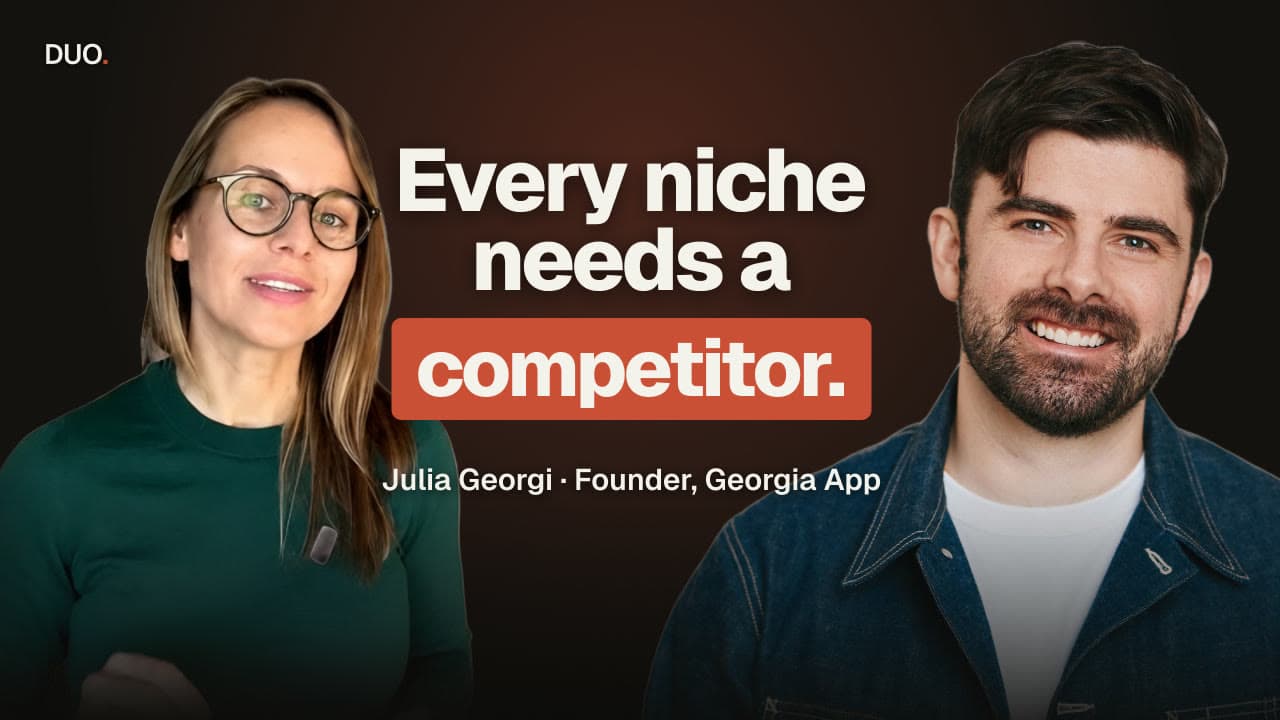
Julia I don't even think I can own one niche, because every niche needs a competitor. Otherwise, what's the point? So you actually want other people to talk about the service and the benefit. And no one can have 100% of market share. I also see many competitors in different countries. They struggle with retention, but they don't necessarily have this set up as we do.
So it's interesting to learn from each other. I talk to people from the UK market, the market I don't address. It's not so simple, like, oh, those guys, I compete against them. It's not a race.
Every niche needs a competitor. Otherwise, what's the point?
A competitor next door
Justin How did you have that mindset around your competitors? Did you learn that from somewhere?
Julia When I worked in distribution business, B2B distribution, someone in the office told me, it's good to have a competitor next door. And I didn't ask why. Sometimes you have showrooms close to each other. And maybe you find one product there, but don't find one product there. And that's how they learn about you.
Where I experienced this, it was really interesting. One of my startups, we had a lot of access to larger companies, because I always worked for leading companies with at least 20 billion of turnover. So I had access to those people. We actually were pitching to those people a lot, only to realize that we were competing against enterprise solutions.
Enterprise said no, small companies said yes
Despite the fact that we were giving a chance to pitch, there was just no way, because we don't have all the compliance procedures, we are not Microsoft friendly or whatever. There's so many things you need to understand about how enterprise work before you actually can enter that segment. I don't say startup cannot enter this. And I realized, oh my God, when we go and pitch to smaller companies, they love it and they want it and it's so easy. You actually talk to decision-maker, and that's great.
So from that moment, I always look at the customer size. I think that's very important. If you look at the way Salesforce of the world looks at the market, always called for companies like 1000 people plus. And what can I offer to the company with 1000 plus people? I go to another segment, and they're absolutely happy to work with the startup.
What she didn't do
Justin Let's transition a little bit to go to market, marketing strategy, content strategy, sales strategy. What did you do?
Julia I think you should ask me what I didn't do.
Justin What didn't you do?
Julia I think the only thing I didn't do yet is Meta ads for Georgia. I think I did everything conventional wisdom tells you to do. I didn't do YouTube channel yet for Georgia, but the natural path for someone in B2B is obviously LinkedIn. LinkedIn is a goldmine. If you don't have access to people in your area, if there is no events you can go, how do you meet people? And I took this path because I wanted to try my product in the U.S.
LinkedIn was my starting point. Literally messaging people, looking through my contacts first. My first proof of concept client came through LinkedIn, just the direct outreach to the people I know. I heard it from my marketing mentor. She was always saying you should always reach out to at least 20 people, assuming that two will give you some feedback.
LinkedIn is a goldmine.
The 90-day rule
I'm by no means any good at this, but it works, because I do it with one rule in mind. If I start something, I try to do it for 90 days. And if I see that I'm exhausted or it's too difficult, I'll try to outsource this.
At some point, I had so much success at LinkedIn that I'll actually stop for two months. It's as much customers as I can take, because the platform was still in development, and we needed to show that we are good. Why would anyone want to work with a startup? So it's either the pain, the tool, the solution, just the type of person you are, but people need to believe in you.
And then once they believe in you, you shouldn't disappoint them. So for me, because we are small startup, that was extremely important, to maintain this high level of service. And it's funny in LinkedIn, there's people say they know how algorithm works.
I don't know how it works, I don't know if anyone knows. I don't feel like my audience is growing, it's just like this. It's huge, it's nothing, but when it's huge, it's great. That's actually the greatest demos I have for someone who engaged with the content.
People need to believe in you.
Your offer is never finished
Justin If you only had to pick a few things to really focus your time on, what would the first, let's say, 90 days of your go-to-market strategy be?
Julia Working on the offer with the professional help is very important. I think having a mindset that the offer and the way you talk to a client in the segment is a work in progress all the time. When I work with founders, I feel like they think it's a product. It's a feature. Think of it like a floating feature, because understanding your ICP is one thing, but then as you interview people, you need to talk about this all the time.
There is no stop. That's the business. Your business as a founder is to figure out how to bring your products to market continuously. Changing the mindset from, oh, I do a campaign. No, it's a whole system.
It's how you think, how you talk, and everything should be linked. It's always work in progress. If you look at anything I do, I always don't like it. I don't like my website. Everything is outdated in my head. I think I need to update it, because I understood that you need to feed this new energy, the vision, to the product. I think figuring the distribution model is the advice I would give, and test a lot of things cheaply. Another thing I think that worked is that I had the budget in mind.
Think of it like a floating feature.
What sales trainers teach
Justin If you were to speak for Georgia, what are the things that someone going through that sales simulation training should know?
Julia One thing you need to know that every sales trainer we work with never gives a script. So we pick the great partners who have understood what makes a person a great salesperson, and then they give them techniques, methodologies and understanding of the situation based on the stage of the sales process. For example, your cold call will not be the same as, let's say, your customer success call. You as an entrepreneur, you probably need to learn many of those things, but it shouldn't be scary for you, because they will be all custom for your situation.
It doesn't take much time and doesn't take much money, and that's what's so beautiful about it. Why some people don't follow up in some industries, like B2B industries? They don't know how. Out of the context, it's not how they operate. So in order to break a habit, you need some training, some rehearsal, and some practice. So it's not a rocket science, actually.
Does she use Georgia herself?
Justin Do you use Georgia yourself? Has it helped you in your own sales process?
Julia I do use Georgia. And I must admit that there are certain products I will never be able to sell. I get horrible grades. But there are some products, for example, I could be better at insurance sales. When I tested the modules, I obviously also get evaluation of how good I am. Because the feedback we give, it's not a hypothetical feedback. We will actually tell you, look, you sound very clear, but you pitch early. That's not a personal feedback, like, oh, you like charisma or something. This is actually technical knowledge, or maybe something you miss because you're nervous when you're speaking. We don't do any personal feedback. We will never judge your style.
I recommend to anyone to try this. And if you don't want to try Georgia, you can try another tool. You can even do it with ChatGPT. Honestly, you can rehearse that. Methodology is the core of any training.
I get horrible grades.
Julia Georgi is the founder of Georgia App.
Full transcript
Julia What gave me 100% confidence is that when one of the competitors raised $12 million, so it gave me confidence like, yes, there is the market fit.
Justin Julia, it's so great to meet face-to-face and to be able to record this session. I thought it'd be a great opportunity, like you have Georgia App, which I'd love to chat more about, but you're also building this company. You built other companies as well. And we were chatting casually about your go-to-market strategy, your content strategy, and also you mentioned what actually happens when you get someone on that call. The sales strategy, how do you communicate your offer with them? There's a lot of things that I think would be valuable for other founders, business leaders to explore based on your experience. It's great to have you in conversation.
Julia Thanks for having me.
Justin Cool. Let's start off here. I guess you're building this company, Georgia App, and that's a great place to start. Maybe you can share just a snippet of what is the company exactly, And then I would love to get into how you went kind of from zero to one, like what that launch strategy was like.
Julia So Georgia App is essentially a soft skill training platform via role-play and realistic simulations. We came into the market with a simple promise of custom role-play, meaning that we don't have a framework, we don't have a template. We have a tool that allows us to build very realistic scenarios to practice any conversations people would have in real life. And our segments today are, or ICPs, depending on who it is, who will understand, are sales trainers in different industries, individuals like founders, and also we are trying to enter via sales trainers, companies directly, and help them to improve their soft skills, essentially for sales and also leadership of raw negotiation conflict management that can work quite far.
Justin Okay, so let's rewind. Basically, before you launched and actually went into Georgia App, what made you think that this was something the market needed and something that you wanted to pursue as your business?
Julia Essentially, it was a negotiation training I took a while back, where I realized that people actually don't know basic communication and negotiation things that will really help them in real life. It's very simple. Once you go through a specific framework, you realize that actually every conversation has a purpose. People talk for a reason. And without being manipulative, you can bring that certain directions more easily if you understand those techniques. So just a little reminder, I don't claim to be good at any of those techniques. I'm just thinking that everyone benefits just by practicing them and it's a lifelong experience of improvements because obviously based on your state of development, you can use different techniques and different methodologies to improve negotiation skills.
So I essentially thought that Georgia would be perfect for female in people environments. And very quickly, I realized that HR is a very difficult market to penetrate. And unless something is imposed, it's very hard to make people buy it. Or maybe I didn't succeed to make people buy it, despite the fact that I did have a lot of contacts in male-dominated industries where women would benefit from such tool. So I quickly switched pivoted to sales trainers, so I needed value and the budgets were already there and that's how I started a Georgia app with a sales focus, hoping that maybe at some point it will be also a platform for women and military in the stress of learning.
It's all sorts of negotiations and conflict management techniques.
Justin Okay. So were there things, I mean, in terms of product market fit, right? Let's talk about that. You had this idea. saw that there was this initial need, what gave you the confidence to say, "Yeah, I can make a business and the business can reach the success that I need to." Obviously, nothing's guaranteed, but what gave you that confidence to actually take that step forward?
Julia It's funny that what gave me confidence is not what happened, and that's very important. So what gave me confidence, essentially, it was really simple, is when I would pitch this idea around me absolutely everyone would confirm yes that's something interesting I like this angle people don't know how to talk I was in France essentially I actually co-founded this with the coach who was really into those topics because that's what she was doing for leaving and then we went through a series of interviews of all the people I knew from different industries and they all, they did confirm they would buy it because obviously a company runs on the process hierarchies and politics, but they in a certain way confirmed that there could be something that's applicable.
And then also I started to do more research that alternatives also exist. And I guess one thing I would like to add that what gave me 100% confidence is that when one of the competitors raised $12 million. So it gave me confidence like, yes, there is the market fit. So they get so much money that definitely is market fit.
Justin Yeah, that's interesting. Because you're talking to the people around you. And there's this thing where support is different than being a customer, right? A lot of people will be like, that's great. Like, you know, do your thing. I think I see potential, but it's different than people actually putting their money up and saying, Yeah, I want I will pay for this myself, you now have a big competitor with major funding. Did you feel like that was going to be a problem for you? Or did you feel like, hey, you have a niche that you think you can you can own that niche in that space?
Julia Yeah. And I don't even think I can own one niche because every niche needs a competitor. Otherwise, what's the point? Right? So you actually want other people to talk about the service and the benefit. And no one can have 100% of market share a name, maybe in some niche, you know, like plastic like for cheese or something something very specific. But when in service, I also see many competitors in different countries. They, for instance, struggle with retention, but they don't necessarily have this name set up as we do.
So it's interesting to learn from each other. And actually, I learned some of my competitors to reach out and discuss, not like a clear contact of interest. Like I talk to people from the UK market, you know, at the market I don't address or people from that address to get to different industries to mine. So yeah, it's, it's not so simple, like, oh, those guys, I compete against them. It's not a race.
Justin Yeah, I think that's a great point. Because the idea of competitors and business, it feels, I mean, very competitive. If it's like we must surpass them, they are the competition, we need to get the edge. But I think in reality, there's a lot of other things around competitors. One is they are also educating the market alongside you, right? They are also sharing similar value props. So yes, like some business might go to them or you could go to them, they could go to you. But it isn't so easy as we need to achieve more than them, we need to surpass them because Because there is often room for both and there is complementary actions that are taking place that support each other, even indirectly.
How did you have that mindset around your competitors? I feel like that, did you learn that from somewhere?
Julia Well, I first heard this theory and I didn't study economics. So there must be broader theories, something more scientific. But when I worked in distribution business, B2B distribution, someone in the office told me, it's good to have a competitor next door. And I didn't ask why. I'm like, God, I don't like why one guy would actually go shop there and then shop there. And apparently it was considered really good. That's why if you look around, they do help this shopping. It's a concentration center, right? And even be to be industries, a company, sorry, sometimes you have like showrooms close to each other, because the dry traffic, you can have 100% of the market.
And maybe you find one product there, but don't find one product there. And that's how they learn about you. But, um, the, but where I experienced this, it was really interesting. So we, I, one of my startups, we had a lot of access to larger companies because I, I always worked for top board leading companies with at least 20 billion of turnover in headquarters. So I had access to those people. And when I first, one of the first startups, we actually were pitching to those people a lot, only to realize that we were competing against enterprise solutions.
And despite the fact that we were giving a chance to pitch, there was just no way, because we don't have all the compliance procedures, we are not Microsoft friendly or whatever, but there's so many things you need to understand about how enterprise work before you actually can enter that segment. I don't say startup cannot enter this, but I say my startup probably learn it in a way, like literally learn it by facing it. And I realized, oh my God, but when we go and pitch to smaller companies, they love it and they want it and it's so easy. And it's meeting with 30 people and you actually talk to decision-maker and that's great.
So from that moment, I started to always look at talk to your competitors at the benchmark, from the enterprise level, what it could look like for us if you want to go further, or what's the market standard is, while still working in my niche, sort of with the right customer size. I always look at the customer size. I think that's very important. And if you look at the way, I don't know, Salesforce of the world looks at the market, always called for companies like 1000 people plus, you know? And what can I offer to the company with 1000 plus people? When why would it fight so hard to not be in the segment where actually, I go to another segment, and they're absolutely happy to work with the startup of myself. So it's sort of, it's not just a textbook like this.
Justin Yeah, that's, that's a great insight. I think. I mean, I've I've done this too. You start off a business and there's this aspirational goal of, "Oh, if I could work with a few of these people," you start to do the calculations, "Well, if I can get even just two of these enterprise clients, I'm doing amazing," and it can be a little bit distracting, because even though that might be the aspiration, what makes sense right now and if you can actually just hone in on the businesses that are most likely to actually give you the yes. And you say, and then you hone in on that specific audience.
Well, that's maybe the best place to start. And so let's transition a little bit to, you know, go to market, marketing strategy, content strategy, sales strategy. What did you do? Like, what was kind of your path with Georgia App there?
Julia I think you should ask me what I didn't do.
Justin What didn't you do?
Julia I think the only thing I didn't do yet is Meta ads for Georgia. I think I did. Everything conventional wisdom tells you to do. Well, I didn't do YouTube channel yet for Georgia, but the natural path for someone in B2B is obviously LinkedIn. LinkedIn is a goldmine. If you don't have access to people in your area, if there is no events you can go be, How do you meet people? You meet them? And I took this path because I wanted to try my product in the U.S. And leaving France, I can't spend so much time and money going to U.S.
all the time, which probably would give better results. But still, LinkedIn was my starting point. I have literally messaging people looking through my contacts first. Yeah, that was the first and my first proof of concept client came through LinkedIn, just the direct outreach to the people I know. I like to use this reference, and I heard it from my marketing mentor. She was always saying you should always reach out to at least 20 people, assuming that two will give you some feedback. So that was really good. And then also during my market research, I kind of would see what people like it most, you know, like, HR would tell me, I have good context with HR people, they really were honest with me, they say, you know what, there's just no way I can push you into the company, not at this stage, even though you didn't do anything, but even if you do it, keep it to me, there is nothing I can do.
It's just not the way it works. And then that's initially how I started. And then obviously I need to try different ways in LinkedIn. I know trying more content stretch. I think that's something you wanted to cover. I'm by no means any good at this, but it works because I do it with one rule in mind. If I start something, I try to do it for 90 days. And if I see that I'm exhausted or it's too difficult, I'll try to outsource this. So the rule I have that I always needed to have something.
At some point, I had so much success at LinkedIn that I'll actually stop for two months. By success, I don't mean people will start thinking that I have like 1 million hour annual revenue in one year. No, but it's as much customers as I can take because the platform was still in development, and we needed to show that we are good because just think, Why would anyone want to work with a startup? They need to be something, right? So it's either the pain, the tool, the solution, just the type of person you are, but people need to believe in you.
And then once they believe in you, you shouldn't disappoint them. So that's super important. Like, so for me, because we are small startup, that was extremely important to maintain this high level of service. It was absolutely not an option for me to lose anyone who had a bunch of concept with me. that was on the market. Then I went to messaging and then I did some, I hired someone for outreach. And then I did campaigns, sorry, campaigns, publishing of content publishing. And it's funny in LinkedIn, there's people say they know how algorithm works.
I want to share numbers, they are real numbers. I get from 100 views to 30,000. I don't know how it works, I don't know if anyone knows and I don't feel like it's growing, I don't feel like people, I don't feel like my audience is growing, it's just like this. It's huge, it's nothing, but when it's huge, it's great, I can't show it to everybody. That's actually the greatest demos I have for someone who engaged with the content.
Justin So when I first asked what are the channels, what was your go-to-market strategy, you said you did everything except Meta ads. If you were to go back in time and be at that early stage where you're thinking, "What are the strategies? What should I do? What should my go-to-market be?" If you only had to pick a few things to really focus your time on, now having seen the results and seen what works, what would you do? What would the first, let's say, 90 days of your go-to-market strategy be?
Julia I think one thing I didn't mention, but working on the offer with the professional help is very important. I think having a mindset that the offer and the way you talk to a client in the segment is a work in progress all the time. When I work with founders and when people talk to me, I feel like they think it's a product. It's a feature. Think of it like a floating feature because understanding your ICP is one thing, but then as you interview people, as you go through this process, as you have received, but you need to talk about this all the time. That's essentially what we're doing here, right? And I can only think of ways of presenting the success story, or another feature, or how else I can justify it for someone, even if someone already has a pain.
So I think that's first thing that it is having this mindset that there is no, like, there is no stop. That's the business. Your business as a founder is to figure out how to bring your products to market continuously. Surely you can be in segments, sorry, in segments in some industries where maybe you need to go to trade shows and you need to engage with people on a different level and a handshake still works, but if you go from like, if you're talking to Georgia now, that's something that works for us is really changing the mindset from, oh, I do a campaign, gave lots of clients, and then another company. No, it's a whole system.
It's how you think, how you talk, and everything should be linked. It's always work in progress. If you look at anything I do, I always don't like it. I don't like my website. I don't like make our veins. Everything is outdated in my head. I think I need to update it because I understood that you need to feed this new energy, the vision to the product. And I see how some of the trainers I work with work with Georgia, they're extremely good at selling. They just go over and over and present and present and talk about and talk. And it just never stops. And like before I started this software, sorry, this business I thought, it's a season activity. For season, it's just like a, maybe you do a campaign in Meta and you do a lot of B2C sales or something like this, eventually. But I think figuring the distribution model is the advice I would give and test a lot of things cheaply. Yeah, you need to think about it. And really, another thing I think that worked is that I had the budget in mind. Like, so I wasn't like every month, think of 500 euros a year, you know, I'm like, oh, like I only spent 4,000. That's okay.
It was different. Like, let's have this budget in mind here. And of course, you burn a lot of money.
Justin - I 100% agree with the great points. So we're short on time, but I want, I have a kind of a last question of relates to Georgia App. So if you were to speak for Georgia in this case and say, what are the things that someone going through that sales simulation training should know? That, you know, these are the things that Georgia helps people to learn, to develop. What are some of those key points? We're like, hey, these are the things that really Georgia will help you do. And it would be great to hear some of those points because even for myself, I would land the phone calls and struggle a little bit at the start with, what am I saying?
How do I walk that person through without feeling too salesy but also without omitting key details that would help them make a decision? Speaking for Georgia, what are some of these points that someone going through that process should think about.
Julia - Let's start with what you just mentioned, this individual training, right? One thing you need to know that every sales trainer we work with never gives a script. So we pick the great partners who have understood what makes a person a great salesperson and then they give them techniques, methodologies and understanding of the situation based on the stage of the sales process. For example, your cold call will not be the same as, let's say, your customer success call and vice versa. You as an entrepreneur, you probably need to learn many of those things, but it shouldn't be scary for you because they will be all custom for your situation, right?
So it will be someone you potentially will meet in life and those are the skills you learn will be you'll be able to replicate them elsewhere for example relating to someone before proposing for example their methodology where you shouldn't actually discuss the product before you understood the value system of the person all those things they work but they require some training not a lot so that you can understand how it works and for the manager or a business owner I think it can give them finally the confidence in the skill set of the company, because they will know what soft skills they possess and what soft skills they're not, and that's very reassuring.
It doesn't take much time and doesn't take much money, and that's what's so beautiful about it. If you think of, let's say, you want to move, one example, you want to move a follow-up indicator. Why some people don't follow up in some industries like B2B industries? Well, because someone asked them and they don't know how. Out of the context, it's not how they operate. So in order to break a habit, you need some training, some rehearsal, and some practice. So it's not a rocket science, actually. It's a very pragmatic way of helping people acquire communication skills that they forgot what they never had.
And it's great for everyone.
Justin Do you use Georgia yourself? Has it helped you in your own sales process?
Julia Look, I do use Georgia. And I must admit that there are certain products I will never be able to sell. I get horrible grades. But there are some products. For example, I could be better at insurance sales, which is so beautiful. Because when I tested the modules, I obviously also get evaluation of how good I am. And you can understand via the structured role-play what is your natural advantage, what's your natural strongest way you need to work. Because the feedback we give, it's not a hypothetical feedback. We will actually tell you, look, you sound very clear, but you pitch into quickly, or you pitch early. That's not a personal feedback. Like, oh, you like charisma or something, right? This is actually technical knowledge or maybe something you miss because you're nervous when you're speaking. And I think that's the beauty of it. We break everything into bite size chunks so that people can understand what's lacking. And the one thing we don't do, we don't do any personal feedback. Like we will never judge your style. We want to say, "Do you know how to negotiate as per this methodology or you don't? Are you doing a good job or aren't you doing?" And so far the feedback was great.
And yeah, I recommend to anyone to try this. And if you don't want to try Georgia, you can try another tool. You can even do it with ChatGPT. Honestly, you can rehearse that. The only thing is that it's difficult. Of course, it's not the full blown role play if you do it yourself. But this will help you to understand how it can work if it's set up correctly with different voices, different contexts, and obviously the good methodologies. Methodology is the core of any training.
Justin Absolutely. So thank you so much, Julia, for joining. I appreciate there's a lot of really good nuggets. And it's great to see the product that you built and what it's doing for people, honestly, in shoes like myself or probably others who are listening to this right now. So thanks for joining me. It was great to chat with you.
Julia Thanks for having me.