
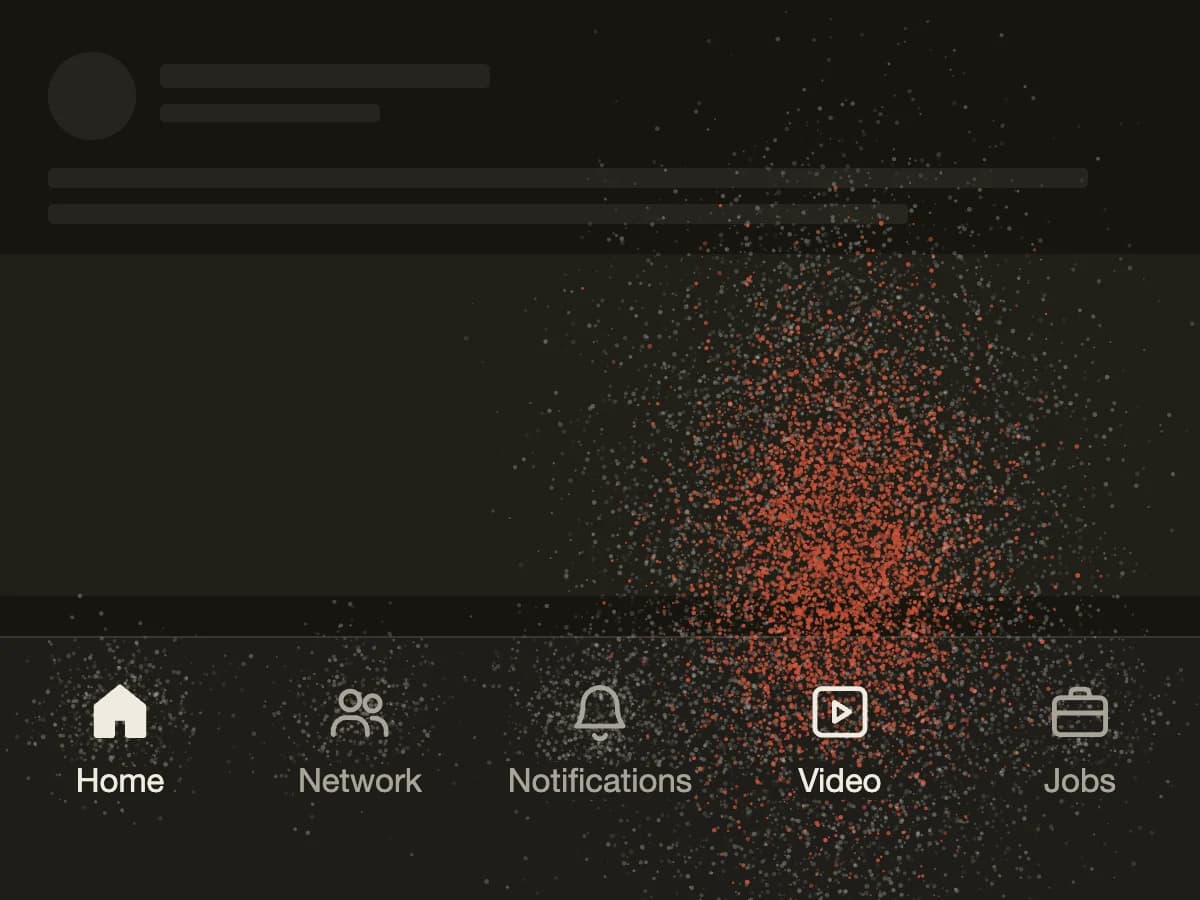
Did you notice something different on LinkedIn's mobile nav bar?
Where the Notifications button used to be, there now sits "Video." Notifications is still there, just shifted over one space. It seems simple, but it's most definitely a strategic and calculated decision, which I'll get to a bit later.
I thought for sure this was a brand-new feature, but after a bit of digging, it's more of a comeback, if you can call it that.
LinkedIn first tested the Video tab in 2024 and rolled it out more broadly a year later, in 2025. It was then pulled back, with LinkedIn saying it was testing different video placements to see what drives more viewing.
So now, in October 2026, LinkedIn hasn't just brought the Video tab back. It's positioned it in arguably the number one spot, right where Notifications used to sit.
LinkedIn did flag the return, quietly. Back in May, its Creator Video newsletter said the tab was coming back to more markets, starting with Canada, the UK and Australia. But unless you're reading creator newsletters, you probably found out the same way I did: by tapping where Notifications used to be.
That said, let's take a step back and note a couple of things. Video posts have been a big part of LinkedIn for years, and they still show up in the main feed. What's new is the Video tab itself: a separate, mobile-only feed of short-form vertical videos, rather than something merged into the main feed. So while this feels like a real shift, it doesn't mean LinkedIn is moving away from text-only posts, newsletters, articles and the like. It's simply a clear signal that LinkedIn is putting real attention into short-form vertical video.
Hijacking muscle memory
The UI positioning is what first caught my attention. What LinkedIn did is essentially hijacking muscle memory. Users are so used to opening the app and tapping Notifications that swapping the function with little fanfare, and without adjusting the space, is almost certain to push traffic to the new area.
The "new" section works much like Instagram Reels and TikTok. Different type of content, naturally, but the swipe motion and basically the entire UI are the same.
What could be driving LinkedIn to make this change?
We can only speculate, but here are some potential reasons the folks at LinkedIn brought Video back and gave it such a prominent position.
1. Following their research
Based on their earlier testing, user patterns, and what they're seeing more broadly in the market, LinkedIn clearly has enough data in favour of a dedicated destination for video. And the numbers seem to back that up: during the first round of the Video tab, LinkedIn's Director of Product, Lakshman Somasundaram, said video watch time on the platform had grown 36% over the past year.
2. The anti-AI shield
Anyone on LinkedIn these days sees a steady stream of polished (or purposely unpolished) AI posts and images. We've all been curious how the platform would deal with it. Will it detect and deprioritize posts that seem AI-written? Will we, the users, do the policing ourselves with the "Seems like AI Slop" button?
It's quite possible LinkedIn sees video as a countermeasure to AI slop. Sure, AI can create video, and it's getting better fast. But for now, a real person talking to camera is still much harder to fake at scale than a well-written post, which makes video a stronger signal that there's a human on the other end.
3. Tailoring the app experience for mobile
LinkedIn's own figures showed 60% of members visiting on mobile as far back as 2016, and more recent estimates from B2B data firm Cognism put it at nearly 70%. Prioritizing the video feed this way not only tailors the app to the mobile experience, it also further encourages users to create content in this vertical format.
4. A new stream of ad revenue
Video is already paying off for LinkedIn's ad business. On Microsoft's January 2026 earnings call, CEO Satya Nadella said paid video ads on LinkedIn grew 30% year-over-year. A dedicated, scrolling video feed gives LinkedIn a whole new stream of ad placements to sell.
What does this decision mean for LinkedIn users?
When platforms like LinkedIn make changes like this, users respond quickly: either they take to the feature or they don't. But these moves are rarely a gamble. They're highly calculated, made with a pretty good sense of how people will react.
Look at Reels on Instagram, carousels on LinkedIn, or Shorts on YouTube. Whenever a platform opens up a new way to share content, creators adapt and take on the challenge, hoping it pays off in visibility.
And this isn't just another place to post. LinkedIn already supported video, but when a platform makes a product change like this, even to bring back an old feature, the new format usually gets some kind of favouritism. Exactly what that looks like is up to the people at LinkedIn, but the goal is for creators to feel rewarded for making more 9:16 vertical videos, which fill the feed, draw more attention to it, and, of course, give advertisers a reason to spend money there.
Of course, not everyone will welcome this. Plenty of people open LinkedIn to check notifications, reply to messages and keep up with their network, not to scroll. For them, a video feed sitting where their thumb expects Notifications can feel less like a new feature and more like a nudge they didn't ask for, especially since there's currently no way to turn the tab off.
That's LinkedIn's side of it. But step back, and there are a lot of people who have ignored video on LinkedIn, partly because of the friction of production, and partly because short-form video felt like an Instagram or TikTok thing. LinkedIn is a business, professional platform, so where would these videos fit? I think this plainly shows that while LinkedIn may be B2B in nature, the lines are blurring in how people want to consume content across platforms. Business owners and decision-makers are leaning into video, and not just by producing it. They're consuming information through video, too.
It's worth noting, though, that LinkedIn built Video as its own tab rather than blending it into the main feed, so the audience you've built through text posts and carousels won't automatically follow you there. If you're looking at this as a new avenue, I wouldn't abandon what's already working, but I would add video to the mix.
So whether you're a creator or just someone who posts on LinkedIn, I'd take this as a sign that video deserves real experimentation, and real time and resources. To me, that's the most significant takeaway.
Twice a month we meet for a live session. I work out your message with you and turn it into short videos for the people you want to work with.
Book a call →Questions people ask
Is the LinkedIn Video tab new?
No. LinkedIn first tested a Video tab in 2024, rolled it out more broadly in 2025, then pulled it back to test other video placements. In October 2026 it returned in the mobile nav bar, in the spot where Notifications used to be. LinkedIn's Creator Video newsletter said in May that it was coming back to more markets, starting with Canada, the UK and Australia.
What is the LinkedIn Video tab?
A separate, mobile-only feed of short-form vertical videos that you swipe through, much like Instagram Reels or TikTok. Video posts still appear in the main LinkedIn feed as well.
Why did LinkedIn put Video where Notifications used to be?
LinkedIn hasn't said exactly why. Likely reasons include its own testing data, video being harder to fake with AI than text, most members using LinkedIn on mobile, and a new place to sell video ads. The placement also uses habit: people used to tapping Notifications now land on Video.
Can you turn off the LinkedIn Video tab?
Not at the moment. There is currently no setting to remove the Video tab from the mobile nav bar.
Should B2B founders post vertical video on LinkedIn?
It's worth experimenting with. The Video tab is its own feed, so the audience you've built through text posts and carousels won't automatically follow you there. Keep doing what already works and add vertical video to the mix.