The interview
We talk about how to tell real demand from polite interest: why enthusiasm on a sales call tells you almost nothing, what the PULL framework looks for, who does the work in a deal that has pull, and why trying to create pull with content is a dangerous game.
Edited for length and clarity. Times play the video from that point.
Two years pushing a product nobody bought
Justin Could you walk us through a little bit what that scenario was where you were kind of pushing the product? Give us a little background on that experience.
Rob It was an employee scheduling tool for hourly workplaces. We had done a bunch of research, done a bunch of customer interviews, we had secured design partners, we had built it, and design partners were super interested in it, and they were using it every single day, getting real ROI out of it. And then we tried to sell it and nobody would buy it. It was super confusing because they all complain about their current scheduling process. There was clear ROI, we had a differentiated product, and I felt like I was losing my mind as I cycled through sales book after sales book, sales advisor after sales advisor, sales hire after sales hire, and nothing worked.
Why enthusiasm isn't a buying signal
Justin Knowing what you know now, are there signs that you wish you paid attention to?
Rob Enthusiasm is a really, really unhelpful signal. When I would have a call with a potential customer and they were enthusiastic, I took that to mean predictive of purchase, likely to buy. And it is basically irrelevant. What I was experiencing was people were enthusiastic and talking about pilots, but they kept kind of getting delayed.
I interpreted all of that as these are just the normal things. These are sales problems versus something upstream of that. If somebody could have just shaken me at that moment and given me a different way of seeing the situation, I probably would have saved a couple months and many, many brain cells.
How to test demand before you build
Justin I work with a lot of founders who are at that stage where they believe in their product, but they haven't crossed that threshold of traction. What can I do so that the data isn't just enthusiasm but there's something that is concrete? What are some of those signals that I could pay attention to?
Rob If you read about how Bill Gates started Microsoft, he called up whatever the company was in Albuquerque and said, will you buy this? I haven't built it yet, but will you buy it? Yeah, if you bring it to me and it works, I will buy it. And so just do that. We don't need all these fancy, fluffy, kind of like experimentation approaches.
Just need to figure out, is there somebody right now who is stuck, who will buy it, commits to buy it, ideally proves to you that this is so important to them that they will buy it before you have built it? That's the gold standard. If I'm in your shoes, not wanting to waste the years of my life, I'd be skeptical of anything short of that.
Is there somebody right now who is stuck, who will buy it, commits to buy it?
Justin It feels like it's kind of the Kickstarter model that you're applying to B2B world. You get people putting their credit card down before the product is even finished being built.
Rob I've seen people put even credit cards, purchase orders down for things that don't exist yet in deep tech and hardware, and obviously B2B software, AI stuff as well. What you're doing is you're testing to see if there is enough stuckness, unacceptable stuckness in their world before they know about you, such that they are willing to commit to doing something.
The PULL framework
Justin I know this is the Power of Pull, pull versus push, but knowing whether you're pulling versus where you're pushing maybe isn't as simple as it sounds. What is this pull method?
Rob It's an acronym for letters P, U, L, L. It says what's going on in a customer's world before they know you exist that causes your product to be relevant. If they have pull before they know your product exists, then when you show up, they're going to rip your product out of your hands. They're going to try to pre-order. They're going to say, how do I get started right now? If they don't have pull, it's weird if they buy from you.
When you show up, they're going to rip your product out of your hands.
It's all about what's going on in their world, again, before they know you exist. They don't wake up thinking, if only today I could have agentic workflow software. Nobody's ever thought that in the history of the world. Nobody's ever wanted a CRM. So there has to be something they're trying to do that they're unable to do with their available options. P is for project. U is for unavoidable. They're trying to do that right now. They have to do it. The first L is list of options, the way they could try to get the project done, and the second L is for limitations. Those options they have available to them are unacceptable to them in some way.
Pull or push: who does the work?
Justin I do want to have pull. I don't want to be pushing. How do I know if I'm doing more pulling versus pushing?
Rob You can determine if you have more pull than push based on who initiates the next step in a sales conversation. Who exerts the effort to buy? Is it mostly you following up and twisting arms and doing a bunch of calls and begging and throwing in a bunch of incentives? That's you pushing. If it's them, the potential customer on the other side, saying, Okay, Justin, shut up. Please stop talking. We need to move forward on this, so here's what I need from you. They are pulling you in. You have pull when the buyer is exerting most of the effort.
You have pull when the buyer is exerting most of the effort.
Getting known vs. closing deals
Justin When you're unknown, you're putting out your narrative, letting people know you exist. Is that fair?
Rob I distinguished between what's happening between you and I on a sales call versus what I'm shouting into the void online. I care primarily about what's happening in a sales conversation. And then we take what we learn from that, and then we can put it out into the world. I've seen people closing deals on their LinkedIn, on their profile, they have no website, closing deals with big companies because there is so much pull present with somebody in that big company.
Rewriting the book five days before the deadline
Justin I think you were like literally days before bringing it to the publisher, and you discovered this pull acronym. How did you come across this?
Rob That was nuts. So good friend named Gorick, who's also written a book, way better book than I've written, and he was kind of like helping me throughout the process of writing this. Five days before the book was due to the publisher, he texted me. It was a Sunday. He's like, you know what? You really should have an acronym. What if you did something with the word pull? And when he said it, I knew it was obviously right. I had a framework, but it wasn't a catchy framework. And so yeah, I rewrote the book with five days left. And actually, our daughter came three weeks early. And so I submitted the final draft of the book in the hospital just before baby came.
Writing to solve a mystery
Justin You've definitely amassed a following. Was there a specific positioning strategy? How did you go from kind of zero to where you are now?
Rob I really never wrote online very much. I started writing a newsletter during COVID just to be like, what the heck is this? I have this sense that there was something missing in how we think about startups. And it kind of didn't work for a while and then started to slowly tick up.
At some point I cared about the stats on things and I've just stopped caring about any of that now. I'm trying to solve a mystery, which is like, why do startups take off? Why do people buy things? What is product market fit? How does this thing we call a startup work? I think most people don't realize it's a mystery. Everything I write is just the exhaust of the thinking I'm doing.
Why our go-to-market instincts are backwards
Justin The conclusion I keep coming to is it is hard. Is it just like there's no secret? Or is it a bit of a mix where you have noticed some things that make it easier for founders?
Rob I have seen that most of our intuitions about go-to-market and sales and product market fit are exactly backwards. We tend to think I can convince you to buy my product, or you will buy my product if it provides XYZ value. All of these things are the reasonable ways of thinking about things that are entirely backwards.
The ways that we are approaching sales calls, for example, guarantees we don't learn. The way that we send outreach guarantees that we get middle fingers instead of meetings. We just have the wrong theory about what we're doing. I believe you will meet with me because blank. I believe you will buy from me because blank. And our theories on those are wrong. When we get them right, we at least have a chance of winning. And it's still hard in that case.
The way that we send outreach guarantees that we get middle fingers instead of meetings.
What Rob is thinking about now
Justin What are you kind of ruminating on these days?
Rob One is how to very quickly build the intuition, the way of seeing how the market sees. The other, and I'm working on a blog on this today, is how do you make other people comfortable telling you the truth in a sales call? And then, how does pull work across scale? For a startup to grow fast, a lot of people have to have pull. Claude Code, for example, early adopters were shouting about it and put other people into a situation where even if they didn't want to adopt AI for coding stuff, they were forced to.
Can content create pull?
Justin Content is a big part of what I do. What role does content play in the pull? Does it help generate pull?
Rob What I've seen is that it's a very dangerous game to try to generate pull. Especially in the early stage, your goal is to find people who already have pull who don't know that you exist, such that when you show up, they rip your product out of your hands. They might be ahead of other people in a timeline. They may be six months ahead of the rest of the market.
Once you understand that reality out there in the world, then you can put content out there that says, Hey, here's the sign, are you seeing the signpost? But if you try to create pull, you're like, here's how I believe the world should work. You wind up just shouting into the abyss and being annoying.
If you try to create pull... you wind up just shouting into the abyss and being annoying.
It always comes back to talking to customers
Justin Pick up the phone, call them, and ask them, will you buy? The answer that keeps coming up is talk to your customers, talk to people. There's no other way to know where you fit, what your messaging should be, your positioning.
Rob The reason for that is that there are infinite things that you can come up with that makes sense in your head that do not actually exist in reality. And so by default, if you go to your head or you just think about it hard, you will not find something that exists in reality.
Where AI fits in a buyer's options
Justin Let's take AI as a general topic. What is going through your mind?
Rob What I'm seeing is that AI is one of the things on the list of someone's options now, that allows them to do something themselves. Do it yourself with AI is increasingly a good option for a large part, not all of the market. You have to find the places where people do not want to DIY with AI or they've tried to DIY and it's not good enough.
Wrapping up
Justin Rob, it's such a pleasure. I feel like we could keep going on and on. Thank you for joining today's episode.
Rob Yeah, it's been awesome.
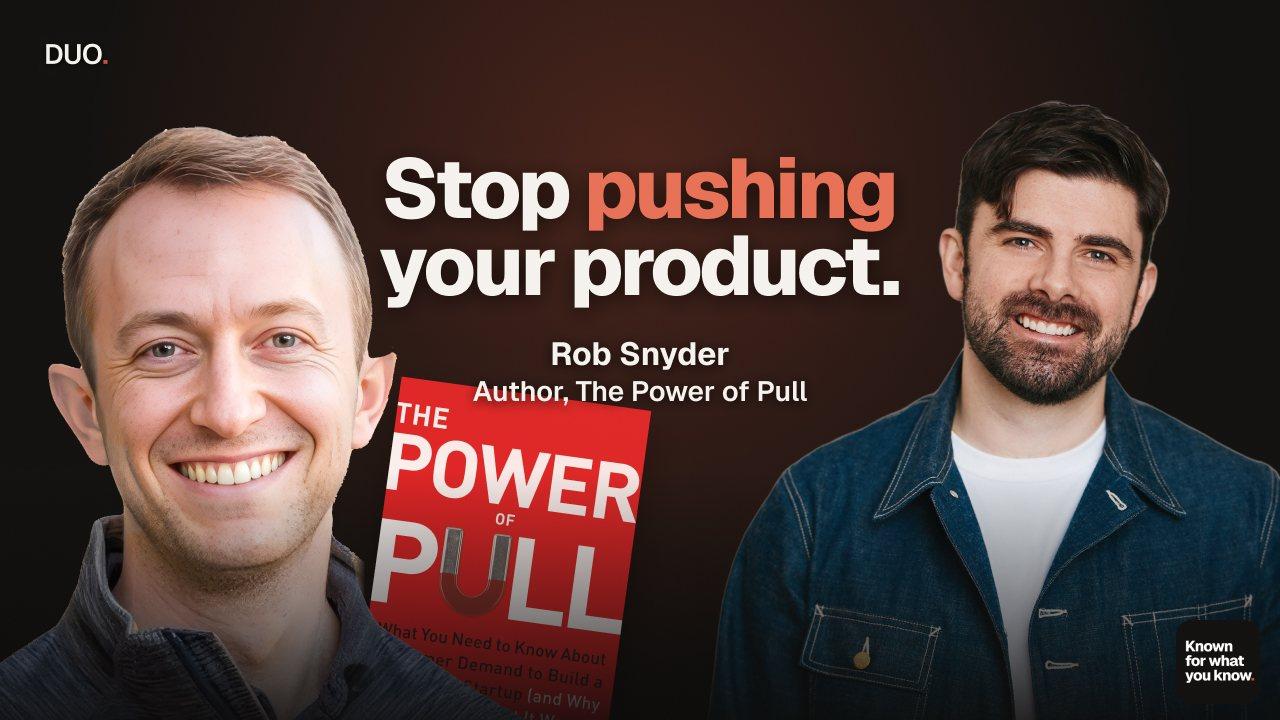
Rob Snyder is the author of The Power of Pull.
Full transcript
Rob They don't wake up thinking, if only today I could have agentic workflow software. Like nobody's ever thought that in the history of the world.
Justin I'm with Rob Snyder. Rob has advised more than 50 startups on getting from zero to a million in revenue. He knows the other side of that too. As a founder, he spent two years pushing a product the market didn't want before stumbling onto what actually works, finding customers who already need what you're selling instead of trying to convince them. He turned that into a framework called Pull, a book, The Power of Pull, and a newsletter, The Physics of Startups. Rob, it's so great to have you on today's episode. Thanks so much for joining.
Rob Yeah, thanks for having me.
Justin So I think, man, we see the book behind you, The Power of Pull. I think this is a great spot to start, which is that story of when things maybe weren't working as good as you thought they were. So could you walk us through a little bit what that scenario was where you were kind of pushing the product, so to speak? What was that? Give us a little background on that experience.
Rob Yeah, so it was an employee scheduling tool for hourly workplaces, and so we had done a bunch of research, done a bunch of customer interviews, we had secured design partners, we had built it, and design partners were super interested in it, and they were using it every single day, getting real ROI out of it, and so in our mind, it was like, Cool. are all the things you do before you get to hockey stick growth and then we tried to sell it and nobody nobody would buy it and we it was super confusing because they all complain about their current scheduling process they'd all complain about all these different things there was clear ROI we had a differentiated product and I felt like I was losing my mind as I cycled through sales book after sales book sales advisor after sales advisor sales hire after sales hire and like nothing worked and so we just kind of started pivoting around aimlessly and I think of it as like flopping around it was just like nonsense and so it actually felt like I was losing my mind.
Justin If you went back to that experience like is there something you wish you noticed sooner or did sooner? I think it's you know we have to we have to experience these things it's not like you can we can avoid struggle but knowing what you know now like are there signs that that you wish you paid attention to?
Rob Yeah, I'd say there's a couple like enthusiasm is a really, really unhelpful signal. And so when I would have a call with a potential customer and they were enthusiastic, I took that to mean predictive of purchase, likely to buy. And it is basically irrelevant. And so what I was experiencing was people were enthusiastic and talking about pilots, but they kept kind of getting delayed.
And to me, it was, well, they're enthusiastic, real value, like all of these things. And I just didn't have the right way of seeing the situation. So I interpreted all of that as these are just the normal things. These are sales problems versus something upstream of that. And so if somebody could have just shaken me at that moment and given me a different way of seeing the situation, I don't know how long I would have saved in the pancake, but I probably would have saved a couple months and many, many brain cells.
Justin If I'm a founder, I mean, I work with a lot of founders who are at that stage where they believe in their product, but they maybe are at that point where they haven't crossed that threshold of traction. It's tough though, because part of a startup or being a founder is like you need to have a period of not push because I know there's a word, but you need to be believing in yourself before maybe there is revenue or there's material growth. What can I do so that the data isn't just enthusiasm but there's something that is concrete that I'm like, Okay, there's something here that's worth investing more in because it's more concrete than that.
What are some of those signals that I could pay attention to?
Rob Before we had all these kind of fancy approaches to startups like the way that people did things where they went out there like Bill Gates if you read about how Bill Gates started Microsoft he called up you know whatever the company was in Albuquerque and said hey would you buy that like will you buy this like I haven't built it yet but will you buy it yeah if you if you bring it to me and it works I will buy it and so just do that it there's you know we We don't need all these fancy, fluffy, kind of like experimentation approaches.
Just need to figure out, is there somebody right now who is stuck, who will buy it, commits to buy it, ideally proves to you that this is so important to them that they will buy it before you have built it? Like that's the gold standard. Anything less than that is, if I'm in your shoes not wanting to waste my life, the years of my life, of my prime, uh, I'd be skeptical of anything short of that.
Justin It feels like it's kind of the Kickstarter model that you're applying to, to, I don't know, like B2B world. It's like you get literally people putting their credit card down before the product is even finished being built. Of course, you're not going to get that level of commitment, but it's very similar. It's like show the person what you are intending to build and see if they have a real enough commitment that they will actually invest in it. I mean, it's simple but it's not even it exists already in other in other business worlds
Rob Totally and I've seen this by the way I've seen people put even credit cards now purchase orders down For things that don't exist yet in deep tech and like hardware in all these kinds of spaces Um, and obviously B2B software, AI stuff as well. It's it is what you're doing is you're testing to see if there is enough stuckness, unacceptable stuckness in their world before they know about you, such that they are willing to commit to doing something.
And that requires a kind of different orientation, a different way of seeing, a different way of engaging with potential customers.
Justin And that sounds, it makes sense. It sounds rational. It sounds simple in essence. And I know this is the Power of Pull, pull versus push, but I feel like there's probably so much nuance there where knowing whether you're pulling versus where you're pushing maybe isn't as simple as it sounds based on the two words. So maybe this is, I know you've talked about like on Lenny's podcast, for example, you really went into the depths of the pull method, but could you give us, because not everyone maybe has listened to that episode, could you give us like a short snippet of what that is. And for everyone, anyone who wants to dive in more, I mean, you have your book, you have that podcast, so there's different ways that they can dive in. But what is this pull method and maybe like the pull versus push element there?
Rob Yeah. So it's a pull framework is an acronym for letters P, U, L, L. We can talk about them, but it says what's going on in a customer's world before they know you exist that causes your product to be relevant. If they have pull before they know your product exists, then when you show up, they're going to rip your product out of your hands. Or even if it doesn't exist yet, they're going to rip the concept out of their hands. They're going to try to pre-order. They're going to say, how do I get started right now? If they don't have pull, it's weird if they buy from you.
And so it will feel like you are pushing on them. And so it's all about what's going on in their world, again, before they know you exist, they don't wake up thinking, you know, if only today I could have agentic workflow software. Like nobody's ever thought that in the history of the world. Nobody's ever wanted a CRM. Like these things are just weird. So there has to be something they're trying to do that they're unable to do with their available options. And that's the pull framework. P is for project. There's something. U is for unavoidable. They're trying to do that right now. It's unavoidable. They have to do it.
The first L is list of options, the way they could try to get the project done, and the second L is for limitations. Those options they have available to them are unacceptable to them in some way,
Justin Okay. I'm a founder. I'm listening to this. I'm like, Okay. I like a good acronym. That makes sense. I do want to have pull. I don't want to be pushing. How do I know if I'm doing more pulling versus pushing? Is it obvious, or are there things that I can ask myself?
Rob Yeah, so you'll you can determine if you have more pull than push based on who initiates the next step in a sales conversation. Who exerts the effort to buy? Is it mostly you following up and twisting arms and doing a bunch of calls to get them to show up to the next day and begging and throwing in a bunch of incentives and we can just start free and like all that kind of stuff? That's you pushing. If it's them, the potential customer on the other side, saying, Okay, Justin, shut up.
Please stop talking. We need to move forward on this, so here's what I need from you, and can I bring you to X? Like, they are pulling you in, and it's basically there's some amount of effort required to get a deal done that is split between the seller and the buyer. Pull, you have pull when the buyer is exerting most of the effort.
Justin Is it fair to say though with the go-to-market when you're unknown there's a little bit of Not push, but you're putting out your narrative Maybe that's a better way to say letting people know you exist But ultimately when someone does understand what you do what you saw then that pull to push becomes quite apparent and whether You know, they really want what you're what you're offering or not. Is that fair like
Rob Yeah, so I distinguished between what's happening between you and I on a sales call versus like what I'm shouting into the void online, or whatever, like there's a slight difference there. So I care primarily about what's happening in a sales conversation. And then we take that, what we learn from that, and then we can put it out into the world. And yes, you have to put out, you have to like, but I've seen people who just have still founder closing deals on their LinkedIn, on their profile, they have no website, closing deals with big companies because there is so much pull present in those big company with somebody in that big company.
Justin There's an interesting story that I came across and related to you with this book that you had written this book, I think you were like literally days before bringing it to the publisher. Yes. And then you would discover, I think it was with someone else in collaboration as well, but you discovered this pull acronym, that framework, you're like, this has to make it into the book. What was like, how did you come across this? And that's a big decision, you know, to say whatever in a few days to say, we must bring this in and it's going to be permanently like stamped into the book.
Walk me through that a little bit, that scenario.
Rob Yeah, that was nuts. So good friend named Gorick who's also written a book, way better book than I've written, but he wrote a book and he was kind of like helping me throughout the process of writing this. Again, five days before the book was due to the publisher, he texted me, it was a Sunday, I remember it. He's like, you know what? You really should have an acronym. And I was like, you know, like, don't do this to me. And he called me and walked me through like, you know, you really should have an acronym.
What if you did something with the word pull? And I was like, oh. And I just, when he said it, I knew it was obviously right. 'Cause I had a framework, but it wasn't a catchy framework. It was, you know, it was kind of project situation, options, like that kind of thing. he said it, I was like, okay, yeah, that's it. And so I just knew that was it. And so yeah, I rewrote the book with five days left. And actually, our other part of the story is our daughter came three weeks early. And so I submitted the final draft of the book in the hospital just before baby came. So that was a fun week.
Justin Did you rename the book too, to incorporate pull?
Rob Yes.
Justin Cool. Well, I love it. I love a quick pivot where with so much conviction under short notice, we got it. We have to add it in. Super interesting. In terms of pivoting a little bit to, which is related because personal branding, building your brand, definitely the book you're writing as part of that, your newsletter, your podcast, your social media activity, personal brand, you've definitely amassed a following. People that listen to you, respect what you say. authority. What's that process? Because a lot of times you look at the people look at the end goal, they're like, Oh, I want to get to that point. But you started from somewhere you had to start from the beginning. And there's a journey.
Was it calculated? Was there a specific positioning strategy? Like, how did you go from kind of zero to where you are now?
Rob Yeah, so I really never wrote online very much. I like had a little newsletter for just a couple friends as I was trying to understand why my startup wasn't working then worked. It just like didn't make any sense to me and so I started writing a newsletter during COVID just to be like what the heck is this? What's going on? But yeah I didn't write online but I have this sense that there was something missing in how we think about startups and that just is so interesting that I started writing about that and just kind of writing whatever came to mind about that.
And it kind of like didn't work for a while and then started to kind of like slowly tick up. And at some point I cared about the stats on things and I've just stopped caring about any of that now. And instead what I've found is that I can't really think about the writing or about the audience or about like any of those kind of the content type things. I'm trying to solve a mystery, which is like, why do startups take off? Why do people buy things?
What is product market fit? And how does this work? How does this thing we call a startup work? And I think it's a mystery. And I think most people don't realize it's a mystery. And I think there's a lot of nonsense out there. And so I am just in pursuit of this thing, which is upstream of everything else. I'm trying to figure this thing out. and everything I write is just the exhaust of the thinking I'm doing um and it and so it takes me very little time to write and it's and I don't really care that much and I don't think about my positioning or I'm not very deliberate about positioning I all I think about is like there's this thing out there that I'm trying to figure out and I'm just gonna keep doing that and basically if you I would keep I I wish I could not do that it would be great if I didn't have to do this if somebody else would do it or if I could just like have a normal job in life. But I have to do that and that's what all of this stuff comes out of.
Justin It's interesting. It's kind of refreshing to hear that you know, it's upstream. It's a pursuit that you're never going to really like hold on to me. Like I figured it out. It is there because in this world that I operate to, which is the content, a little bit of GTM positioning, it's like I feel like the more I dive into it, not the less I know, but the conclusion I keep coming to is it is hard. It is so difficult.
I haven't figured it out in terms of this. It just feels like you need to continually explore and listen and pivot and explore, listen, pivot until something tells you that it's working and it's worth investing more in that area, which is not really the answer that a lot of clients or company want to hear because they want the person to come and say, Oh, I can run this outbound strategy that you should see, you know, 30 leads in the first month and so on and we're going to ignite the fire, these things, but does that kind of align with what you're saying?
Is it just like there's no secret? I keep saying like secret sauce or that doesn't really exist or is it a bit of a mix where it is hard but you have noticed some things that have made it, you know, that make it easier, so to speak for founders.
Rob I have seen that most of our intuitions about go-to-market and sales and product market fit are exactly backwards. And so we tend to think I can convince you to buy my product, or you will buy my product if it provides XYZ value. All of these things are the reasonable ways of thinking about things that are entirely backwards. And so as I'm exploring this, what I'm actually looking for is to build a way to beam across an intuition, a way of seeing the world that makes building a startup way more intuitive, that makes go-to-market way more intuitive.
And so I just think we look at it wrong, and there are very many cases in which the ways that we are approaching sales calls, for example, guarantees we don't learn. way we're approaching marketing guarantees that we're shouting into the void or we're putting things out there that aren't the way that we send outreach guarantees that we get middle fingers instead of meetings right like there's there's all these different things that I think are downstream from the core like we have we just have the wrong theory about what we're doing and so that's what I'm in pursuit of there's a lot of tactics I found that generally work and might work in certain circumstances but not but that there's There's this underlying like, I believe you will meet with me because blank.
I believe you will buy from me because blank and our theories on those are wrong. When we get them right, we at least have a chance of, of winning. And it's still hard in that case.
Justin So it seems like in terms of your writing on social, a little bit is stream of consciousness or like what's kind of consuming you at the moment. So broad question for you, but what are you kind of ruminating on these days?
Rob A couple of things. One is how to very quickly build the intuition or to beam across the intuition from the way of seeing that we typically have to the way of seeing how the market sees, I guess, is a way to think about that. The other, and I'm working on a blog on this today, is how do you make other people comfortable telling you the truth in a sales call, in that kind of a context?
And then the other things that I'm thinking about are like the pull is something that an individual person has. The question is like, what's the path to pull? Do I have the, what's the path by which pull kind of comes together? And then how does pull work across scale? So it's an individual person thing, but like for a startup to grow fast, a lot of people have to have pull and there are effects, there are scale effects. So like, you know, Claude Code, for example, there was something that happened where early adopters were shouting about it and put other people into a situation where even if they didn't want to adopt AI for coding stuff, they were forced to, like the situation forced them to.
And so those are just all sorts of things.
Justin It's interesting to get a kind of a snapshot into what's going on in your brain. Content is a big part of what I do, the people, the audience of the series. What role does content play in the pull? Does it help generate pull? Or do you need to have a product or service already having pull and then content is the way in which you connect with your audience, let them know you exist, educate them. What's your kind of general thoughts, I guess, on the role of content?
Rob Yeah, what I've seen is that it's a very dangerous game to try to generate pull. And specifically, especially in the early stage, your goal is to find people who already have pull who don't know that you exist such that when you show up, they rip your product out of your hands. to understand why they have pull. They might be ahead of other people in a timeline, right? They may be six months ahead of the rest of the market. They may be, right, like all these different things. And at which point you can kind of see what the journey is to put what are the signposts on the way to pull.
And at that point, once you understand that, that kind of reality out there in the world, then you can put content out there that says, Hey, here's the sign, are you seeing the signpost? Are you seeing this sign, but like that kind of thing. But if you're out there, just what I've found is if you try to create pull, you're like, here's how I believe the world should work. You wind up just shouting into the abyss and being annoying.
Justin It feels like you need to really understand your business, the positioning, what you offer, who you serve. And then the content is just like, hey, Rob, just want to let you know that I exist in case that's something, is that kind of fair?
Rob Yeah, I would say like the most important thing to understand is what's going on in the customer's world independent of you existing that's leading up to them buying?
Justin Got it. Yeah. And there's no other way to do that by having conversations. It kind of goes back to what you said, where I was asking, how do you know this? How do you know this? You're like, here's a wild thought. Pick up the phone, call them, and ask them, will you buy? The same thing is like, you have a customer, why did you buy? Someone interesting, why didn't you-- And Rob, I've done a number of these episodes and I've asked people in these kind of positions where they've seen so many companies and advise or been leading a company, the answer that keeps coming up is talk to your customers, talk to people.
There's no other way to know where you fit, what your messaging should be, your positioning. It's crazy. It's like the most simple straightforward answer, but it just keeps coming up over and over again where it's like, that's the root of kind of positioning, marketing, go to market.
Rob And the reason for that is that there are infinite things that you can come up with that makes sense in your head that do not actually exist in reality. And so by default, if you go to your head or you just think about it hard, you will not find something that exists in reality.
Justin Absolutely, especially that's when you're a founder or executive, it's lonely. Often you're sitting there with your thoughts and sometimes those thoughts are guiding your next business decision and that can be tricky. Couple questions more, one is around AI, we can't obviously go down to the extent, but similar to what the broad question asked earlier, let's take AI as a general topic, what is going through your mind?
Rob So with AI, what I'm seeing is that AI is a list of, is one of the things on the list of someone's options now, that allows them to do something themselves. Do it yourself with AI is increasingly a good option for a large part, not all of the market, and not all the different places, you have to find the places where people do not want to DIY with AI or they've tried to DIY and it's not good enough.
Justin Rob, it's such a pleasure. I feel like we could keep going on and on again. There's so many excellent nuggets. I just want to thank you for joining today's episode, sharing your thoughts. It's been a pleasure.
Rob Yeah, it's been awesome.