The interview
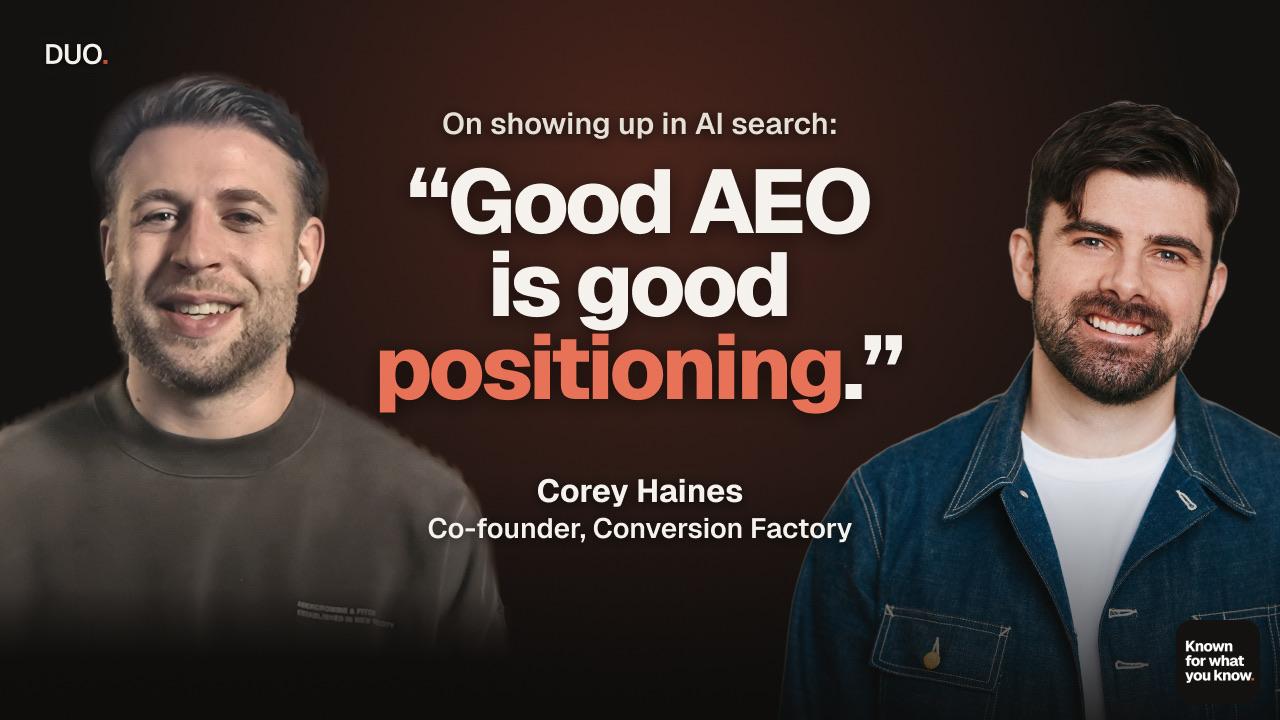
We talk about how AI is changing the way buyers find and choose, and what still works: why AI search checks your website against what others say about you, why good AEO is good positioning, how he tests a client's positioning with agent evals, and why the top AI recommendation takes most of the market.
Edited for length and clarity. Times play the video from that point.
From layoffs to Conversion Factory
Justin What were you doing that led you into that world and then co-founding a SaaS marketing agency?
Corey I've been working in marketing since 2016, 2017. I started as a junior marketing intern at a local startup here in San Diego, bounced around a couple of different times as like a first marketing hire, COVID happened, got laid off, did a bunch of consulting. That's when I started Swipe Files.
I was doing courses, ebooks, coaching, just trying to, one, share what I knew, two, make ends meet, three, see if I can make a business out of this. So I ended up going back in-house at a company. They promised the world to me, big budget, big vision, big team, the whole nine, and then nine months in after I did some digging, discovered that they were wildly unprofitable and were on the brink of basically going bankrupt.
And then me relaying that news to them got me laid off. And so at that point I was so tired of kind of getting burned and I just wanted to do good work.
About six months prior, I had been working with two of my friends on Webflow templates, like conversion rate optimized Webflow templates. And then when they laid me off, I was like, hey guys, what if we start an agency? And let's just give it a shot. And within a month, we were all working on it full time.
But frankly, I swore I would never start an agency 'cause I thought it was a horrible business, and it was only because of need and kind of this new productized AI first way of doing things.
Running an agency through the AI shift
Justin Now that you're in it, it just seems to be rapidly evolving. How are you addressing this as a business owner? There's certainly opportunities, but then there's new competition.
Corey It's been a roller coaster, and I think it has been for everybody. There's no business that's safe from AI. So as a service business, the way that we look at it is like, well, for one, this helps us because it helps us do our jobs better, faster, cheaper. We can deliver on a lot more for a lot less to our clients.
There's no business that's safe from AI.
Our leads kind of slowed down. A lot of the sales conversations were like, Oh, well, can I just automate this with AI? In fact, we even had a guy who was like, Hey, I have no idea what I'm doing in marketing. I need all the help I can get. Two weeks later on the follow-up sales call, he was like, yeah, so I built a whole marketing automation AI platform and I wanna invite you guys to be the first customers.
But then in like May, things turned around again. I think everyone realized, one, you still need a human in the loop. Two, they were putting out a bunch of slop that was really hurting them. And three, someone still has to oversee the AI. And in fact, that's like a whole skill in and of itself.
And so now we're basically positioning ourselves as like, hey, we're AI native, AI first. We're on the bleeding edge here. And ironically, a lot of our clients who are software companies, they're feeling pressure from AI. So now they're like, hey, we got to really push the gas pedal on marketing because there's 10 times more copycats and there's open source versions of our software now.
And so everyone's realizing now that because building products, building software is easier, marketing, the distribution, the audience, the go-to-market, that is the hard part. That's a lot more difficult to just spin up and to replicate. And so now there's really more demand than ever.
Computer use and browser agents
Justin Have there been recent developments with AI where you're like, Yeah, that's been a game changer for my business, or what we can deliver for clients?
Corey One of the big things that's just been a huge game changer is to be honest like computer use and browser use. I can't just tell the agent to build a script. I can't tell the agent to use the MCP of this tool. I needed to actually do something on my computer on a device. And in that way, computer use, particularly Codex computer use, and Claude browser use have been phenomenal.
For example, there's this old PR syndication site that we pay for to do AEO stuff for our clients. It's very tedious to fill out the forms and write the press releases. And so now I just tell Claude, Hey, use computer use. Open this in my browser, fill it out for me, here are the details, let me review everything. Me as a human being, I would have to do one at a time. As an agent, it can do 10 simultaneously.
Does your website still matter?
Justin I've been sort of brainstorming recently how things are changing based on my own use. What role does the website play now and how will it change over time? I know it's good to have a source of information for AI, but will we really need the user experience to be there?
Corey There's a lot of differing information going around about AEO, GEO, AI SEO, whatever you want to call it. A lot of it's conflicting, which I think is confusing for people. There was even a popular YouTuber who made a video, “your website is now obsolete,” and I was like, that is horrible advice. What I've learned too is that everybody thinks that they are an expert in AI because they use AI a lot, but they don't know how AI works or what an LLM even is.
Everybody thinks that they are an expert in AI because they use AI a lot, but they don't know how AI works.
There's actually a lot of studies that have come out super recently that have verified that there's a two-step cross-reference process for how LLMs ingest information about you or about your company or about your product. One is it's going to index and gather information from your website. So it's a primary first-party source of data. That is always going to be true. And then it's going to cross-reference that against third-party citations, against outside off-page Reddit mentions, PR blasts, backlinks, community discussions, review sites, things like that.
So when people say, Oh, you don't need your website anymore, that's because they think, Oh, all that matters now is third-party citations. Six months ago, everybody was like, You don't need third-party citations, you only need websites. They're both wrong. It's always going to be both.
For the app, however, I think that UI is taking a big downgrade in its importance and the user experience. I use every app now, not from the interface on the website. I don't care how the UI works. I don't care how it looks. I don't care what it does. It just needs to accomplish the end result of what the UI is.
Justin I was looking for a scheduling platform for my social media. I don't care about needing the visual UI. I just need something that can store the posts and schedule them. So my criteria has changed.
Reaching buyers: what hasn't changed
Justin There's so much noise, so much competition. What are you seeing out there in terms of generating that interest and distribution in this day and age?
Corey This might, I mean, may or may not be a hot take, but nothing has changed at all. Only like the medium, the place that people have the same kinds of buying behaviors have changed a little bit. From an inbound perspective, a lot of it has shifted away from Google and towards the LLMs, right? But it hasn't really changed because it's really the same kind of buyer behavior.
Now a lot of that top of funnel stuff is being handled by the LLMs. The difference there is that you're having a lot more in-depth conversations and that AI is grabbing a lot more data and information to make these comparisons. And it's super, super important to have your product marketing crystal clear. This is what I think a lot of people are missing about this whole AEO stuff, is like good AEO is good positioning.
Good AEO is good product marketing. If the AI can't understand exactly who you're for and why, and if the LLM can't understand your different feature suite and what's included on which plan and the prices, you're cooked. You're done. It's not even, you're dead on arrival, because that's how a lot of people are making these decisions now.
If the AI can't understand exactly who you're for and why... you're cooked.
Previously, that would have been a Google search. It wasn't even a search in the Claude web app. Well now that experience is gonna bias a lot more heavily towards basically developer friendly or developer first types of products. It's gonna go look at GitHub, it's gonna look for open source products. One of my tools, TrueList, I knew really, really early on, we need to be able to let people sign up for an account without going into their browser. Their agent should be able to sign up for an account, get an API key, and then be done. Because the less friction, the higher our conversions are gonna be.
Testing positioning with agent evals
Justin There's a lot of work that needs to happen before that, in terms of positioning, product market fit. When you're working with a company or even for your own self, how are you doing the positioning and then constantly evaluating that and pivoting? What are you looking for signal wise?
Corey One of the things you can do now is you can run what's called evals. So I just did this the other day with my Marketing Skills repo, where anytime that I make a change to the repo, I run that skill through evals, which basically spins out and spoofs as if someone were using the skill on their own on a blank computer. It records how it uses the skill, if it accomplishes the goals that I want it to, and then it gives it a score.
In the same way for positioning, I can make an update to a client's positioning. In other words, like the description, what the agent knows about it, what I'm telling it, how it compares to competitors. And then I can run these evals and see if the results are more or less favorable to my client from the agent's perspective.
I can basically keep tweaking the positioning until the agent does what I want it to. And now this is the winning positioning, 'cause now I know that the agent is in real life, in theory, going to favor my tool over these competitors, purely because of positioning.
I can basically keep tweaking the positioning until the agent does what I want it to.
That's not always true or possible. You also have to be really, really in sync with your product owner, with your product team, with your CTO, with your co-founder, and say, Hey, from a position perspective, this is how I think that we win. Here's the proof. When can we build out these features in order to make this true? Now let's march in that direction.
Content and AI visibility
Justin Your GitHub repo of 20,000 plus stars, that in itself is content. What role does content play now in the positioning, in the distribution, and separating one company from another?
Corey The more and better content you put out, the wider surface area you have for AI to be able to understand you, recommend you. If the agent has to choose between marketing consultant A and marketing consultant B, and marketing consultant A has written three blog posts and marketing consultant B has written 300 blog posts, which one seems more trustworthy? There is a factor here of like more equals better. Quality plays a huge part, and what you're trying to do is position yourself as an expert.
This is, I think, one of the harsh realities of this new AI-driven world, where it's not that it's a winner-takes-all market, but it's kind of a winner-takes-most market dynamic. If I'm in ChatGPT and I'm asking for the best AI social media scheduler for me, at the end of the day, it's going to make a recommendation for your top pick. And if you're not that one, it's really hard to get number one. And most people are going to trust the agent's number one recommendation for a tool. In the same way, for a consultant, for a plumber, for a fill in the blank, if you're not that number one recommendation, good luck.
One of my goals for my content is like, be the AI marketing guy, be the number one choice, be the number one voice in this field on this topic. So for content, that's like the whole game now, is building this expertise and doing whatever necessary to make sure that you're at the top of the list for when people especially come down to a buying conversation with AI. It doesn't matter if you're a person, a tool, a company, a service.
Wrapping up
Justin So there's a lot there, Corey. I feel like we could keep going. I really appreciate your time.
Corey Yeah, thanks for having me. Happy to chat anytime. People can feel free to find me basically anywhere and everywhere online, so don't be a stranger.
Corey Haines is the co-founder of Conversion Factory.
Full transcript
Corey This is what I think a lot of people are missing about this whole AEO stuff, is good AEO is good positioning. Good AEO is good product marketing.
Justin There's so much noise right now about AEO and how to show up when people ask AI what to buy and Corey Haines is right in the middle of it. I'm really excited to have Corey on today's episode. Corey is the co-founder of Conversion Factory, a SaaS marketing agency. He writes Swipe Files, a newsletter for more than 27,000 marketers. He built Marketing Skills, a free AI toolkit on GitHub with over 20,000 stars. So with that, let's get into it. Before Conversion Factory, I want to know how did that form?
What were you doing that led you into that world and then co-founding a SaaS marketing agency?
Corey Here's the non-PR friendly version in the open book version because the real story is that I've been working in marketing since 2016, 2017. I spent about 10 years, I started as a junior marketing intern at a local startup here in San Diego, bounced around a couple of different times as like a first marketing hire, had a marketing, had a growth, COVID happened, got laid off, did a bunch of consulting, That's when I started Swipe Files.
I was doing courses, ebooks, coaching, just trying to, one, share what I knew, two, make ends meet, three, see if I can make a business out of this. Kind of flailed around for a while and couldn't manage to really make a full-time business out of it. So I ended up going back in-house at a company. They promised the world to me, big budget, big vision, big team, the whole nine, and then nine months in after I did some digging, discovered that they were wildly unprofitable and were on the brink of basically going bankrupt.
And then me relaying that news to them got me laid off, which is great because they're like, Well, we can't afford you anymore. And so at that point I was so tired of kind of getting burned and I just wanted to do good work. And I wanted to work for myself but have like the flexibility to work on any other projects or things that I wanted to. And there was always this kind of weird like, oh, you know, if you're working for us, then make sure anything you do and you post, you run it by us and there's no conflicts and da, da, da.
So at the same time, kind of leading up to that, about six months prior, I had been working with two of my friends on Webflow templates, like conversion rate optimized Webflow templates. Because I kept seeing all these templates on there and we were all heavy Webflow users. We were like, these are beautiful, but these don't have any of the layouts that we need for an actually conversion optimized site. And then when they laid me off, I was like, hey guys, what if we start an agency?
And just instead of making templates, we can build websites for companies, we can do marketing, we can do design, we can have this whole kind of team in a box offer for them. And let's just give it a shot. And within a month, we were all working on it full time. So it worked out, feels super, super blessed. But I wish I could say it was like a part of my master plan and I had been dreaming of starting an agency forever. But frankly, I swore I would never start an agency 'cause I thought it was a horrible business and it was only because of need and kind of this new productized AI first way of doing things.
And this was even back in summer of 2023 that encouraged me to see if I could make it work and make it happen.
Justin Yeah, that's interesting. Like even loss of job and pandemic and certain events kind of guided you to this moment. Now that you're in it, I feel like there's, there's with AI, there's been another significant or even just AI in the last year, six months. Like it just seems to be rapidly evolving. How are you addressing this as a business owner? I mean, there's certainly opportunities, but then there's new competition. people are unable to do certain things themselves. Like how have you responded to that with your business?
Corey It's been a roller coaster, and I think it has been for everybody. You know, there's no business that's safe from AI. Even the AI companies, you know what I mean? They're all, it's very cutthroat, they're all hyper competitive. So as a service business, the way that we look at it is like, well, for one, this helps us because it helps us do our jobs better, faster, cheaper. We can deliver on a lot more for a lot less to our clients. And so I think that that's like a net win. And initially, there was definitely some talks about like, I would say like earlier this year, probably from like January to April of 2026.
Our leads kind of slowed down a lot of the sales conversations were like, Oh, well, can I just automate this with AI, you know, blah, blah, blah. In fact, we even had a guy who was like, Hey, I have no idea what I'm doing in marketing. I need all the help I can get to then two weeks later on the follow-up sales call. He was like, yeah, so I built a whole marketing automation AI platform and I wanna invite you guys to be the first customers. And we were like, dude, get out of here. Like, come on. And he never ended up shipping anything.
It was like, he was just automating building slides, basically like Google Slides. But then in like May, things turned around again. I think everyone realized, one, you still need a human in the loop. That's like very, very important. Two, they were putting out a bunch of slop that just wasn't resulting anything. In fact, was like really hurting them. And three, like someone still has to oversee the AI. And in fact, that's like a whole skill in and of itself.
And so now we're basically positioning ourselves as like, hey, we're AI native, AI first. We're on the bleeding edge here. I have this Marketing Skills repo, like we're the experts in this. And so if this is how you want us to execute marketing for you, then we can absolutely do that. And ironically, a lot of our clients who are software companies, they're feeling pressure from AI. So now they're like, hey, we got to really push the gas pedal on marketing because there's 10 times more copycats and there's open source versions of our software now.
And there's pressure. People are thinking about building this software internally, right? And so everyone's realizing now that because building products, building software is easier, marketing, the distribution, the audience, the go-to-market, that is the hard part. That's a lot more difficult to just spin up and to replicate. And so now, I mean, there's really more demand than ever. It's been a net benefit to us.
Justin Yeah, this, you know, use of AI, I think people say I use AI. I don't use AI as if it's a binary, but I've really committed to it over the last two years. And I'm constantly learning new ways to use it, implement it, going back and redoing things. It takes a lot of work, time, and effort to continually stay up to date. So I can see the value here. It's like, yeah, people do have access to AI, but to be able to kind of wield it in a really efficient, effective way, you know, unless you're spending all day thinking about it, yeah, go to someone that they built entire systems orientated to how to make best use, and also you're keeping up to date with the systems.
Have there been recent developments with AI where you're like, Yeah, that's been a game changer for my business, or what we can deliver for clients?
Corey Let's see, recent developments, I mean, this is going to age things pretty quickly, but I mean one of the big things that's just been a huge game changer is to be honest like computer use and browser use. So I mean there's lots of different ways to use AI, right? Like I can be in Claude Code and I can be telling the agent what to do and what to build. But and then there's like okay now I'm going to connect it to my tools and I'm going to either connect it via MCP, CLI, API, SDK, blah, blah, blah, blah.
But then there's still some things that you can't do in either one of those. I can't just tell the agent to build a script. I can't tell the agent to use the MCP of this tool. I needed to actually do something on my computer on a device. And in that way, like computer use, particularly Codex computer use and browser use, particularly Claude browser use have been phenomenal. For example, there's this old PR syndication site that we pay for to do AEO stuff for our clients.
And I mean, this is like really old school. Like it's basically still just all HTML. Like there's no way they have an API or an MCP or anything like that. And it's very tedious to fill out the forms and write the press releases and do all the different little tags that we need to do. And so now I just tell Claude, Hey, use computer use. open this in my browser, fill it out for me, here are the details, let me review everything, now let's make some updates, and it can do all those simultaneously.
So let's just say I have 10, me as a human being, I would have to do one at a time. As an agent, it can do 10 simultaneously. So I'm literally doing it 10 times faster with the agent, and I'm doing 10 at a time, which is like a 100x productivity improvement.
Justin Huge, I would say the same thing. I mean, there was a certain point where, I feel like MCP was the buzzword for AI users and it feels like it's not really as important anymore because now the way to connect Claude to whatever you're doing through browser use, for example, it's like, it's, it's easy to do whether there's an MCP available or not.
Corey Um, yeah, there are ways, there are ways. Same thing with Grokbot too. Like Grokbot has a server and it has a virtual computer and you can literally have it like log in to your tools on its computer and then it's clicking around on things for you. So like, yeah, there's a way to do everything now. It's not just MCP. I still think that that's super, super, like there's a time and place for each of those tools that are different, but yeah, MCP is not like the one I'll be all up by any means.
Justin I agree. I've been sort of brainstorming recently how things are changing based on my own use, like the website, for example, like is that still an important part of what you're doing for I mean, certainly conversion and the website, but I'm also thinking like, what role does the website play now and how will it change over time? I know it's good to have a source of information for AI, but will we really need the user experience to be there? Or can it just be like raw code on a site to give the information?
What are your thoughts around of this and how things are changing with the way information is accessed?
Corey Yeah. Right. This is an interesting one. glad you asked this because it's there's kind of two sides the same coin here one is the website one is like the app experience so for the website I mean there's a lot of differing information going around about AEO, GEO, AI SEO whatever you want to call it a lot of it's conflicting which I think is confusing for people something that was going around semi recently I would say there was even a popular youtuber who made a video and I was like your website is now obsolete and I was like that is horrible advice like you are literally asking people like you're telling people to shoot themselves in the foot basically because as an aside what I've learned too is that everybody thinks that they are an expert in AI because they use AI a lot but they don't know how AI works and or like what an LLM even is.
This is one of the things that back in 2023 when I first started using it, I also did a coding bootcamp. I'm like technical-ish, you know what I mean? I'm not like a software engineer, like a developer, but I understand all this stuff from like more of a first principles perspective. And when people talk about AI and how it works and oh, LLMs don't care about your website now, I'm like, you wouldn't say that if you actually knew how an LLM worked. And there's actually a lot of studies that have come out super recently that have verified that at least how an LLM works today, but probably how it's gonna work in the future, is that there's a two-step cross-reference process for how LLMs ingest information about you or about your company or about your product, whatever it is.
One is it's going to index and gather information from your website. So it's a primary first-party source of data. That is always going to be true. And then it's going to cross-reference that against third-party citations, against outside off-page Reddit mentions, PR blasts, backlinks, community discussions, review sites, things like that. And it needs to have both of those in order to make a confident recommendation or description of yourself, your company, or your product.
So when people say, Oh, you don't need your website anymore, that's because they think, Oh, all that matters now is third-party citations. Like six months ago, everybody was like, You don't need third-party citations, you only need websites. They're both wrong. It's always going to be both. It's a two, it's always going to cross-reference. And the methods it's going to cross-reference are only going to get more and more sophisticated as well. And they're going to change and evolve and adapt because the LLMs are in the same stage as Google was, maybe like 15 years ago, because it's an early product, it's an early search kind of experience, right?
If you wanna think about it that way. You used to be able to keyword stuff a page in Google and then trick it into thinking that this was the number one authoritative piece on X, Y, and Z. That's kinda how it is with LLMs, but still people are like, Oh, you only need to do this, you only need to do that. That's just not true. So anyways, that's one side of the coin for the website. Definitely still relevant. so are third-party citations. For the app, however, I'll say, I think that UI is taking a big downgrade in its importance and the user experience.
I use every app now, not from the interface on the website. I use the app via Claude or via Grokbot or via Codex, via MCP, API, or even computer or browser use. I don't care how the UI works. I don't care how it looks. I don't care what it does. It just needs to accomplish the end result of what the UI is. And I think that that's gonna be a big wake-up call because there's a lot of people that just fiddle over the product design and UX and UI.
And I think that now we have to, it needs to be balanced. Again, it needs to be both. 50/50, okay, it should really, There's a lot of people having an agent-first experience. Some people are still going to be using the UI, but it's not all UI-driven, and it's not that the UI is going to completely go away either. But there's definitely a shift going on on both sides.
Justin Absolutely. I was looking for a scheduling platform for my social media. There's limitations to how in advance you can schedule posts. I'm like, I don't care about needing the visual UI. I just need something that can store the posts and schedule them and connect to my cloud. So my criteria has changed. And in terms of setting it up, I don't even want to go on that website and have to enter my details. I'd rather just Claude already knows things. Maybe I securely will go and enter, you know, credit card details But even that now there's secure ways to do that where I'm not physically typing in the address like the experience changes But I'm sure I'm with you that the extreme advice from people who don't know the inner workings or how things are changing It can be misguiding for people like you don't want to shut down your website because some youtuber said There there's obviously a bit of catchiness that they're trying to do an engagement with with these posts Yeah, things are shifting and I think it's good to just pay attention to the shifts like anything else rather than commit to drastic changes.
From a conversion standpoint, what are you seeing when you're working with your clients that seem to matter more than other things these days from a conversion standpoint?
Corey A conversion standpoint, in other words like turning traffic into customers or just gathering any kind of attention and turning that into real users?
Justin That's a great question. I guess there's both sides to it. One is generating interest and the second part is turning interest into customers or paid users. So we can start maybe, timeline-wise, generating interest at this point. There's so much noise, so much competition. What are you seeing out there in terms of generating that interest and distribution in this day and age?
Corey Yeah, this might, I mean, may or may not be a hot take, but nothing has changed at all. Only like the medium, the place that people have the same kinds of buying behaviors have changed a little bit. From like a outbound perspective. In other words, I'm gonna take my product and company and I'm gonna put it in front of someone who's maybe a prospective buyer. That hasn't changed at all.
It's got a lot more competitive 'cause I think people are moving more towards that. So you see a lot of influencer campaigns. On Twitter, for example, there's all these launches that look organic, right? I feel like, oh, this is a new tool, this is a new model, this is a new whatever, a new AI, blank, blank, blank. And you're like, wow, this has 500 retweets and it has a million impressions. That's crazy, they're really good at marketing. It's like, yeah, they paid for all those retweets.
And I would know, because these companies pay me to do this too. And like there's, so I'm not knocking on it, it's not a bad thing, it's just their reality. So I think people are getting a lot more aggressive about getting in front of prospective buyers. From an inbound perspective, a lot of it has shifted away from Google and towards the LLMs, right? But it hasn't really changed because it's really the same kind of buyer behavior where people are going to move down the funnel from, you know, there's the Eugene Schwartz five stages of awareness, unaware, problem aware, solution aware, product aware, fully aware, unaware being like literally they have no idea they even have a problem or that your type of tool exists to fully aware being a customer of yours.
Usually someone would have typed into Google, you know, how to do X, Y, and Z that's somewhat adjacent related to what your product does. Maybe they stumble upon, oh, maybe I need a CRM for this, or maybe I need some kind of software that has this feature, now they're problem aware, now they're becoming more solution aware, so on and so forth. And that's just a series of Google searches, maybe YouTube searches, maybe something else, maybe, you know, Medium or social media, Reddit, that hasn't really changed.
Now a lot of that top of funnel stuff is being handled by the LLMs, that's not news to anybody. The difference there is that you're having a lot more in-depth conversations and that AI is grabbing a lot more data and information to make these comparisons. And it's super, super important to have your product marketing crystal clear. This is what I think a lot of people are missing about this whole AEO stuff is like good AEO is good positioning.
good AEO is good product marketing. Like if the AI can't understand exactly who you're for and why and if the LLM can't understand your different feature suite and what's included on which plan and the prices and how that can you know you're cooked you're done it's your it's not even you're dead on arrival because that's how a lot of people are making these decisions now it's even I I think one of my favorite parts about this whole shift now is stuff happening directly in the terminal where people are like, Hey, Claude, tell me how to automate scheduling my social media posts.
This is like a perfect example. Previously, that would have been a Google search. It wasn't even a search in the Claude web app. This was something maybe in your terminal in Claude. This was in my Claude Code. This is literally what I was doing. Yeah. Right. What is Claude doing in Claude Code in your terminal? Well now that experience is gonna bias a lot more heavily towards basically developer friendly or developer first types of products to fulfill this.
It's gonna go look at GitHub, it's gonna look for open source products, it's gonna in its criteria look for things that are conducive to the medium in which you are asking for this. And then it might even pull in something and be like, oh, here's this tool, it's Postiz, or it's Post Bridge, or it's Typefully. They have X, Y, and Z. Do you want me to set up an account for you? Cool, like, over one of my tools, TrueList, I knew really, really early on, we need to be able to let people sign up for an account without going into their browser.
Like, their agent should be able to sign up for an account, get an API key, and then be done. Because the less friction, the higher our conversions are gonna be people are actually activating here. So anyways, that's a long winded way of saying a few things about what's changed.
Justin I agree. Like when you're in the flow of work, when I'm working on the platform or doing something for clients and I just want to solve it, I don't want to go off on a tangent. Like I want to solve it then. So there's an opportunity there for businesses. If you can reduce the friction and someone's just like, yes, I committed this. If that solves me immediately, my problem and it does, then you're just going to get more signups. I love your point though about positioning. I think in the world of conversion, I would say it's similar for growth marketing where someone just says, Oh, we just have to tweak some things and then the flood of customers will just be entered into it.
Well, first, there's a lot of work that needs to happen before that like in terms of positioning, product market fit. When you're working with a company or or even for your own self, how are you doing the positioning and then constantly evaluating that and pivoting? Like what are you looking for signal wise?
Corey Yeah, for the positioning, I think that there are times where, okay, here's a really interesting way that we're doing this. So with this whole new AI first way of doing things, right? One of the things, I don't know if you've gotten this far into the rabbit hole. One of the things you can do now is you can run what's called evals. So I just did this the other day with my Marketing Skills repo, where anytime that I make a change to the repo, in other words, I'll update a skill, I run that skill through evals, which basically spins out and spoofs as if someone were using the skill on their own on a blank computer, in other words, not mine.
It's kind of unbiased, it's this new little vacuum environment for it to work within. and then it records. how it uses the skill, if it accomplishes the goals that I want it to, and then it gives it a score, like a quantifiable result. And that way I know, okay, let's just say for this skill, I want to make sure that this tool is called every single time, or as often as possible, because this is a really key part of using this skill.
Well, I can run the evals, and depending on what changes I make to the skill, I can see if it improves the tool call rate or if the tool call rate declines, right? In the same way for positioning, I can make an update to a client's positioning. In other words, like the description, what the agent knows about it, what I'm telling it, how it compares to competitors. And then I can run these evals and see if the results are more or less favorable to to do my client from the agent's perspective.
So now let's just say I'm a social media scheduler and I'm trying to compete with Postiz and Post Bridge. And I really wanna know, okay, what is the wedge? What is the thing that's really gonna tip the hand in my favor? I can basically keep tweaking the positioning until the agent does what I want it to. And now this is the winning positioning 'cause now I know that the agent is in real life, in theory, going to favor my tool over these competitors, purely because of positioning.
So, now that's kind of manufactured, right? This is like, if we could do anything, if we could build anything, if any of these things could be made true, then what do we do? What do we say? How do we position ourselves? That's not always true or possible. And again, this is why it's like two sides of the same coin. It's both. From a positioning perspective, You also have to be really, really in sync with your product owner, with your product team, with your CTO, with your co-founder, right?
And say, Hey, from a position perspective, this is how I think that we win. Here's the proof. Should we, can we, when can we build out these features in order to make this true? Now let's march in that direction. And so, and then the cycle repeats, right, where then competitors make some updates, They launch the new features, they change their prices, da da da. And we just keep doing that to try to stay ahead of it. But that's never really been true.
I'm even an investor in one of these companies called Winter where they do messaging testing for websites. So they're getting feedback about, Oh, it's just resonating with you. It's just confusing. How likely are you to book a call or send it for a free trial? So on and so forth. to quantify, is this better or not than the version before? This whole agent evals thing is a whole new playground for us to test and tweak positioning as well.
Justin Yeah. It sounds amazing. I mean, especially for the founder, the go-to-market person, there's budget, there's limited runway. The more you can to kind of shorten the window of data, like we know traditionally with websites, know, do it, keep it as it is for a prolonged period of time so you get enough data. But if you're a new startup, you're getting, I don't know, a few hundred visitors a week until you get enough content traction and it climbs.
So it could be a year plus before that data actually comes back and it's substantial enough where you can make changes. If you can shorten that window to literally a week, then all of a sudden new opportunities open up. One last question if I may to kind of explore, because I think it's relevant for you and for my audience in terms of the content space. You mentioned positioning, but content is often the way that we take that positioning and put it out to the public. If I look at even your own positioning, right, with the newsletter, even content these days is different.
Your GitHub repo of 20,000 plus stars, that in itself is content. That is now attached to your name. What role does content play now in the positioning, in the distribution, and separating one company from another? How do you approach it?
Corey Yeah, well content is for one, the more and better content you put out, the wider surface area you have for AI to be able to understand you, recommend you. It's basically like, it's kind of like one of these rules is alright, if the agent has to choose between marketing consultant A and marketing consultant B, and marketing consultant A has written three blog posts and marketing consultant B has written 300 blog posts, which one seems more trustworthy. The one with more content doesn't even matter if it's better content right but it's just there is a factor here of like more equals better. We've also seen that in web mentions and third-party citations where it's a pure volume play. So again if we're trying to like game the system here there's definitely something to just like content production volume that matters a lot. But I think the really like quality plays a huge part and what What you're trying to do is position yourself as an expert.
This is, I think, one of the harsh realities of this new AI-driven world, where it's not that it's a winner-takes-all market, but it's kind of a winner-takes-most market dynamic. In other words, if I'm in ChatGPT and I'm asking for the best AI social media scheduler for me. There's a couple of nuances in there, maybe about me, my budget, my use cases, but like at the end of the day, it's going to make a recommendation for your top pick.
And if you're not that one, it's really hard to get number one. And most people are going to trust the agent's number one recommendation for a tool. In the same way, for a consultant, for a plumber, for a fill in the blank, if you're not that number one recommendation, good luck. It's an uphill battle, right? And so, all right, one of my goals for my content is like, be the AI marketing guy, be the number one choice, be the number one voice in this field on this topic so that anything related to AI marketing that comes up, I want to be in the discussion, I want to be the recommendation, I want to be the most trustworthy choice and source of information.
So for content, yeah, that's like the whole game now is building this expertise and doing whatever necessary to make sure that you're at the top of the list for when people especially come down to a, you know, buying conversation with AI or some kind of evaluation of who to choose. It doesn't matter if you're a person, a tool, a company, a service. That same dynamic comes into play where it's a winner takes most.
Justin Yeah, and to your point about that first recommendation that ChatGPT or Claude gives, you generally want to take the top pick. It's convincing. They lay it out. But if you think about prior SEO would say, if you're not on the first page of Google, your chance of getting it. But even then you had a whole page and people would, I mean, I would, you would kind of be curious enough sometimes to scroll into page two and three and see, so at least in that environment, it's not like, yeah, your chance is higher if you're in the first two to three slots, but it's not zero.
Like you might get still picked up if you were, if your language resonates with a particular audience now with AI recommendations, if you're not the recommended choice, there's not this scroll ability, it will continue asking you questions before providing you, you know, further choices. So that makes, that makes a lot of sense and balancing to quantity and quality. And I think that's where someone with this knowledge of AI, you know, and marketing and positioning come in, because it's like, how do you, how are you building a system that's efficient that you can have high output while maintaining quality?
So there's a lot there, Corey, I feel like we could keep going because I've been so deep in this AI world where that's, you know, that's your whole thing. but I really appreciate you having you on. There's a lot of nuggets here that I look forward to kind of exploring after the call, but appreciate your time.
Corey Yeah, thanks for having me. Happy to chat anytime. People can feel free too to find me basically anywhere and everywhere online, so don't be a stranger.