
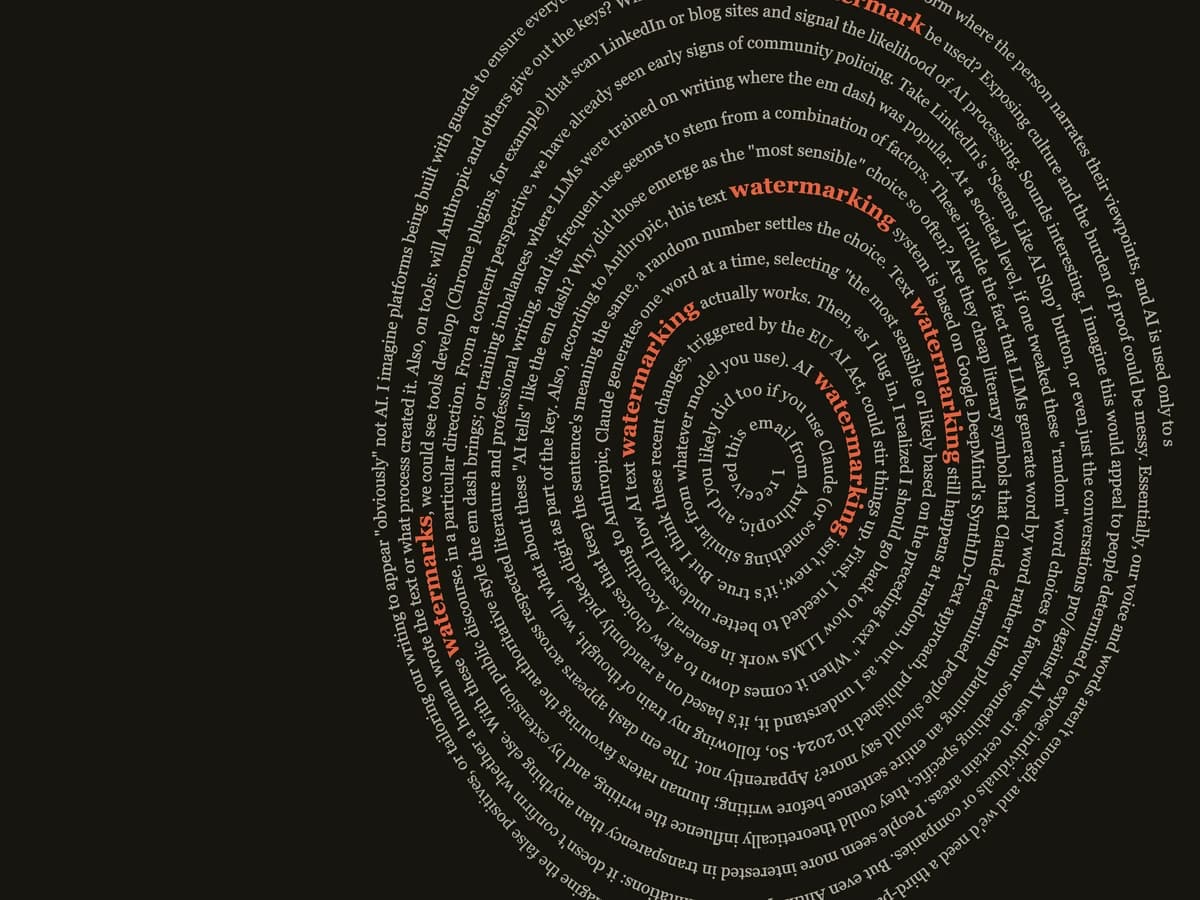
I received this email from Anthropic, and if you use Claude, you likely did too (other AI providers may send something similar).
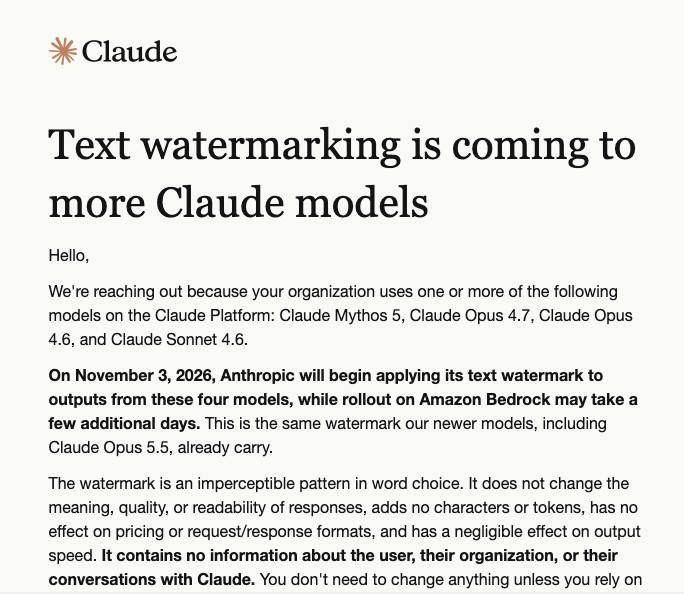
AI watermarking isn't new, and Anthropic's announcement explains its version in detail. But these changes, triggered by the EU AI Act, could stir things up.
What does the EU AI Act require?
The EU AI Act is the European Union's law on artificial intelligence, adopted in 2024. Article 50 covers transparency. It says providers of AI systems that generate text, images, audio or video must mark those outputs "in a machine-readable format" so they're "detectable as artificially generated or manipulated."
The rule applies from August 2, 2026. There's an exception for AI that performs "an assistive function for standard editing" or doesn't substantially change what you gave it. So a tool that tidies your grammar may not need a mark, while one that writes the text does.
Anthropic says it's adding the watermark to comply with the act.
How do LLMs generate text?
Before getting into watermarks, it helps to know how large language models (LLMs) like Claude write in the first place.
According to Anthropic, Claude generates one word at a time, selecting "the most sensible or likely based on the preceding text." Often there's more than one good answer. After "The sky was," the words grey, overcast and dark all work. The model gives each one odds, say 40% for grey, 35% for overcast and 25% for dark. When it comes down to a few choices that keep the sentence's meaning the same, a random number settles the choice.
That's why asking the same question twice gets you slightly different answers. The odds stay the same, but the roll doesn't.
How does AI text watermarking work?
Watermarking changes how the model makes that final choice. Instead of leaving it entirely to chance, it nudges the model toward one of the sensible options. In Anthropic's words, the watermark "uses the key and a few words that come before to settle what word the model should pick."
The key is a secret number. For each sensible next word, the model runs the key, the last few words and the candidate word through a calculation. The result is a score for that word, and the model leans toward the highest scorer.
Here's an example version you can check by hand. Turn letters into numbers (a=1, b=2, through to z=26) and make the secret key 7. The calculation: add up the letters of the last few words and the candidate word, multiply by the key, and keep the last digit.
After "The sky was," whose letters add up to 131:
| Candidate | Its letters | 131 + letters | × 7 | Score |
|---|---|---|---|---|
| grey | 55 | 186 | 1,302 | 2 |
| overcast | 103 | 234 | 1,638 | 8 |
| dark | 34 | 165 | 1,155 | 5 |
Overcast scores highest, so the model writes "overcast."
After "The morning was" (166), the same calculation gives grey 7, overcast 3 and dark 0. Now grey wins. The words before changed, so the scores changed. No word becomes a permanent favourite, and the writing reads normally.
In actuality, words aren't scored this way; instead, they have an associated token number. Some larger words, like watermarking, may be split into multiple tokens. But for calculation's sake, the above example illustrates the point.
To check a passage, anyone with the key redoes the calculation for every word. In watermarked text, the words actually used keep scoring high. In human writing, the scores land all over the place. A short passage doesn't provide enough words to distinguish the two, which is why it's hard to check.
Undetectable to the reader, but is detectable to anyone who has a key that encodes it.
The real system uses a much larger key and a calculation that can't be worked backward, so without the key, the scores look like noise. Anthropic says it's based on Google DeepMind's SynthID-Text, published in Nature in 2024.
Why did the em dash become an AI tell?
The idea of a "sensible" next word raises a question: sensible to whom? Take the em dash. Plenty of readers now distrust it, and some writers avoid it entirely. Why did AI keep landing on it?
A common assumption is that it's a cheap literary trick Claude decided people should use more. But it's more nuanced than that.
The em dash appears across respected literature and professional writing. Its frequency in AI writing, especially when AI writing first took off, likely comes from a mix of factors:
- Word-by-word writing. LLMs generate one word at a time rather than planning a whole sentence before writing it.
- Human raters. The people who rated model answers during training tended to favour the authoritative style the em dash brings.
- Training data. Models learned from writing where the em dash was popular.
What could watermarking change for content?
Communities already police AI writing. Take LinkedIn's "Seems Like AI Slop" button, or the running debates for and against AI use in certain areas. People seem to want transparency more than anything else.
Watermarks could push this further. Picture a browser plugin that scans LinkedIn or a blog and flags how likely each post is to have come from an AI model. It would appeal to anyone determined to expose individuals or companies.
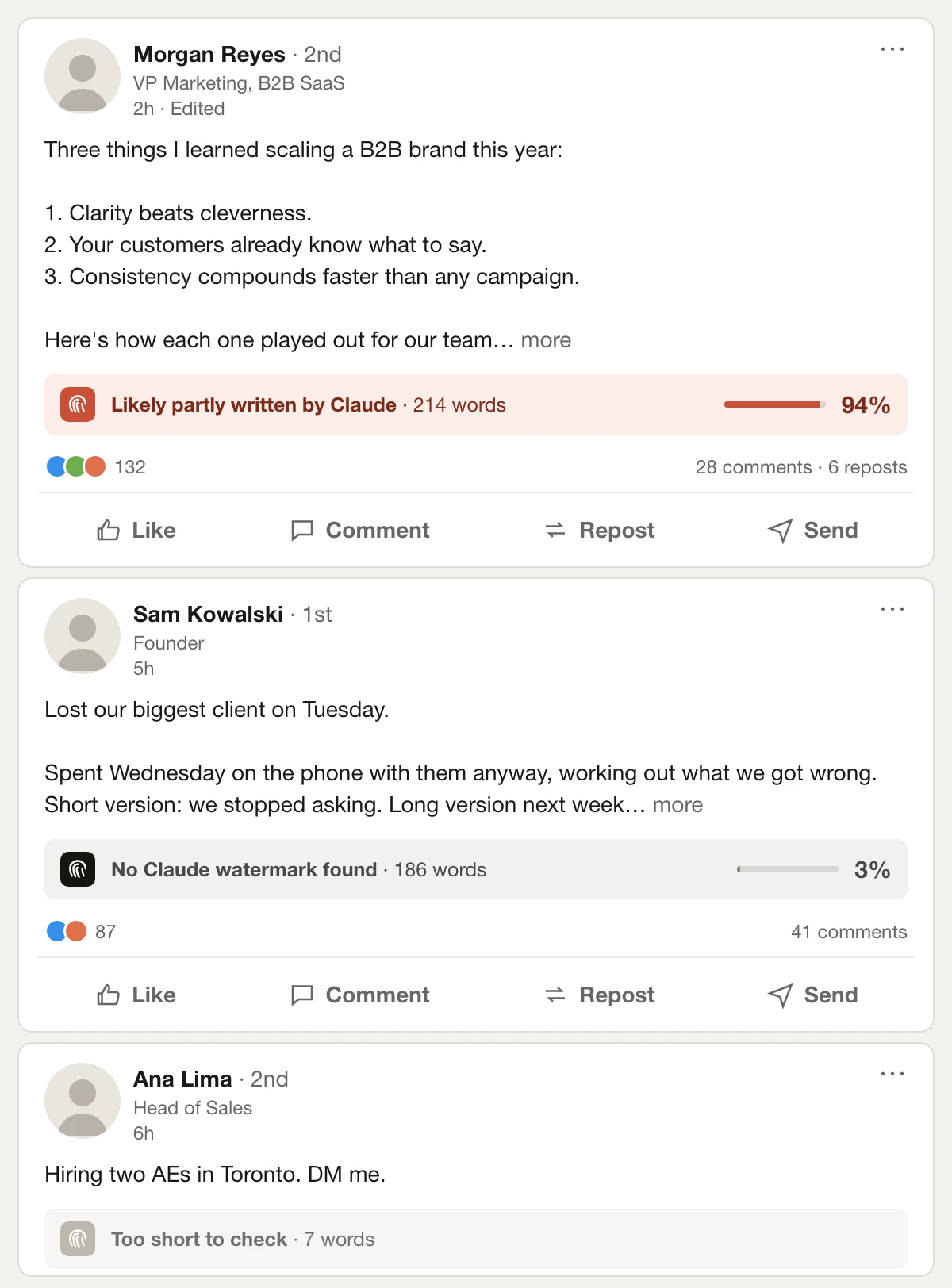
For now, few people could build one. The key is secret, and Anthropic keeps it. Instead of sharing it, Anthropic is releasing a detection API in private preview: outsiders send it text and get an answer, but never see the key. Access is limited to eligible organizations, such as independent researchers, fact-checkers and companies with compliance obligations under EU law. Anthropic says it plans to expand access over time. It hasn't said how far, and each AI provider uses its own key, so one checker can't cover every model.
Anthropic also notes the limits: a watermark doesn't confirm whether a human wrote the text or what process created it.
A culture of exposing people, with the burden of proof on the writer, could get messy. Our own voice and words wouldn't be enough. We'd need third-party proof that they're ours. Expect false positives, and people tailoring their writing to look "obviously" human.
What might come next?
Platforms built with guards to make sure everything published is human-made. Maybe one where people narrate their views, and AI only summarizes them, so the ideas stay theirs.
Efforts to profile digital writers, so a real person stands behind the writing.
More video, plus in-person and virtual events, as ways to get a message out that sidestep the "Is this AI?" question.
There are more questions than answers right now, but my core values for messaging, brand and comms stay the same. Operate authentically and with purpose. Find common meaning that connects you to your audience, and stay consistent. That's what helps people and brands get known, be trusted and win business.
What does this mean beyond content?
People already worry about AI's influence: whether it truly represents our interests or quietly shapes our decisions. The watermark adds a new angle to that worry.
The key decides which of several equally sensible words wins. Anthropic says its watermark doesn't favour particular words, so "overcast" might win in one sentence and "grey" in the next. But the mechanism shows that word choice can be steered without any reader noticing. If someone tuned that selection to favour certain words, framings or opinions, the effect across millions of sentences could nudge public discourse in a particular direction.
I interview you twice a month, work out your message with you, and turn it into short videos for the people you want to work with.
Book a call →Questions people ask
What is AI text watermarking?
An imperceptible pattern placed in the words a model chooses. When a model picks between words that keep the meaning the same, the watermark nudges that choice in a way a detector with the key can later check. Anthropic says its watermark adds no characters or tokens and carries no information about the user or their conversations.
Which Claude models carry Anthropic's text watermark?
Anthropic's newer models, including Claude Opus 5.5, already carry it. From November 3, 2026, Anthropic is applying it to Claude Mythos 5, Claude Opus 4.7, Claude Opus 4.6, and Claude Sonnet 4.6, with Amazon Bedrock rollout possibly taking a few extra days.
Can anyone check text for Claude's watermark?
Not yet. The key is secret and Anthropic keeps it. Anthropic is releasing a detection API in private preview for eligible organizations, such as independent researchers, fact-checkers and companies with EU compliance obligations, and plans to expand access over time.
Can a text watermark prove that a human wrote something?
No. Anthropic notes the watermark does not confirm whether a human wrote the text or what process created it. It signals that a watermarked model was involved. It says nothing about who had the idea or how much a person edited the result.
Why do AI models use so many em dashes?
There is no single confirmed cause. Likely factors include models generating one word at a time rather than planning a full sentence, human raters favouring the authoritative style the em dash brings, and training data drawn from writing where the em dash was popular.