The interview
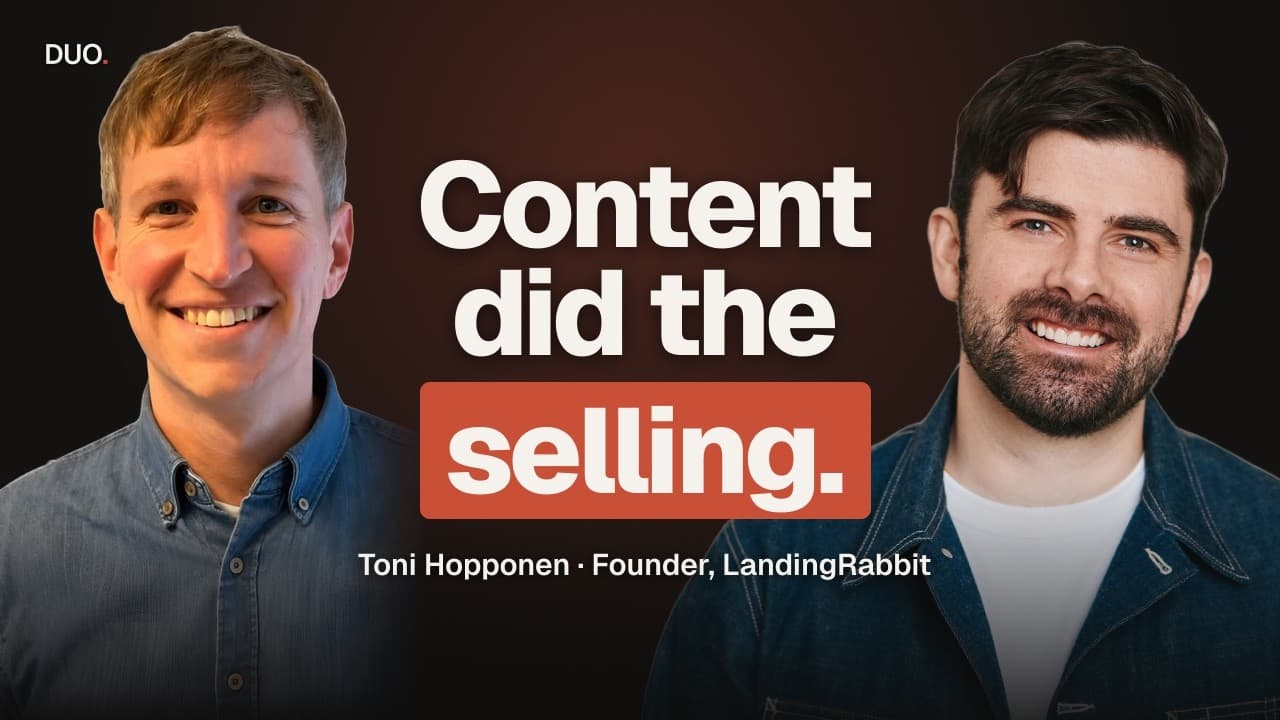
Now he runs LandingRabbit, which helps small business owners turn their know-how into websites that sell. We talk about building a content-led company, how AI search changes where you need to show up, what a personal brand looks like when you just try to be the same person online, and why he lets an AI agent interview him before he writes anything.
Edited for length and clarity. Times play the video from that point.
Flockler: from live TV to brands like Metallica and GoPro
Justin DeMarchi What was Flockler? Tell us about that experience.
Toni Hopponen Flockler in a nutshell is a social media marketing platform helping clients gather content from different social channels or through text messages or other means. It started with an idea that we engaged media companies in live TV shows. So imagine a singing competition or sports competition or anything where it's live and audiences really engage. TV productions wanted to bring that in a show, for example tweets or text messages on live TV, and that's how it started. But then, while Instagram started growing, it became more like engagement platform for brands.
We work with Metallica, Harvard University, GoPro, really nice brands and organizations. The product was marketing product, but also everything we did when it comes to sales and marketing was very content-driven.
Justin What was your content strategy for Flockler?
Toni We started really early investing in blog posts and SEO, creating landing pages. Back then, I was here in London, there were quite a few content marketing agencies which were basically built from the fact that journalism wasn't paying enough or there wasn't enough jobs. And then quite a lot of journalists started working on this proposition: can we sell content marketing to brands? Could brands become media companies? Which I found a bit funny at the time as well, but it inspired me that, hey, maybe there is an option that we don't need all these salespeople. Maybe we can be very marketing-led, content-led company. And we started writing content.
I'm not a writer when it comes to my background, and therefore I hired someone. Slowly but surely, we started getting traffic through SEO. Then Google Ads was kind of easy addition to that. When you start getting SEO traffic you start to understand that, okay, we get certain traffic through SEO, and then there's a lot of keywords that are very transactional and they're maybe more difficult to get traffic through SEO.
As a CEO, founder, product guy of that company, I wrote maybe 100 pages a year, whether they were blog posts, help docs, landing pages and so forth. So I was just living and breathing content all those years, and really successful. We didn't have any salespeople, but we were able to attract those big name organizations, and somehow they trusted us regardless of the fact that we didn't have that sales relationship. They actually signed up after reading content, probably reading quite a few pieces of content. And then if they like the product they might have asked us a few questions, but otherwise it was full self-serve.
I wrote maybe 100 pages a year, whether they were blog posts, help docs, landing pages.
Steady content and quick growth
Justin When you were starting LandingRabbit and you had this background, this experience, how did you balance short-term strategies and long-term strategies? Because you also need quick growth to validate and to keep the lights on.
Toni We invested a lot in continuous content creation. Instead of like, “Hey, let's just create a lot of content for six months and let's not do anything else.” Back then it took so much time to write one, so you actually needed like four to eight hours at least. Right now it's so much easier to just translate your thoughts into a blog post. I think content writing takes less time than it did.
Of course it was a balance. We had to figure out all other ways of how we can build that brand awareness, whether that was events or LinkedIn content or Twitter. Some of those tactics are obviously a bit more short term than the other ones. But I'd say that the SEO play works pretty well if you have quite a few channels going on. Google Ads is a great partner with SEO: if SEO is working for you, it's pretty certain that you will find opportunities in Google Ads, or these days maybe somewhere else like ChatGPT.
One thing that has changed recently is that in ChatGPT you can actually find opportunities much more short term. So if you see what people are actually talking in communities right now, what they're sharing on LinkedIn, and you then write content for that, it's quite likely that you will be ranking high for that in more AI driven search, that is looking at content beyond just that search ranking, the old kind of ways.
I think the old way is more like long term, you need to really invest for a long time. But right now I think you can find opportunities short term as well.
What he'd do differently: personal brand and video
Justin If you were to look back at the journey and say, “Wow, if I could start from scratch, these are the things that I would invest most of my effort in,” what would you say?
Toni I'd definitely invest a bit more in my personal brand, so building that audience for myself, so that whenever my situation changes, okay, this era was for Flockler and now I'm moving somewhere else, then I could capitalize on that. I started with LandingRabbit, I actually started using LinkedIn a lot more, and I started from the point of view that I had a lot of contacts, but they were mostly people that I met, investors, not really anyone who's following me for content or even the business that I'm doing. Maybe a few chats, but nothing content driven.
That doesn't need to be LinkedIn, it can be other channels of course. And then right now feels like a couple of things. One, having more videos than I've had in the past. It would be great if I would have done more videos already. And then the second one is that distribution in multiple channels probably now benefits you quite a bit.
If someone is searching on AI search, whether that's Google's search bar or Claude, ChatGPT, they like to show things like, oh, this post is on LinkedIn talking about the same thing, this is on YouTube, and this is on someone's website, and maybe even in communities. They kind of like the fact if you are visible in multiple places. My previous company focused just like SEO, Google ads, that's it. And now I'm like, okay, let's build a bit more around personal brand that can, you know, last longer, regardless of what we do.
What a personal brand means to him
Justin What do you find successful in personal branding? And stepping even further back, what does that even mean to you?
Toni I think personal brand is something that people describe in many ways and nobody knows what it actually means. Some people always think about it more like a celebrity style, that you become some sort of, not really known for your thoughts, but maybe some actions that you take. And that can be a personal brand for sure.
But for me, how I approach it myself is that I'm just trying to be the same person that I am outside the social media. I'll try to be as transparent as I can, share really some of the thoughts behind the business, but also what my customers are saying. Things that you wouldn't really add on the website as they are, because a website needs to be this cohesive thing, some sort of a story, a lot of really clear instructions that, hey, if you want to do x, y and z, this is how you can do it. Whereas on social media, in different channels, you can share more about behind the scenes and why you are building something, and then connecting with those people that are actively thinking about it.
Today I shared something that was related to the fact: are you building a bit too complex website, or should it be more like the minimum viable website? And someone commented that I'm just now building this website. You can tell that the person was thinking about it, that it's getting a bit too complex. I'm trying to find those things that either I'm thinking or my customers are thinking, and I'm trying to build my profile in a way that, okay, this guy probably is trying to communicate what he feels and thinks, and not really trying to become or be someone else.
Same topics, new angles
Justin It sounds easy: present yourself authentically. But then there's this real strategic part about what am I going to present? Have you found certain messaging or certain things that you've done that you feel like, hey, this has actually really connected me with my audience?
Toni When I started posting on LinkedIn, I felt a bit weird about the fact that I'm talking about the same things all the time. And then I tried to kind of escape that: okay, let's create more content, different topics and so forth. But that didn't work that well. I noticed immediately when I wrote something that was not around the topic that I was talking about, then people were not that interested in. Posting about pretty much the same thing, but different writing, different idea, the same topic, then people reacted to it. They commented on that and so forth.
It's kind of like this loop where I think you need that experience first. You can't just figure out that these are the topics, that's it. It's more like, let's test what could bring the best possible leads for you, and then write content around that same thing. For me, it's all about having calls with clients, then listening to them. Today I had a great call with someone. I have so many ideas what I could write about. Writing about those same topics but different things, that seems to work the best for me.
I've definitely noticed that if I go a bit outside of that, then I might get likes and comments, but I don't get people connecting with me. And what I've noticed as well is LinkedIn has become a lot better at finding, okay, this is your audience, this works really well, let's push it to this audience. And then if you write about something that is really not your topic in the past, then it might struggle.
If you write about something that is really not your topic, then it might struggle.
Sharing clips of other people
Justin It's my personal brand, because I'm the one talking about it, but I'm sort of spotlighting other people. I've seen posts where you're doing something similar, you're commenting on the work that you've seen. What would you say about that?
Toni I love collabs. If I can, I'll just find more people to have a chat with me and record clips, quick ones. And I also enjoy sharing content that is not actually me talking at all. If I recorded a podcast this week, I only create clips where the other party is talking. Maybe I asked the question and then the other party is talking. But it gives a nice mix for my LinkedIn content so that not everything is about me.
And then another thing why I like to do it is that it's nice to have someone else's comment as a video, and then you can have a new angle to it. So you're not repeating what's said on the video. You're commenting on one thing or something that they said. I find it inspiring for me. I can write something slightly different. I can also benefit from the network of the other person a bit. So many benefits.
Let AI interview you
Justin With LandingRabbit, you are helping people get their website up and running, but also to stay updated, which is a big pain, I think, for founders. You have no time, so the website, you set it and forget it. In terms of that website, what are some things that you've seen really work?
Toni One of the things that I invest in, when it comes to the product but also personally, is that I use interviews. Basically I've got this AI agent inside the app that is interviewing me and asking questions. Even if you wouldn't use LandingRabbit, I strongly recommend people to do that, that they ask, for example, Claude: okay, could you ask me questions? And then you can talk them through.
Obviously it depends on the person, but for me the best way to get thoughts out of me is walk around the office or home or wherever I am, or maybe even outside, and then think and just talk things through, in a way that I'm not really trying to create the best possible bullet points. And then that content is much more valuable than trying to create a perfect sentence, another perfect sentence, and then you're so tired that you're like, well, that's it. Let's just go with these bullet points. Easier to just explore thoughts in a more brainstorming way.
And what AI is really good at is taking a look at what did you actually say in this blurb. Even if you kind of made mistakes or went a bit outside of the focus, it knows that, okay, let's just pick the relevant bits. Another thing that I like to do a lot is that I'll either record a video or I'll write a LinkedIn post, something where I already have content, and then I expand that as much as possible, so that when someone is searching for this topic there's a higher chance that AI services are gonna recommend me, because they see that, okay, there's a blog post about this, there's some content pretty much everywhere.
Justin These founders have a lot of this really valuable information inside them. It's just applying that to proper web design practices.
Toni It really depends on the person. Some people, they wanna see everything as text. When they are thinking about things, they find it really helpful if Claude will write a lot of content and they read it. But then there are a lot of people who are more like they wanna just express themselves in a different way, and I think that voice currently is the great way of extracting that information. AI can help to ask you questions even if you wouldn't have a team around you.
I found it really interesting that this AI gives us opportunities for different types of ways of learning, ways of building stuff. One example is that when I'm building the product, Claude is so cool because it can create me a text version of the plan. It can give me, hey, this is the code plan. Then it can create, this is the business bullet points. And then it can create a visualization out of it. So I can look at it from so many angles and have a think: does this make any sense, or should I skip this feature?
Toni Hopponen is the founder of LandingRabbit.
Full transcript
Toni We didn't have any salespeople, but we were able to attract those big-name organizations.
Justin Hey, Toni. Well, it's great to connect. This isn't our first time. We've had a few chats, but when I started this content series, I immediately went and messaged you and said, hey, we've got to do a session together because you have such great expertise. And also you've done this. I mean, a lot of times I talk to people and their knowledge is maybe more theoretical or consulting based, but you have started not just LandingRabbit, but you've also started and had a successful company prior to this. So you've lived this, you've tested things. And now you're also supporting other people with your company LandingRabbit to build and maintain their web presence, which is huge.
So thanks so much, Toni, for joining.
Toni Thanks for the invite. Always pleasure to have a chat. And yeah, I've been doing content for more than 10 years in one way or another. I could describe myself as a content marketing fanboy or something like that.
Justin That's great. So maybe before we even get into what you're doing now, I think you have such an interesting story with your work at Flockler. I want to dive in. Maybe you can just give the audience or anyone listening, what was Flockler, maybe a short snippet of tell us about that experience. And then I would love to ask more about positioning that company, marketing it, and what you found was successful, maybe what you tried, and it didn't work as well as you hoped.
Toni Yeah, Flockler in a nutshell is a social media marketing platform helping clients gather content from different social channels or through text messages or other means. It started with an idea that we engaged media companies in live TV shows. So imagine a singing competition or sports competition or anything where it's live and audiences really engage. TV productions wanted to bring that in a show for example tweets or text messages on live TV and that's how it started but then it became while Instagram started growing then it became more like engagement platform for brands.
We work with Metallica, Harvard University, GoPro, really nice brands and organizations and yeah it was all about marketing. The product was marketing product, but also everything we did when it comes to sales and marketing was very content-driven.
Justin So what did that look like specifically? What was your content strategy for Flockler?
Toni Yeah, we started really early investing in blog posts and SEO, creating landing pages. I was back then, I was here in London, there were quite a few content marketing agencies which were basically built from the fact that journalism wasn't paying enough or there wasn't enough jobs and then quite a lot of journalists started working on this proposition that can we sell content marketing to brands? Could brands become media companies which I found a bit funny at the time as well but it inspired me that hey maybe there is an option that we don't need all these salespeople, maybe we can be very marketing-led, content-led company, and we started writing content.
I hired someone to do that for us. I was thinking that I could never write in a professional. I'm not a writer when it comes to my background, and therefore I hired someone. Slowly but surely, we started getting traffic through SEO then Google Ads was kind of easy addition to that when you start getting SEO traffic you start to understand that okay we get certain traffic through SEO and then there's a lot of keywords that are very transactional and they're maybe more difficult to kind of get traffic through SEO.
So yeah we had those post pillars going on and yearly as a CEO, founder, product guy of that company, I wrote maybe 100 pages a year, whether they were blog posts, help docs, landing pages and so forth. So I was just living and breathing content all those years and really successful. We didn't have any salespeople, but we were able to attract those big name organizations and somehow they trusted us regardless of the fact that we didn't have that sales relationship or that sort of like relationship building that they actually signed up after reading content probably reading quite a few pieces of content and then if they like the product they might have asked us a few questions but otherwise it was full self-serve.
Justin Okay, so now thinking about what you're doing with LandingRabbit and also helping companies. You mentioned SEO. You mentioned blog writing. I would consider these strategies to be a little bit more long-term strategies. It takes time to build the SEO traction. You write a blog. You publish it. It's going to be a slow trickle unless it's timely and relevant. It maybe takes off in a few weeks. But when you were starting LandingRabbit and you had this background, this experience, How did you balance short-term strategies and long-term strategies?
Because you also need quick growth to validate and to keep the lights on where you live. How did you approach that?
Toni That's a great question. We invested a lot in continuous content creation. Instead of like, "Hey, let's just create a lot of content for six months and let's not do anything else." It was more like couple of week, just like, okay, get some time. Back then it took so much time, the right one, so you actually needed like four to eight hours at least. Right now it's so much easier to just translate your thoughts into a blog post, I think content writing takes less time than it did.
But yeah, of course it was a balance that we had to figure out all other ways of how how we can build that brand awareness whether that was events or LinkedIn content or Twitter. Some of those tactics are obviously a bit more short term than the other ones. But I'd say that the SEO play works pretty well if you have quite a few channels going on. Like Google Ads is a great partner with SEO that if SEO is working for you, it's pretty certain that you will find opportunities in Google Ads or these days maybe somewhere else like chat GPT and then also one thing that has changed recently is that in ChatGPT include you can actually find opportunity is much more short term so if you see what people are actually talking in communities right now what they're sharing on LinkedIn and you then write content for that it's quite likely that you will be ranking high for that in more like AI driven search that is looking at content beyond just that search ranking the old kind of ways.
I think the old way is more like long term you need to really invest for a long time but right now I think you can find opportunities short term as well.
Justin I think that's a great point because there's so many areas online where we can see what conversations are taking place. We can actually go on ChatGPT or whatever AI right now and actually search as if we are the customer and actually see what comes up, which is interesting. You can go on SEO. I think Reddit is also a really good place. You can go on LinkedIn, like LinkedIn search is such a great resource for people to use. I think it's probably underutilized in a lot of areas. And if you start to see what conversations are taking place, and then you just provide the content to support those existing conversations, you're not maybe starting at zero, you're kind of like hopping in the middle of a conversation, which I think can speed up the results there.
Are there other things like hindsight is always great if you look back and reflect, even now you're continuing to progress with LandingRabbit, but if you were to look back at the journey and say, "Wow, if I could start from scratch, these are the things that I would invest most of my effort in, and maybe this stuff I would do a little bit less and this stuff I'd do a little bit more, that's the magic question for a lot of founders, leaders, because you can spend your time doing a million different things, so the question is always, but what? What will actually bring value?
I don't know, what would you say if you reflected on that?
Toni Yeah, I'd definitely invest a bit more in my personal brand, so building that audience for myself so that whenever my situation changes that, okay, this era was for Flockler and now I'm moving somewhere else, then I could capitalize on that. I started with LandingRabbit. I actually started using LinkedIn a lot more and I started from the point of view that I had a lot of contacts, but they were mostly people that I met, investors, not really anyone who's following me for content or even the business that I'm doing.
like a transactional hey create to be connected, maybe a few chats but nothing content driven. I would probably invest in personal brand a bit more than I did and that doesn't need to be linked in it can be other channels of course and then right now feels like a couple of things one having more videos than I've had in the past it would be great if I would have done more videos already and then the second one is that like distribution in multiple channels probably now benefits you quite a bit.
If someone is searching on AI search whether that's Google's search bar or Claude, ChatGPT they like to show things like oh this post is on LinkedIn talking about the same thing this is on YouTube and this is on someone's website and maybe even in a communities. And whereas they kind of like like the fact if you are visible in multiple places, my previous company focused just like SEO, Google ads, that's it. And now I'm like, okay, let's build a bit more around personal brand that can, you know, last longer, regardless of what what we do.
And then also the video and distribution in multiple channels is more important right now.
Justin This idea of personal brand, I think it sounds simple. I think it's a word if you look up on the Google trends, like it's a popular term that people love to talk about, building your personal brand, do this. But I think what that actually means is more nuanced and it also looks different for a lot of different people because we talk about a personal brand, how I will be successful at it, it's gonna be different than you and someone else, not just because of the work I'm doing, but because it brings in our temperament or personality, what do you find successful in personal branding?
And I guess like stepping even further back, like what does that even mean to you?
Toni Yeah, it's a great question. I think personal brand is something that people describe in many ways and nobody knows what it actually means, but some people always think about it more like a celebrity style that you become some sort of like, not really known for your thoughts but maybe maybe some actions that you take and that can be a personal brand for sure but like for me and how I approach it myself is that I'm just trying to be like the same person that I am you know outside the social media I'll try to be as as sort of like transparent as I can share really some of the thoughts behind the business but also like what my customers are saying things that you wouldn't really add on the website as they are because a website needs to be this cohesive thing some sort of a story a lot of really clear instructions that hey if you want to do x y and z this is how you can do it whereas on social media in different channels you can share more about like behind the scenes and why you are building something and then connecting with those people that are actively thinking about it.
Like today I shared something that was related to the fact that are you building a bit too complex website or should it be more like the minimum viable website? And someone commented that I'm just now building this website and this appeared in the... You can tell that the person was thinking about it, that it's getting a bit too complex. I'm trying to find those things that either I'm thinking or my customers are thinking and I'm trying to build a brand that if it can be called as a brand product, I'm trying to build my profile in a way that okay, this guy probably is trying to communicate what he feels and thinks and not really trying to become or be someone else.
That's how I approach it.
Justin I think that's really good. Something that I say to describe kind of personal branding is it's really obvious when you talk to someone in person what that means, I think, because if I walked up to you in an event, for example, or a coffee shop and I met you, things would naturally come across. I would have the, I'd be personable, I would maybe joke or ask you something and I would share a little bit about what I'm doing. It's really obvious when you have that direct interaction, it's to who you are and who, then I get the sense of who you are. But if we can take a portion of that and also present it in the digital environment, then it's never going to be exactly the same as me sitting across from you.
But if we can, if we can step in that direction to let people know who we are, what we're doing, then I think that is sort of the essence of personal branding, where it's not corporate, it's just trying to connect with people authentically online. And you kind of alluded to it where there's a lot of things about you. So there's a strategic angle to where you want to be authentic, but you sort of have to also choose what are you going to focus on? Because if you have 10 different hobbies, you're like, I'm just going to share everything under the sun, then it can be quite distracting.
So I think that's where it sounds easy, present yourself authentically. But then there's this real strategic part about what am I going to present? And how do I phrase that? And there's a million ways I could describe it, but you know what it is. Have you found certain messaging or certain things that you've done that you feel like, hey, this has actually really connected me with my audience in a good way?
Toni I think you touched the point at the start when I started posting on LinkedIn, I felt a bit weird about the fact that I'm talking about the same things all the time. And then I tried to kind of escape that in a way that I'll like, okay, let's let's create more content, different topics and so forth. But that didn't work that well. I noticed immediately when I wrote something that was like not around the topic that I was talking about, then people were not that interested in. And then one size, you know, was like posting about pretty much the same thing, but different kind of like different writing, different idea.
the same topic, then people reacted to it. They commented on that and so forth. It's kind of like this loop where I think you need that experience first. You can't just figure out that these are the topics. That's it. It's more like let's test what could bring the best possible leads for you and then write content around that same thing. For me, it's all about like having calls with clients then listening to them.
Today I had a great call with someone I'm like I have so many ideas what I could write about that about it's like taking those and writing about those same kind of same topics but different things then that seems to work the best for me and yeah I've definitely noticed that if I go a bit outside of that like what is the best possible content then I might get likes and comments but I don't get those rights, right, kind of like people connecting with me. And what I've noticed as well is like, LinkedIn has become a lot better at finding like, okay, this is your audience, this works really well, let's push it to this, this audience.
And, and then if you write about something that is really not your topic in the past, then it might struggle to find, like, who should I share this is what doesn't really belong to you.
Justin Yeah, that's a great point. I think you touched on a really effective strategy, especially for people who are new to that or who are still developing that authority. Because personal brand, I think a lot of people take that on LinkedIn as, I've got to pretend like I have more experience or more authority than I really do. And it's like this bit of posturing that takes place. But I have found-- and I did a little bit of that. I think I tested it at the start. But then when I switched my strategy a bit and saw a significant increase in engagement and conversations happen, and that was me highlighting the conversations I have and highlighting other founders who I found are doing really great work and who I'm actually working with.
So it's my personal brand, because I'm the one talking about it, but I'm sort of spotlighting other people, which there's a couple-- we talked about this just before we hopped on. There's a couple of benefits there. One, we're not pretending to be someone. We're just highlighting each other. But two, the collaboration that that happens. My content web started to grow way beyond what I could have done individually, because now you have all the other people tagging me, collaborating with posts that I'm in, all these different things.
And I see that kind of with you. and that's kind of why we decided to do this as well. I don't know, is that something that, I think I've seen posts literally where you're doing something similar, you're commenting on the work that you've seen, but what would you say about that?
Toni Yeah, I love collabs. If I can, I'll just find more people to have a chat with me and record clips, quick ones. And I also enjoy sharing content that is not actually me talking at all. I can, like if I recorded a podcast this week and I only create a clips where the other party is talking. Maybe I asked the question and then the other party is talking. But it gives a nice mix for my LinkedIn content so that not everything is about me.
And then another thing why I like to do it is that it's nice to have someone else's kind of like comment as a video and then you can kind of have a new angle to it. So you're not repeating what's said on the video. You're kind of like commenting on one thing or something that they said. I find it inspiring for me. Like I can write something slightly different. I can also benefit from the network of the other person a bit. So many benefits.
Justin So we have maybe a couple more minutes and it's not gonna do it fully justice, But with LandingRabbit, you are helping people get their website up and running, but also continued-- sorry-- but also to stay updated, basically, which is a big pain, I think, for founders. You have no time, so the website, you set it and forget it. There's a lot we can get into, Toni. But what are some quick things that for a founder or company, growth leader, whoever that this may be, listening to this, in terms of that website, what are some things that you've seen really work?
Toni Yes, one of the things that I invest in when it comes to the product but also personally is that I use interviews, so basically I've got this AI agent inside the app that is interviewing me and asking questions and even if you wouldn't use LandingRabbit, I strongly recommend people to do that, that they ask for example Claude that okay, could you ask me questions and then you can talk them through and obviously it depends on the person but for me the best way to get thoughts out of me is like walk around the office or home or wherever I am or maybe even outside and then think and just like talk things through in a way that I'm not really trying to you know create the best possible bullet points and then that content is much more valuable than trying to create a perfect sentence another perfect sentence and then you're so tired that you're like, well, that's it.
Let's just go with these bullet points easier to just like explore thoughts in a more like brainstorming way. And what AI is really good at is like taking a look at what did you actually say in this blurb. And even if you kind of like made mistakes or went a bit outside of the focus, it knows that okay, let's just pick the relevant bits and let's find that and then yeah that's been really helpful and then another thing that I like to do a lot is that I'll either record a video or I'll write a LinkedIn post or something but something where I already have content and then I expand that as much as possible so that when someone is searching for this topic there's a higher chance that AI services are gonna recommend me because they see that okay there's a blog post about this there's some content pretty much everywhere so yeah those are the things that I like
Justin that's awesome I think what I love most about landing rabbit is this element that you just shared because not every team not every person founder has the privilege of a whole web design development and copywriting team so they might be thinking what do I even say Hey, how do I position this? But the thing is, though, these founders have a lot of this really valuable information inside them. It's just applying that to proper web design practices. So the interview, what that does is it kind of takes a lot of the barriers away from what's best practice, and it's just answer honestly, and let your platform decide out of that organic natural discussion what should be taken and actually applied to that website, to the landing page.
So in some ways it removes a lot of the friction and that person who's maybe unfamiliar with good web design still ends up with a really effective website for themselves.
Toni Yeah and it's also like, it really depends on the person. Some people are like, they wanna see everything as text. They kind of, when they are thinking about things, they find it really helpful if Claude will write a lot of content and they read it. But then there are a lot of people who are like, like they're more like they wanna just express themselves in a different way and I think that voice currently is like the great way of extracting that information like AI can help to ask you questions even if you wouldn't have a team around you and yeah I found it kind of really interesting that this AI gives us opportunities for different types of you know ways of learning ways of building stuff and one example is is that when I'm building the product, Claude is so cool because it can create me a text version of the plan.
It can give me like, hey, this is the code plan. Then it can create like, this is the business bullet points. And then it can create a visualization out of it. So I can look at it from so many angles and have a think that, does this make any sense or should I skip this feature?
Justin When we were, I don't know, you grew up in Finland, right? I grew up in Canada, but when you were young, The big thing was, what kind of learner are you? Are you a visual person, auditory? So what you just said, like total light bulb moment for me, because when I'm doing web and design, like I need to see, I can't just read what the concept is, I need to actually see a mock-up or something, because that's just how my brain works. So what you just said was, everyone's different, let's display the information in the way that you actually need it to be, to process it. So Toni, it was a pleasure to have you.
I think a lot of the discussion here, There's a lot of good nuggets that hopefully people take and can apply to their own business. So thank you so much. I'm sure we'll be doing a session again at some point. So thanks, man. Appreciate it.
Toni Thank you so much, Justin.