The interview
We talk about how buyers now ask ChatGPT and Claude instead of Googling, why his personal posts beat his product posts, and how he found his own voice instead of borrowing someone else's.
Edited for length and clarity. Times play the video from that point.
How buyers find B2B tools now
Justin DeMarchi One of the things that you were saying before we hopped on the call was that connection of you to Howly, which is the company that you founded. You felt like that was such an important part of your success, why people trusted the brand, how people heard of it. Is that something that resonates: your personal brand and the importance of it with your company, Howly?
Christian Baun Howly is B2B SaaS. And with the invention of things like Claude and ChatGPT and AI coding agents, I would say one of the things that is now easier than ever is to copy a product. Howly's been copied, I would even say a handful of times at this point, which I think is fine. If anything, it validates the idea, and it validates that there is a need for this out in the market.
But when it comes to things like marketing and distribution, I think the buyer's mentality has completely switched from where it was a couple of years ago, where you would Google around, find a blog post, you would read about it, you would ask your team, to where it is now, where you go to Claude or ChatGPT and you say, “Hey, I need to audit my HubSpot workflows. What's the best tool to do that?”
Of course, I also write Howly's blog, and I do a lot of these content engagements across YouTube and webinars, and even with other creators and founders. What that has allowed me to do is be mentioned when folks ask their LLM of choice.
If we look at something like LinkedIn, it is the most cited B2B source when it comes to things like software, when it comes to anything B2B related. And so what I've really tried to do is, when I post on LinkedIn, yes, I post about Howly, yes, I post about my business, but I also am vulnerable and I talk about what it's like to start a business. I talk about what it means to grow an audience. I talk about other things that are not necessarily related to my business. But if we look at number of impressions, if we look at who can actually discover and find me or Howly or what I'm doing, LinkedIn to me has been the best growth lever I've ever used.
LinkedIn to me has been the best growth lever I've ever used.
Where to start with content
Justin The thing about content, which is so tough, is there's almost an infinite amount of things that you can do. And a lot of them are very time intensive. You chose a few channels. How did you land on those channels?
Christian I think I landed on these channels through trial and error. When I first started building out Howly, I was employed elsewhere. So my growth strategy couldn't be post on LinkedIn, go live on YouTube, write the blog, because I didn't want my employer at the time to think, this guy's one foot in the door, one foot out, he's doing something else. And so my growth strategy at the beginning of Howly's journey was very much around Reddit.
Even Reddit has changed a lot. It feels like everything I'm reading is either, quote unquote, AI slop, or it's self promo. And I think subreddits have even become a lot more stringent. Buyers can sniff out when something is promotional versus truly authentic and helpful. When I first started posting on Reddit, I had some of my posts perform really, really well, especially on the HubSpot subreddits. Of course, it's self promo to an extent, right? But I'm talking about the journey and what it takes to build something on the marketplace and getting my first customers, and how all of this fits into what it means to be a founder.
It was only actually up until recently, five months ago, six months ago now, that I went just all in on LinkedIn, because I wasn't tied to an employer relationship anymore. Being a solo founder, it's also really fun because you're not beholden to a VC or anything like that. You can really write whatever you want.
If I were to show you my impressions from pre-me posting to where it is now, it's been a hockey stick of growth. I attribute a lot of it to trial and error and having fun with it and seeing what sticks. Part of that growth also enables you to build an audience and loyal followers and a strong network of people who now discover you and learn about Howly and reach out. That has also enabled new demos, new relationships, new buyers. I attribute the majority of the success to delivering content, being authentic, and building this personal brand.
200 impressions a post: push through or change course?
Justin Everyone wants quick results, but these are brand plays, not outbound sales strategies. This takes time. And there's points where, you said, that hockey stick, you're at the bottom of that curve, and you're thinking, is this a waste of time? Do I push through, or do I adjust the strategy? What would you say to someone who's maybe having those doubts?
Christian When I started, you're seeing 200 impressions per post, maybe 250. And as somebody who is starting out with content for the very first time, you're also thinking about judgment from peers, or am I being cringe, or did I say the wrong thing here? Why is this not performing? And to that I can say: embrace all the cringe, embrace who you are and be authentic.
But to your point about pushing through, I think if you really want something and you're passionate about it, I think your audience can feel that too. Because I have seen peers or ex-peers who have tried a similar content type strategy, but it very often leads directly to the product. And then they go, okay, well, I'm not selling something this month. I'm gonna pivot, or I'm gonna try something else, or I'm gonna drop it, because it didn't yield results in the first three months of me doing this.
For me, it has been passion, definitely about building software and about helping my community and my peers. But certainly also, in a weird way, it's enabled me to meet brand new people who I would have never had the opportunity to meet with, shake hands with, or even get to know.
As we talk about attributing this hockey stick growth, yes, it didn't happen overnight. But one day, one post will get 20,000 impressions, and somebody who you've looked up to will comment on it, and you will engage with them and create that relationship. And at that point, it's like, okay, let's take a step back, because something's happening now, and let's not take the foot off the gas.
Treat content like an experiment
Justin Putting yourself out there, whether that's LinkedIn or Reddit or something, these are experiments. So you're trying to pick up on signals. Did something similar happen, so you start to get these early signals of, OK, hold on, there might be something to this?
Christian 1,000%. With my product, I'm selling visibility into a client's HubSpot workflows. HubSpot solution partners, they will get a brand new client. And some of these clients will have workflows that are sitting just dormant in their portal, and they have been for years. The solution partner's job is, first of all, we want to audit these, and then we want to figure out how they're all connected, to know: what can we turn off? What can we leave on? What's broken? And this, in turn, of course, enables the solutions partner to do more work for this client and sell their expertise as the solution.
When I first started posting on LinkedIn, I was talking perhaps more so about the product. Sort of throwing spaghetti at the wall and seeing what sticks, and nothing really stuck. Until a colleague of mine reached out and said, “Hey, this looks really interesting. Have you thought about pivoting some of your content?”
We had a call, and he is a RevOps expert. And so what he recommended was: your overall theme should be RevOps is fundamentally broken. And why is it broken? Because there's no visibility, everything's a mess. And when you inherit a HubSpot portal, for example, for the first time, it's a sense of dread and overwhelmed, and you don't even know how to get started. And so that actually became the core theme across my content pillars.
Rather than talking about the what, the what being Howly solves for this, my core content became the how and the why behind why RevOps is broken. So yes, I touched on themes like visibility and integrations breaking, no one having any sense of what's going on in the HubSpot portal. And all of a sudden I saw all of these solutions partners agreeing with it, showing up in my comments. I was engaging with the content, and I knew at that point there's definitely something here. So the content pivot from talking about the what to now talking about the why and the how really defined the next steps in not only my journey, but in Howly's journey too.
Every day shouldn't be about the what and the how and RevOps is broken, because that also gets tiresome, and your audience will get content fatigue about that. So what I try to do is mix in a little bit of my founder journey: “Here's what I've learned from talking with a customer,” or “Here's a case study of somebody who went through a whole Howly audit and what it meant for their customer.”
Sprinkle in a little bit of authenticity around yourself, your childhood. I'm an immigrant to Canada, so I talk about that at times. And it's often those authentic, real posts that give folks an insight as to who is Christian. And I would even say posts like those have way outperformed my RevOps is broken type posts, and have resulted in net new demo engagements, net new customers, because people see you as a real human. There's a real person behind the screen, that's someone you can trust, that's someone who's reputable, and we should try his software.
Posts like those have way outperformed my RevOps is broken type posts.
Get on the same side as your audience
Justin You said RevOps is broken. You're building an idea that other people can relate to. So all of a sudden, it's not like I'm on this side, you're on this side. It's like, no, no, we're on the same side. And when you're on the same side as someone, all of a sudden there's a deeper connection. How did you arrive at that, though? What is the best way for someone to get to that point where they can understand that concept?
Christian I think the biggest thing, in my opinion, is finding your voice and knowing who you are. And when I say that, I mean that I have colleagues, friends who have seen, okay, Christian is posting, seeing a lot of engagement. I'm going to borrow his writing style in my own industry. But from what I can tell from those posts, they don't perform, because it's not them who is writing it.
And I think that your audience can tell when something is copied, or AI. Okay, this post is not authentic. This post is not real. Maybe it took two minutes to write. And they'll scroll past that, and you won't see that engagement.
I arrived at it because I thought to myself, yes, people will judge you for what you're writing. And I'm sure you're going to inspire others, et cetera. But none of those people attribute anything to my bank account or my family's wellbeing. So I might as well post whatever I want to post, and finding my voice in the process has allowed me to do that.
So the biggest thing I say to anybody who's starting out with content is: LinkedIn is sort of past the whole B2B language, boring snooze fest, into embrace who you are, embrace the cringe, write with your own voice and get the message out there. What are you doing? What have you learned today? Those are things that folks want to engage with or want to read, because either they can learn something or they can have some sort of takeaway from it. But if you beg, steal and borrow from other people's successful content, it's never truly gonna be your own voice that you're writing with.
No better time than yesterday
Justin Any closing note for those wanting to build your founder brand?
Christian The biggest thing I can say to anybody who is wanting to build their founder brand is: as cringe as it is to start posting on LinkedIn for the first time, or thinking about, well, what should I post? What should I do? I don't know. There's no better time than yesterday.
And I think if you can just embrace the fact that people will judge you for it, and if you can accept that, you'll be truly free to do whatever you want, and that is how you grow on this platform. So embrace the cringe and be yourself, and people want to hear your exciting perspectives about whichever industry you're in, or what you're working on, or what you're building. Folks are generally very supportive.
And I have found that it is strangers on the internet who are the most supportive of everything that we do. Whereas I'm lucky if I get a like from my mother on LinkedIn once every fifth post. And so I would say just find your tribe. And as soon as you do that, that's your opportunity to grow.
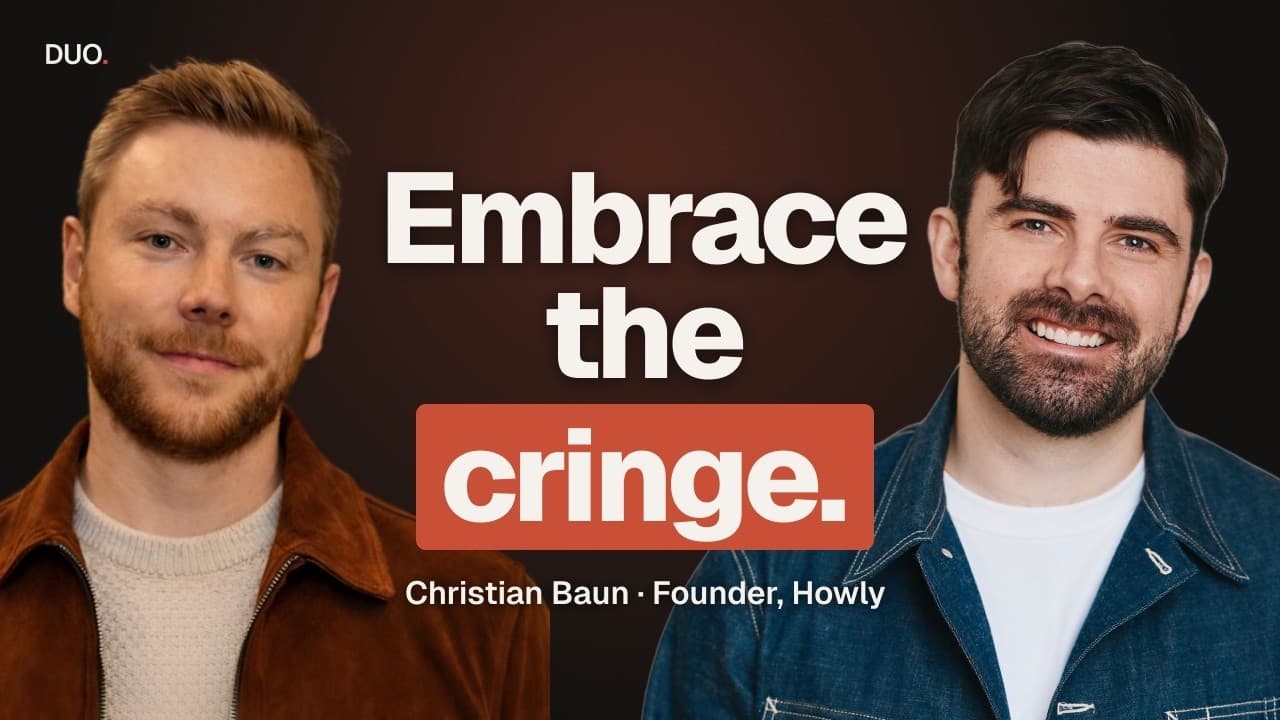
Christian Baun is the founder of Howly.
Full transcript
Christian But none of those people attribute anything to my bank account or my family's wellbeing. So I might as well post whatever I want to post.
Justin Hey everyone, I'm with Christian Baun. We've connected weeks and weeks ago. Christian is the founder of Howly and he's done such an amazing job building his personal brand online, not just on LinkedIn, but he's done blogs and collaborations and contributed for HubSpot content as well. Whole bunch of things where I've gotten a lot of inspiration from the work you've done, Christian. So I'm happy to have you here to share some insights around building your personal brand, marketing, but also doing so in the most authentic way possible.
And one of the things that you were saying before we hopped on the call was it was that connection of you to Howly, which is the company that you founded. You felt like that was such an important part of your success, why people trusted the brand, how people heard of it. Would you agree? Is that something that resonates? your personal brand and the importance of it with your company, Howly?
Christian So Howly, right? It is B2B SaaS. And with the invention of things like Claude and ChatGPT and AI coding agents, et cetera, I would say one of the things that is now easier than ever is to copy a product. And there certainly has happened to myself, Howly's been copied.
I would even say a handful of times at this point, which I think is fine. I mean, if anything, it validates the idea and it validates that there is a need for this out in the market. But when it comes to things like marketing and distribution, I think the buyer's mentality has completely switched And from where it was a couple of years ago, where you would Google, Google around, find a blog post, you would read about it, you would ask your team to where it is now, where you go to Claude or ChatGPT and you say, hey, I need to audit my HubSpot workflows.
What's the best tool to do that? And by creating content that is authentic from myself, Of course, I also write Howly's blog, and I do a lot of these content engagements across YouTube and webinars, and even with other creators and founders. What that has allowed me to do is be mentioned when folks ask their LLM of choice.
And I think even if we look at something like LinkedIn, it is the most cited B2B source when it comes to things like software, when it comes to anything B2B related. And so what I've really tried to do is when I post on LinkedIn, yes, I post about Howly, yes, I post about my business, but I also am vulnerable and I talk about what it's like to start a business.
I talk about what it means to grow an audience. I talk about other things that are not necessarily related to my business. But if we look at number of impressions, if we look at who can actually discover and find me or Howly or what I'm doing, LinkedIn to me has been the best growth lever I've ever used.
Justin Yeah, absolutely. I think the citation part is really important because people will often say, I'm not getting that much engagement or that much impressions or not that many inbound leads coming in. But there's these other aspects of it where the LLMs are using what you're putting on LinkedIn. And that's part of your identity, your web identity there. The thing about content, which is so tough, is there's almost an infinite amount of things that you can do.
And a lot of them are very time intensive. I get it. Content, videos, podcasts, the social media, the blogs. There's a lot of stuff. And you do multiple things, but how do you even know where to start? You chose a few channels. How did you land on those channels?
Christian That's a great question. I think I landed on these channels through trial and error. When I first started building out Howly, I was employed elsewhere. So my growth strategy couldn't be post on LinkedIn, go live on YouTube, write the blog, because I didn't want my employer at the time to think, this guy's one foot in the door, one foot out, he's doing something else. And so my growth strategy at the beginning of Howly's journey was very much around Reddit. And when I started posting on Reddit a year and a half or so ago, even Reddit has changed a lot. And it feels like everything I'm reading is either quote unquote, AI slop, or it's self promo. And I think Reddit, like subreddits have even become a lot more stringent as to, you know, buyers can sniff out when something is promotional versus truly and authentic and helpful. And so when I first started posting on Reddit, I had some of my posts perform really, really well, especially on the HubSpot subreddits, because again, of course, it's self promo to an extent, right? But I'm talking about the journey and what it takes to build something on the marketplace and getting my first customers and how all of this fits into what it means to be a founder, that theme.
And it was only actually up until recently, five months ago, six months ago now that I went just all in on LinkedIn because I wasn't tied to an employer relationship anymore. And Being a solo founder, it's also really fun because you're not beholden to a VC or anything like that. You can really write whatever you want. So a lot of it has been trial and error.
And if I were to show you my impressions from pre-me posting to where it is now, it's been a hockey stick of growth. And I attribute a lot of it to trial and error and having fun with it and seeing what sticks. But eventually, part of that growth also enables you to build an audience and loyal followers and a strong network of people who now discover you and learn about Howly and reach out. And that has also enabled new demos, new relationships, new buyers that have found it. And so I attribute, I would say, the majority of the success to delivering content, being authentic, and building this personal brand.
Justin Here's something that you might relate to where you're starting a business. You're putting the content out. It's sort of a leap of faith. Everyone wants quick results, but these are brand plays, not outbound sales strategies where you're thinking, "I'm going to send out a thousand emails. What's the return?" This takes time. And there's points where you said that hockey stick, Like, you're at the bottom of that curve. And you're thinking, is this a waste of time?
Like, what would you say in that moment? Because I feel like we're all, people in brand and marketing have experienced that, where they've got to say, do I push through, or do I adjust the strategy? And both, one's not necessarily right and one's wrong. It depends on the scenario. So what would you say to someone who's maybe having those doubts and trying to evaluate, Is this worth going with the current approach or is it worth thinking about things and seeing if a change is needed?
Christian Yeah, that's an excellent question. And yeah, you're right. I mean, one does not. 'Cause when I started, yeah, you're seeing 200 impressions per post, maybe 250. And as somebody who is starting out with content for the very first time, You're also thinking about judgment from peers or am I being cringe or did I say the wrong thing here?
Why is this not performing? And to that I can say embrace all the cringe, embrace who you are and be authentic. But to your point about pushing through, I think if you really want something and you're passionate about it, I think your audience can feel that too. because I have seen peers or ex-peers who have tried a similar content type strategy, but it very often leads directly to the product.
And then they go, okay, well, I'm not selling something this month. I'm gonna pivot or I'm gonna try something else or I'm gonna drop it because it didn't yield results in the first three months of me doing this. And unless you have the ability to just keep going and you're passionate about what you're doing, I think naturally the pieces will fall into place. And so for me, it has been passion, definitely about building software and about helping my community and my peers, but certainly also in a weird way, it's enabled me to meet brand new people who I would have never had the opportunity to meet with, shake hands with, or even get to know.
And so again, right, as we talk about attributing this hockey stick growth, yes, it didn't happen overnight, but one day, one post will get 20,000 impressions and somebody who you've looked up to will comment on it and you will engage with them and create that relationship. And at that point, it's like, okay, let's take a step back because something's happening now and let's not take the foot off the gas.
Justin Yeah, I would add too. I mean, this is something that I've faced where putting yourself out there, whether that's LinkedIn or Reddit or something, these are experiments. So you're putting something out there and then you're trying to see what the response is, what did it do? And the response might not be the thing that we expect. It might not be a post drives three inbound leads, but it might be, there's someone who interacted with it who was a previous person you talked to who just wasn't interested at the time.
And now you're like, okay, that's something that could mean something. So you're trying to pick up on signals. I would say another piece is like just with an experiment is you're trying to bring in as much information as you can. So in my case, I'm doing my organic content strategy, but I'm also doing 30, 40 calls a month and we're finding the strategy based on real input from people. So I think that's important where you're not just blindly saying I'm just gonna do this for seven months because that's maybe not a realistic approach, but you're doing it and it's another form of input or feedback that you're getting and you're constantly pivoting until something tells you, hey, let me keep going at this because I'm getting some signal that it's worth it.
Did this type of approaches that resonate with you, did something similar happen So you start to get these early signals of, OK, hold on. There might be something to this.
Christian 1,000%. So with my product, I'm selling core visibility into a client's HubSpot workflows. So HubSpot solution partners, they will get a brand new client. And some of these clients will have 5 to 6 to 1,000 workflows that are sitting just dormant in their portal. And they have been for years.
And so the consultant's job or the solution partner's job is to go ahead and actually, well, first of all, we want to audit these, and then we want to figure out how they're all connected to know, what can we turn off? What can we leave on? What's broken? And this, in turn, of course, enables the solutions partner to do more work for this client and sell their expertise as the solution.
And so for myself, when I first started posting on LinkedIn, Yes, I was talking perhaps more so about the product. And again, right, sort of throwing spaghetti at the wall and seeing what sticks and nothing really stuck. And then, or nothing really stuck, apologies. Until a colleague of mine reached out and said, hey, this looks really interesting. Have you thought about pivoting some of your content?
And we had a call and he is a RevOps expert. And so what he recommended was your overall theme should be RevOps is fundamentally broken. And why is it broken? Because there's no visibility, everything's a mess. And when you inherit a HubSpot portal, for example, for the first time, it's a sense of dread and overwhelmed and you don't even know how to get started.
And so that actually became the core theme across my content pillars. And so rather than talking about the what, the what being Howly solves for this, my core content became the how and the why behind why RevOps is broken. So yes, I touched on themes like visibility and things integrations breaking, no one having any sense of what's going on in the HubSpot portal.
And all of a sudden I saw all of these solutions partners agreeing with it, showing up in my comments, I was engaging with the content and I knew at that point I said there's definitely something here. So the content pivot from talking about the "what" to now talking about the "why" and the "how" really defined the next steps in not only my journey but in Howly's journey too. From there too, I will say to add on to that, But every day shouldn't be about the what and the how and RevOps is broken because that also gets tiresome and your audience will get content fatigue about that.
So what I try to do is mix in a little bit of my founder journey of, "Hey, I fucked something up this month," or "Here's what I've learned from talking with a customer," or "Here's a case study of somebody who went through a whole Howly audit and what it meant for their customer. And then if you sprinkle in a little bit of authenticity around yourself, your childhood. I'm an immigrant to Canada, so I talk about that at times.
And it's often those authentic, real posts that give folks an insight as to who is Christian. And I would even say posts like those, have way outperformed my RevOps is broken type posts, and have resulted in net new demo engagements, net new customers, because people see you as a real human, there's a real person behind the screen, that's someone you can trust, that's someone who's reputable, and we should try his software.
Justin That's such a great point. I think a lot of times we make it about us branding like this is my experience. This is what I'm doing, right? Versus, I forget the line, you said RevOps is broken. I think that's more or less what it is, but you create an idea or you're building an idea that other people can relate to. So all of a sudden, it's not like I'm on this side, you're on this side. It's like, no, no, we're on the same side. And we are both, we both can relate to this idea that RevOps is broken.
And when you're on the same side as someone all of a sudden, there's a deeper connection. It's I mean, that that concept of trying to, you know, be on the same side happens all over messaging and comms because you want to relate to the to your audience. But it's so important, I think, for people doing their personal brands, like what is the main thing that you want to relate to your audience with that what is the problem that that you are fixing, but they intimately know where they see you're like thank gosh like Christian like you get it you hundred percent get it how did you arrive at that though because I think this is like you know if I'm someone and I'm doing my personal brand I get it's important I hear what you're saying I get it kid don't just talk about myself it's good to inject that I need to have a common like a thing that relates me how did you arrive like what is the best way for someone to get to that point where they can understand that, that concept?
Christian That is a really good question. I think the biggest thing in, in my opinion is finding your voice and knowing who you are and when I say that, I mean that I have colleagues, friends who have seen, okay, uh, uh, you know, Christian is posting it, seeing a lot of engagement. I'm going to borrow his writing style against my own in my own industry.
Uh, but from what I can tell from those posts, and again, these are conversations I'm having with friends and of course it's okay and try it, right? Of course, of course try it, but they don't perform because it's not them who is writing it. And I think that your audience can tell when something is, you know, copied or your AI or has a certain donation to it, that's not quite them.
That, okay, this post is not authentic. This post is not real. Maybe it took two minutes to write. And they'll scroll past that and you won't see that engagement. I arrived at it because I thought to myself, yes, people will judge you for what you're writing. And I'm sure you're going to inspire others, et cetera. But none of those people attribute anything to my bank account or my family's wellbeing.
So I might as well post whatever I want to post and finding my voice in the process has allowed me to do that. So the biggest thing I say to anybody who's starting out with content is, I think LinkedIn is sort of past the whole B2B language, boring snooze fest into embrace who you are, embrace the cringe, write with your own voice and get the message out there.
What are you doing? What's exciting about your, what have you learned today? Those are things that folks want to engage with or want to read because either they can learn something or they can have some sort of takeaway from it. But if you beg, steal and borrow from other people's successful content, it's never truly gonna be your own voice that you're writing with.
Justin I agree, I agree. I think it's your own journey. I think get out of our heads that when you start to put yourself out there because you know building your personal brand is going to support you, it's going to be a journey and you're not going to get it right. Even now, you've had success, but you're still evolving as a voice, as a person, as new opportunities come up, you're embracing new collaborations.
I think that's one, two, you mentioned really important where there's a lot of inputs and a lot of perspectives. few of them actually are relevant to what you're doing, not who cares about your family, but they're not your ICP, right? So I think listen to people, but really pay attention on whose feedback we're listening to or else imagine we're a car driving, we're just going to end up zigzagging all over the place where if you know these people are truly my customer profile, they're the industry voice, their input matters.
Other people maybe aren't so supportive of this like take that with a grain of salt I would say is important you know this is meant to be you know quick and quick session you gave so many insights what's a closing like any closing note for those wanting to build your founder brand you've done such a great job at it Christian it could be you know quick little feedback of encouragement or any any last word that you want to share
Christian Honestly the biggest thing I can say to anybody who is wanting to build their founder brand is as cringe as it is to start posting on LinkedIn for the first time or thinking about, well, what should I post? What should I do? I don't know. There's no better time than yesterday. And I think if you can just embrace the fact that, you know, people will judge you for it and if you can accept that, you'll be truly free to do whatever you want and that is how you grow on this platform. So embrace the cringe and be yourself and people want to hear your exciting perspectives about whichever industry you're in or what you're working on or what you're building. Folks are generally very supportive. And I have found that it is strangers on the internet who are the most supportive of everything that we do. And I'm sure you know this as well. Whereas I'm lucky if I get, you know, a like from my mother on LinkedIn, once every fifth post. And so I would say just find your tribe.
And as soon as you do that, that's your opportunity to grow.