Build in public is trending. Are you building the wrong thing?
Most founders share metrics and milestones. What actually builds trust is sharing how you think. Here's what build in public should look like.
Build in public has become one of the most repeated pieces of advice in founder circles.
Post your MRR. Share your growth chart. Tweet the milestone. Let people watch you build.
The advice isn't wrong. What most founders do with it is.
Most build in public content is just a scoreboard. Numbers, milestones, a monthly recap of where the metrics landed. It looks like transparency. It mostly functions as a slower press release. And it does almost nothing to build the kind of trust that actually moves a business forward.
Sharing Progress Is Easy. Sharing Thinking Is Hard.
There's a reason most build in public content looks the same.
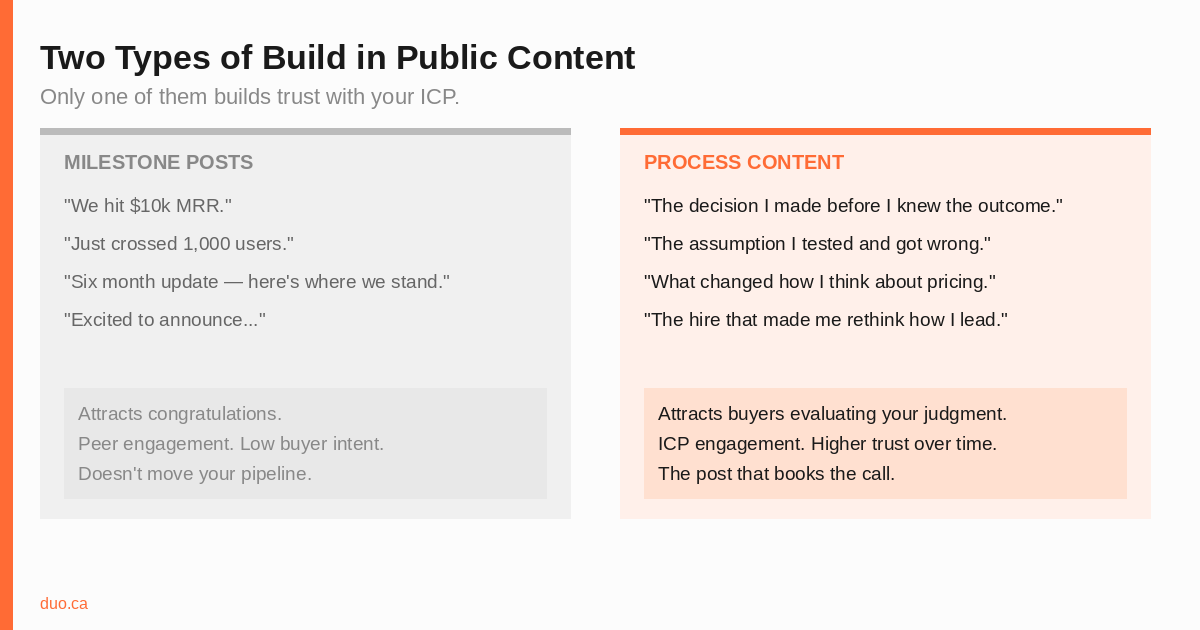
"We hit $10k MRR." "Just crossed 1,000 users." "Six month update — here's where we stand."
These posts are safe. You're reporting a number, not revealing anything about how you think, what you got wrong, or why you made the calls you made. A metric can't be questioned. It doesn't expose your judgment to scrutiny.
Sharing how you think does all of those things. Which is why it's harder. And why it's worth more.
According to the 2024 Edelman-LinkedIn B2B Thought Leadership Impact Report, 75% of B2B decision-makers say thought leadership prompted them to research a product or service they hadn't previously considered. Not a product spec. Not a growth stat. The thinking behind the company.
Your ICP is not reading your MRR update and deciding you're the right partner. They're reading how you reason through problems and deciding whether your judgment is worth trusting.
Those are two completely different things. Most founders only do one of them.

The Founders Getting This Right
There are founders who have figured out the difference, and the contrast is instructive.
Arvid Kahl, who built and sold FeedbackPanda and has spent years writing about bootstrapping, doesn't just share revenue milestones. He shares the frameworks behind his decisions. How he thinks about pricing. Why he approaches positioning the way he does. What he'd change if he were starting over. His audience isn't following him for the scoreboard. They're following him because reading his content makes them sharper at solving the same problems.
Nathan Barry, founder of Kit, has shared the reasoning behind major company pivots in real time. Not just "we changed direction" but why, what the data said, what he was afraid of, and what made him pull the trigger anyway. That kind of content doesn't just build an audience. It builds a group of people who trust your judgment before they've spent a dollar.
The pattern is the same in both cases. One type of content says "here's where we are." The other says "here's how we got here and what we're actually thinking about." One is a status update. The other is a window into your mind.
Your ICP doesn't care where you are right now. They care whether you think the way they think. Whether your instincts match theirs. Whether they'd trust you in the room.
That second question only gets answered by process content. Never by a metrics post.
The Milestone Trap
Here's what makes this harder than it sounds.
Milestone posts perform well in the short term. They generate congratulations. Engagement goes up. It feels like the content is working.
But congratulations aren't customers. Reactions from your founder peer group aren't warm inbound from your ICP. A post that gets 300 likes from other bootstrappers doesn't move your pipeline.
The posts that build real trust rarely perform like that in the feed. They reach the right people quietly. A decision-maker reads your post about how you think through enterprise pricing, sends it to their team, and books a call three months later. That doesn't show up in your LinkedIn analytics. But it's the post that mattered.
This is the trade founders have to make consciously. Broad engagement now or deep trust over time. Most default to whatever feels rewarding in the short term, then wonder why consistent posting isn't generating inbound.
What Process Content Actually Looks Like
This isn't abstract. It's a shift in what you choose to share.
The decision you made before you knew how it would turn out. The assumption you tested and found wrong. The thing you believed six months ago that you've quietly revised. The customer conversation that changed how you think about your positioning. The hire that forced you to rethink how you lead.
These posts are uncomfortable to write because they require you to be specific, visible in your uncertainty, and honest in a feed that rewards performance. That discomfort is the signal. It means you're sharing something real.
The founders building the most durable audiences right now are not the ones with the cleanest growth charts. They're the ones willing to let people watch them think.
And that's a skill. It doesn't come naturally to most founders because most founders were never trained to narrate their own reasoning. They were trained to report results.
The shift is deliberate. Before you post a metric, ask one thing: does this tell someone something about how I think?
If the answer is no, it's an announcement. Which is fine. But don't confuse it with the kind of content that compounds.
The Bottom Line
Build in public is a good idea being executed badly by most of the people doing it.
Sharing metrics is low risk and low reward. Sharing your thinking is higher risk and compounding reward. The founders who figure that out early have a meaningful head start on the ones still posting revenue screenshots.
Your ICP isn't impressed by your growth rate. They're evaluating your judgment. Show them that instead.
If you're a B2B founder who wants to build a public presence that actually generates trust with buyers, that's the kind of strategic work we do at DUO. Book a discovery call with Justin.